Results by title
9 books match the query 'Baudelaire, Charles'

Baudelaire and the Poetics of Modernity
Patricia A. Ward
Vanderbilt University Press, 2000
Charles Baudelaire, possibly the most influential author of nineteenth-century France, created a poetics of modernity and a thematics of the city; he transcended genre by moving between poetry and prose. He is also the most accessible of modern French poets to an American readership. These essays examine Baudelaire's poetics and the complex relationship between the poet and his twentieth-century literary heirs, including Rene Char, Yves Bonnefoy, and Michel Deguy.
The contributors, who include Deguy and Bonnefoy, are all distinguished writers or critics noted for their own poetry or for their scholarship on Baudelaire and in French studies. Their essays go to the heart of what makes Baudelaire so important: his modernity and his influence from the very beginning on other poets, including those outside of France. The essays are written in English, with citations from Baudelaire and other sources in both French and English.
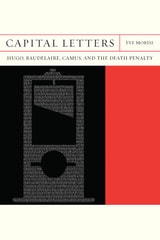
Capital Letters
Hugo, Baudelaire, Camus, and the Death PenaltyÈve Morisi
Northwestern University Press, 2020
Given Time
I. Counterfeit MoneyJacques Derrida
University of Chicago Press, 1992
Derrida reads the relation of time to gift through a number of texts: Heidegger's Time and Being, Mauss's The Gift, as well as essays by Benveniste and Levi-Strauss that assume Mauss's legacy. It is, however, a short tale by Baudelaire, "Counterfeit Money," that guides Derrida's analyses throughout. At stake in his reading of the tale, to which the second half of this book is devoted, are the conditions of gift and forgiveness as essentially bound up with the movement of dissemination, a concept that Derrida has been working out for many years.
For both readers of Baudelaire and students of literary theory, this work will prove indispensable.

Intratextual Baudelaire
The Sequential Fabric of the Fleurs du mal and Spleen de ParisRandolph Paul Runyon
The Ohio State University Press, 2010
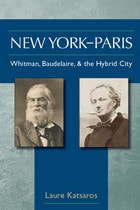
New York-Paris
Whitman, Baudelaire, and the Hybrid CityLaure Katsaros
University of Michigan Press, 2012
As New York and Paris began to modernize, new modes of entertainment, such as panoramas, dioramas, and photography, seemed poised to take the place of the more complex forms of literary expression. Dioramas and photography were invented in Paris but soon spread to America, forming part of an increasingly universal idiom of the spectacle. This brave new world of technologically advanced but crudely mimetic spectacles haunts both Whitman's vision of New York and Baudelaire's view of Paris. In New York-Paris, Katsaros explores the images of the mid-nineteenth-century city in the poetry of both Whitman and Baudelaire and seeks to demonstrate that, by projecting an image of the other's city onto his own, each poet tried to resist the apparently irresistible forward momentum of modernity rather than create a paradigmatically happy mixture of "high" and "low" culture.
Seeing Double
Baudelaire's ModernityFrançoise Meltzer
University of Chicago Press, 2011
The poet Charles Baudelaire (1821–1867) has been labeled the very icon of modernity, the scribe of the modern city, and an observer of an emerging capitalist culture. Seeing Double reconsiders this iconic literary figure and his fraught relationship with the nineteenth-century world by examining the way in which he viewed the increasing dominance of modern life. In doing so, it revises some of our most common assumptions about the unresolved tensions that emerged in Baudelaire’s writing during a time of political and social upheaval.
Françoise Meltzer argues that Baudelaire did not simply describe the contradictions of modernity; instead, his work embodied and recorded them, leaving them unresolved and often less than comprehensible. Baudelaire’s penchant for looking simultaneously backward to an idealized past and forward to an anxious future, while suspending the tension between them, is part of what Meltzer calls his “double vision”—a way of seeing that produces encounters that are doomed to fail, poems that can’t advance, and communications that always seem to falter. In looking again at the poet and his work, Seeing Double helps to us to understand the prodigious transformations at stake in the writing of modern life.

Selected Letters of Charles Baudelaire
The Conquest of SolitudeCharles Baudelaire
University of Chicago Press, 1986
Writing to family, friends, and lovers, Baudelaire reveals the incidents and passions that went into his poetry. In letters to editors, idols, and peers—Hugo, Flaubert, Vigny, Wagner, Cladel, among others—he elucidates the methods and concerns of his own art and criticism and comments tellingly on the arts and politics of his day. In all, ranging from childhood to days shortly before his death, these letters comprise a complex and moving portrait of the quintessential poet and his time.
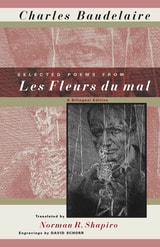
Selected Poems from Les Fleurs du mal
A Bilingual EditionCharles Baudelaire
University of Chicago Press, 1998
"A fine, formal translation of the best poems of France's founder of the symbolist movement."—St. Louis Post-Dispatch
"It's rare to find a rewarding translation of a masterwork, particularly a collection of groundbreaking poetry. . . . Through Shapiro's skillful wordsmithing, the reader can fully appreciate Baudelaire's control of the soul and the word which is the ancient and indefatigable ambition of all great poets. . . . Shapiro's interpretations set the standard for future English translations."—Virginia Quarterly Review
Understanding "Les Fleurs du Mal"
Critical ReadingsWilliam J. Thompson
Vanderbilt University Press, 1997
Surprisingly, there are few book-length studies available that approach the poems in Charles Baudelaire's collection on an individual basis. Understanding "Les Fleurs du Mal" fills this gap by providing students and serious readers with clear, scholarly "explications" to many of the most widely read of Baudelaire's poems.