Results by title
3 books match the query 'Bauhaus'
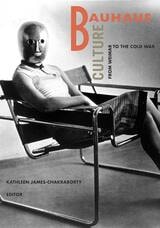
Bauhaus Culture
From Weimar To The Cold WarKathleen James-Chakraborty
University of Minnesota Press, 2006
Offering the first comprehensive training in the visual arts grounded in abstraction, the Bauhaus was the site of a dazzling range of influential experiments in painting, architecture, photography, industrial design, and even artistic education itself. Three-quarters of a century later, the “look” of the new remains indebted to the Bauhaus and its equation of technology with modernism. Central to discussions of the relationships between art, industrialization, and politics in the twentieth century, much of the school’s later impact was derived in part from its status as one of the foremost cultural symbols of Germany’s first democracy and its public reputation as a “cathedral of socialism.”
In this book, editor Kathleen James-Chakraborty and seven other scholars analyze the accomplishments and dispel the myths of the Bauhaus, placing it firmly in a historical context from before the formation of the Weimar Republic through Nazi ascendancy and World War II into the cold war. Together, they investigate its professors’ and students’ interactions with mass culture; establish the complexity of its relationship with Wilhelmine, Nazi, and postwar German politics; and challenge the claim that its architects greatly influenced American architecture in the 1930s.
Their most explosive conclusions address the degree to which some aspects of Bauhaus design continued to flourish during the Third Reich before becoming one of the cold war’s most enduring emblems of artistic freedom. In doing so, Bauhaus Culture calls into question the degree to which this influential school should continue to symbolize an uncomplicated relationship between art, modern technology, and progressive politics.
Contributors: Greg Castillo, Juliet Koss, Rose-Carol Washton Long, John V. Maciuika, Wallis Miller, Winifried Nerdinger, Frederic J. Schwartz.
Kathleen James-Chakraborty is associate professor of architecture at the University of California, Berkeley, and author of German Architecture for a Mass Audience and Erich Mendelsohn and the Architecture of German Modernism.
[more]
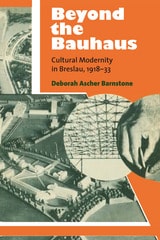
Beyond the Bauhaus
Cultural Modernity in Breslau, 1918-33Deborah Ascher Barnstone
University of Michigan Press, 2016
Although the Breslau arts scene was one of the most vibrant in all of Weimar-era Germany, it has largely disappeared from memory. Studies of the influence of Weimar culture on modernism have focused almost exclusively on Berlin and the Dessau Bauhaus, yet the advances that occurred in Breslau affected nearly every intellectual field, forming the basis for aesthetic modernism internationally and having an enduring impact on visual art and architecture. Breslau boasted a thriving modern arts scene and one of the premier German arts academies of the day until the Nazis began their assault on so-called degenerate art. This book charts the cultural production of Breslau-based artists, architects, art collectors, urban designers, and arts educators who operated in the margins of Weimar-era cultural debates. Rather than accepting the radical position of the German avant-garde or the reactionary position of German conservatives, many Breslauers sought a middle ground.
This richly illustrated volume is the first book in English to address this history, constituting an invaluable addition to the literature on the Weimar period. Its readership includes scholars of German history, art, architecture, urban design, planning, collecting, and exhibition history; of the avant-garde, and of the development of arts academies and arts pedagogy.
This richly illustrated volume is the first book in English to address this history, constituting an invaluable addition to the literature on the Weimar period. Its readership includes scholars of German history, art, architecture, urban design, planning, collecting, and exhibition history; of the avant-garde, and of the development of arts academies and arts pedagogy.
[more]

The Bauhaus Idea and Bauhaus Politics
Éva Forgács
Central European University Press, 1995
Forgacs examines the development of the Bauhaus school of architecture and applied design by focusing on the idea of the Bauhaus, rather than on its artefacts. What gave this idea its extraordinary powers of survival? Founded in 1919, with the architect Walter Gropius as its first director, the Bauhaus carried within it the seeds of conflict from the start. The duration of the Bauhaus coincides very nearly with that of the Weimar Republic; the Bauhaus idea - the notion that the artist should be involved in the technological innovations of mechanization and mass production - is a concept that was bound to arouse the most passionate feelings. It is these two strands - personal and political - that Forgacs so cleverly interweaves. The text has been extensively revised since its original publication in Hungarian, and an entirely new chapter has been added on the Bauhaus's Russian analogue, VkhUTEMAS, the Moscow academy of industrial art.
[more]