Results by title
5 books match the query 'Bay'

Bastion by the Bay
The Presidio of San Francisco, from Outpost of Empire to Magnificent ParkJohn P. Langellier
University of North Texas Press, 2026
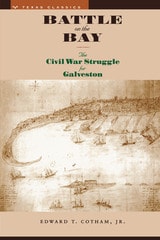
Battle on the Bay
The Civil War Struggle for GalvestonBy Edward T. Cotham, Jr.
University of Texas Press, 1998
The Civil War history of Galveston is one of the last untold stories from America's bloodiest war, despite the fact that Galveston was a focal point of hostilities throughout the conflict. As other Southern ports fell to the Union, Galveston emerged as one of the Confederacy's only lifelines to the outside world. When the war ended in 1865, Galveston was the only major port still in Confederate hands.
In this beautifully written narrative history, Ed Cotham draws upon years of archival and on-site research, as well as rare historical photographs, drawings, and maps, to chronicle the Civil War years in Galveston. His story encompasses all the military engagements that took place in the city and on Galveston Bay, including the dramatic Battle of Galveston, in which Confederate forces retook the city on New Year's Day, 1863.
Cotham sets the events in Galveston within the overall conduct of the war, revealing how the city's loss was a great strategic impediment to the North. Through his pages pass major figures of the era, as well as ordinary soldiers, sailors, and citizens of Galveston, whose courage in the face of privation and danger adds an inspiring dimension to the story.
Death by the Bay
Patricia Skalka
University of Wisconsin Press, 2021
Medina by the Bay
Scenes of Muslim Study and SurvivalMaryam Kashani
Duke University Press, 2023
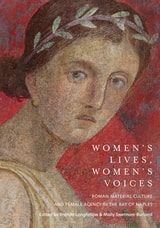
Women's Lives, Women's Voices
Roman Material Culture and Female Agency in the Bay of NaplesEdited by Brenda Longfellow and Molly Swetnam-Burland
University of Texas Press, 2021
Literary evidence is often silent about the lives of women in antiquity, particularly those from the buried cities of Pompeii and Herculaneum. Even when women are considered, they are often seen through the lens of their male counterparts. In this collection, Brenda Longfellow and Molly Swetnam-Burland have gathered an outstanding group of scholars to give voice to both the elite and ordinary women living on the Bay of Naples before the eruption of Vesuvius.
Using visual, architectural, archaeological, and epigraphic evidence, the authors consider how women in the region interacted with their communities through family relationships, businesses, and religious practices, in ways that could complement or complicate their primary social roles as mothers, daughters, and wives. They explore women-run businesses from weaving and innkeeping to prostitution, consider representations of women in portraits and graffiti, and examine how women expressed their identities in the funerary realm. Providing a new model for studying women in the ancient world, Women’s Lives, Women’s Voices brings to light the day-to-day activities of women of all classes in Pompeii and Herculaneum.