Results by title
3 books match the query 'Baynton, Douglas C.'
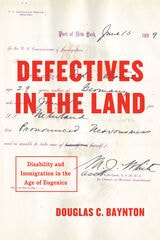
Defectives in the Land
Disability and Immigration in the Age of EugenicsDouglas C. Baynton
University of Chicago Press, 2016
Immigration history has largely focused on the restriction of immigrants by race and ethnicity, overlooking disability as a crucial factor in the crafting of the image of the “undesirable immigrant.” Defectives in the Land, Douglas C. Baynton’s groundbreaking new look at immigration and disability, aims to change this.
In the late nineteenth and early twentieth centuries, Baynton explains, immigration restriction in the United States was primarily intended to keep people with disabilities—known as “defectives”—out of the country. The list of those included is long: the deaf, blind, epileptic, and mobility impaired; people with curved spines, hernias, flat or club feet, missing limbs, and short limbs; those unusually short or tall; people with intellectual or psychiatric disabilities; intersexuals; men of “poor physique” and men diagnosed with “feminism.” Not only were disabled individuals excluded, but particular races and nationalities were also identified as undesirable based on their supposed susceptibility to mental, moral, and physical defects.
In this transformative book, Baynton argues that early immigration laws were a cohesive whole—a decades-long effort to find an effective method of excluding people considered to be defective. This effort was one aspect of a national culture that was increasingly fixated on competition and efficiency, anxious about physical appearance and difference, and haunted by a fear of hereditary defect and the degeneration of the American race.
[more]
Forbidden Signs
American Culture and the Campaign against Sign LanguageDouglas C. Baynton
University of Chicago Press, 1996
Forbidden Signs explores American culture from the mid-nineteenth century to 1920 through the lens of one striking episode: the campaign led by Alexander Graham Bell and other prominent Americans to suppress the use of sign language among deaf people.
The ensuing debate over sign language invoked such fundamental questions as what distinguished Americans from non-Americans, civilized people from "savages," humans from animals, men from women, the natural from the unnatural, and the normal from the abnormal. An advocate of the return to sign language, Baynton found that although the grounds of the debate have shifted, educators still base decisions on many of the same metaphors and images that led to the misguided efforts to eradicate sign language.
"Baynton's brilliant and detailed history, Forbidden Signs, reminds us that debates over the use of dialects or languages are really the linguistic tip of a mostly submerged argument about power, social control, nationalism, who has the right to speak and who has the right to control modes of speech."—Lennard J. Davis, The Nation
"Forbidden Signs is replete with good things."—Hugh Kenner, New York Times Book Review
[more]
Immigrant Identity and the Politics of Citizenship
A Collection of Articles from the Journal of American Ethnic HistoryJohn J Bukowczyk
University of Illinois Press, 2016
The next volume in the Common Threads book series, Immigrant Identity and the Politics of Citizenship assembles fourteen articles from the Journal of American Ethnic History . The chapters discuss the divisions and hierarchies confronted by immigrants to the United States, and how these immigrants shape, and are shaped by, the social and cultural worlds they enter. Drawing on scholarship of ethnic groups from around the globe, the articles illuminate the often fraught journey many migrants undertake from mistrusted Other to sometimes welcomed citizen. Contributors: James R. Barrett, Douglas C. Baynton, Vibha Bhalla, Julio Capó, Jr., Robert Fleegler, Gunlög Fur, Hidetaka Hirota, Karen Leonard, Willow Lung-Amam, Raymond A. Mohl, Mark Overmyer-Velázquez, Lara Putnam, David Reimers, David Roediger, and Allison Varzally.
[more]