Results by title

7 books match the query 'Beachy-Quick, Dan'
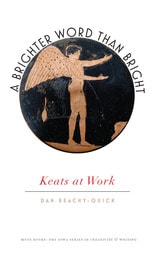
cover of A Brighter Word Than Bright: Keats at Work

A Brighter Word Than Bright

Keats at Work

Dan Beachy-Quick

University of Iowa Press, 2013
The Romantic poet John Keats, considered by many as one of the greatest poets in the English language, has long been the subject of attention from scholars who seek to understand him and poets who seek to emulate him. Bridging these impulses, A Brighter Word Than Bright is neither historical biography nor scholarly study, but instead a biography of Keats’s poetic imagination. Here the noted poet Dan Beachy-Quick enters into Keats’s writing—both his letters and his poems—not to critique or judge, not to claim or argue, but to embrace the passion and quickness of his poetry and engage the aesthetic difficulties with which Keats grappled.
Combining a set of biographical portraits that place symbolic pressure on key moments in Keats’s life with a chronological examination of the development of Keats-as-poet through his poems and letters, Beachy-Quick explores the growth of the young man’s poetic imagination during the years of his writing life, from 1816 to 1820. A Brighter Word Than Bright aims to enter the poems and the mind that wrote them, to explore and mine Keats’s poetic concerns and ambitions. It is a mimetic tribute to the poet’s life and work, a brilliant enactment that is also a thoughtful consideration.

[more]
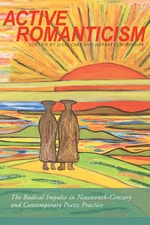
cover of Active Romanticism: The Radical Impulse in Nineteenth-Century and Contemporary Poetic Practice

Active Romanticism

The Radical Impulse in Nineteenth-Century and Contemporary Poetic Practice

Edited by Julie Carr and Jeffrey C. Robinson

University of Alabama Press, 2015

A collection of essays highlighting the pervasive, yet often unacknowledged, role of Romantic poetry and poetics on modern and contemporary innovative poetry.

Literary history generally locates the primary movement toward poetic innovation in twentieth-century modernism, an impulse carried out against a supposedly enervated “late-Romantic” poetry of the nineteenth century. The original essays in Active Romanticism challenge this interpretation by tracing the fundamental continuities between Romanticism’s poetic and political radicalism and the experimental movements in poetry from the late nineteenth century to the present day.

According to editors July Carr and Jeffrey C. Robinson, “active romanticism” is a poetic response, direct or indirect, to pressing social issues and an attempt to redress forms of ideological repression; at its core, “active romanticism” champions democratic pluralism and confronts ideologies that suppress the evidence of pluralism. “Poetry fetter’d, fetters the human race,” declared poet William Blake at the beginning of the nineteenth century. No other statement from the era of the French Revolution marks with such terseness the challenge for poetry to participate in the liberation of human society from forms of inequality and invisibility. No other statement insists so vividly that a poetic event pushing for social progress demands the unfettering of traditional, customary poetic form and language.

Bringing together work by well-known writers and critics, ranging from scholarly studies to poets’ testimonials, Active Romanticism shows Romantic poetry not to be the sclerotic corpse against which the avant-garde reacted but rather the wellspring from which it flowed.

Offering a fundamental rethinking of the history of modern poetry, Carr and Robinson have grouped together in this collection a variety of essays that confirm the existence of Romanticism as an ongoing mode of poetic production that is innovative and dynamic, a continuation of the nineteenth-century Romantic tradition, and a form that reacts and renews itself at any given moment of perceived social crisis.

[more]
cover of Circle's Apprentice

Circle's Apprentice

Dan Beachy-Quick

Tupelo Press, 2011

Dan Beachy-Quick has produced six collections of solo or collaborative poetry and a unique prose companion to Moby Dick. In the process, this amazingly productive writer has become recognized as one of the nation’s most exciting dramatists of the mind in ferment, and of our urgent and ongoing connections with a tradition that extends back to the origins of literature.

After a series of book-length poems, Beachy-Quick’s new volume is as carefully structured as a suite of chamber music pieces, yet made of distinctly individual poems. Building upon the visceral and conceptual fascinations of Ralph Waldo Emerson’s essay, “Circles,” these poems trace patterned tensions to connections in existence on many levels, from molecular to millennial.

“Dan Beachy-Quick’s splendid new collection reveals the echoes between the measure of verse and the measure of time. If it is true, as Thoreau suggests, that the poem of creation is ongoing, this ambitious and prolific poet shows us that learning to listen for that music of daily life involves a lifetime. Circle’s Apprentice vividly reminds us that all our human life may be marked by ritual but is returned to us through song. ‘The minute gears mutely whir. / To put your ear / against it is to put your ear inside it.’”—Susan Howe
[more]
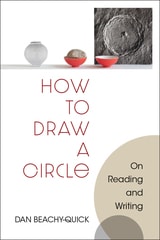
cover of How to Draw a Circle: On Reading and Writing

How to Draw a Circle

On Reading and Writing

Dan Beachy-Quick

University of Michigan Press, 2024

What is it to write a poem? What work do words do when placed with care and vision into the intensely charged space of poetic effort? How to Draw a Circle does not seek to answer those questions, but to encounter them as fully and honestly as one can. The thread running through the essays is an ongoing investigation into poetry as an epistemological experiment, one which binds the imagination to the worldly, and trusts that creative endeavor is a form of participation in the ongoing creation of the world. It does so in part by focusing on thinkers, poets, writers, and literary movements where such thinking for a while prevailed, from Socrates to Melville, Mythology to Romanticism. Here the poem is approached as something deeply rooted in human consciousness, done so not to make an atavistic claim about poetry's history, but to show the ways in which oldest tradition gives us ever-new eyes. The hope this book gathers around is that poetry—poetic expression, the wild wonder of working in words—turns us back toward the world in more vibrant, more open, more ethical ways. How to Draw a Circle summons lyric powers—not an argument, but a participation in the ways poetry works in us and on us. 
[more]
cover of This Nest, Swift Passerine

This Nest, Swift Passerine

Dan Beachy-Quick

Tupelo Press, 2009
One of America’s most acclaimed younger poets entwines original and scavenged texts, lyric fragment and lyric song, to make a new form—this book—from wild metaphor. A passerine is a bird of the taxonomic order Passeriformes, often called “songbirds” or “perching birds.” The passerines are among the most diverse of terrestrial vertebrates, and in his book-length canticle—both aria and elegy—the poet sings like a modern-day St. Francis to the wonder of creation in its splendor and peril.
[more]
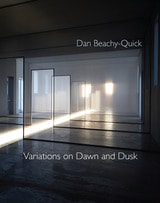
cover of Variations on Dawn and Dusk

Variations on Dawn and Dusk

Dan Beachy-Quick

Omnidawn, 2019

Acting as poetic records of light, the poems in Variations on Dawn and Dusk follow the sun as it warms, cools, colors, and shifts the space of Robert Irwin’s untitled (dawn to dusk) in the desert of Marfa, TX. Built on the footprint of the town’s old hospital, Irwin’s permanent installation is a remarkable structure with walls, windows, and screens that both capture and are taken over by the sun’s changing light. Through this deeply engaged ekphrasis, Dan Beachy-Quick uses language to participate in the overpowering elegance of Irwin’s structure. The poet’s fervent observations lead us in cycles of meditation, moving with the light that slides through the surfaces of the installation. Here, the very foundation of our vision—light—forms the vocabulary from which these poems are built.
Building from Irwin’s use of rhythm and structure, the poems in this collection are constructed with an architectural framework. Rhythmic procedures inversely link the first and last words of the first and last lines of each poem and tie the number of lines to the number of syllables in the first line. These structures form a pattern, a thoughtful consistency through which we are invited to move and meditate with each variation of light.
 
[more]
cover of Wind–Mountain–Oak: The Poems of Sappho

Wind–Mountain–Oak

The Poems of Sappho

Dan Beachy-Quick

Tupelo Press, 2023

Dan Beachy-Quick writes, “There are depths within the denotative life of Greek words that English seldom allows readers in translation to access. At some basic level, I wanted to offer a translation that traced out some of those complexities into an apprehendable substance in the poems themselves—sometimes by allowing an image to unfold more fully than is the norm, at other times by giving some sense of a word’s complicated life, the compound nature of the Greek language, or by translating the same line in multiple ways. The hope, far-fetched as it might be, is to give a reader in English some semblance of how an ancient Greek listener might hear these songs. I’ve also veered away from the various traditions of ordering the poems. I’ve clustered them into groups that seem to loosely trace the entirety of life, from childhood to older age, from the birth of desire to the fear of no longer being desirable. In a quiet way, I mean the book to read as a kind novel, a bildungsroman, so that a larger sense of the life—the poem of the life—becomes palpable. “
[more]