Results by title
15 books match the query 'Beast'
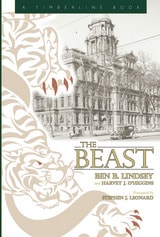
Beast
Benjamin B. Lindsey
University Press of Colorado, 2009
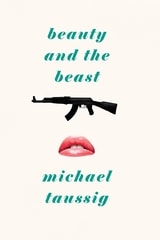
Beauty and the Beast
Michael Taussig
University of Chicago Press, 2012
Beauty and the Beast begins with the question: Is beauty destined to end in tragedy? Drawing on extensive fieldwork in Colombia, Michael Taussig scrutinizes the anxious, audacious, and sometimes destructive attempts people make to transform their bodies through cosmetic surgery and liposuction. He balances an examination of surgeries meant to enhance an individual’s beauty with an often overlooked counterpart, surgeries performed—often on high profile criminals—to disguise one’s identity. Situating this globally shared phenomenon within the economic, cultural, and political history of Colombia, Taussig links the country’s long civil war and its bodily mutilation and torture to the beauty industry at large, sketching Colombia as a country whose high aesthetic stakes make it a stage where some of the most important and problematic ideas about the body are played out.
Central to Taussig’s examination is George Bataille’s notion of depense, or “wasting.” While depense is often used as a critique, Taussig also looks at the exuberance such squandering creates and its position as a driving economic force. Depense, he argues, is precisely what these procedures are all about, and the beast on the other side of beauty should not be dismissed as simple recompense. At once theoretical and colloquial, public and intimate, Beauty and the Beast is a true-to-place ethnography—written in Taussig’s trademark voice—that tells a thickly layered but always accessible story about the lengths to which people will go to be physically remade.

Beauty and the Beast
Italianness in British CinemaElisabetta Girelli
Intellect Books, 2009
Scholarly interest in issues of national identity and representation has been increasing for years, and cinema is a major resource for that work, as it allows for cross-cultural dialogue and the portrayal of different layers of representation and cultural stereotypes. Beauty and the Beast takes a look at the depictions of Italy and the Italians in British cinema.
Elisabetta Girelli draws upon cultural and social history to assess the ongoing representation of “Italianness” in British film, and its crucial role in defining and challenging British national identity. Girelli provides an original survey of archival material such as World War II footage, and an analysis of significant British films like Summer Madness and A Room With A View. Drawing on British literary and filmic tradition to analyze the rise of specific images of the Italian other, Beauty and the Beast is a noteworthy and unique contribution to film and cultural studies.
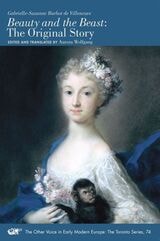
Beauty and the Beast
The Original StoryGabrielle-Suzanne Barbot de Villeneuve
Iter Press, 2020
The Other Voice in Early Modern Europe: The Toronto Series volume 74
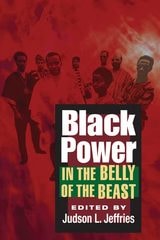
Black Power in the Belly of the Beast
Edited by Judson L. Jeffries
University of Illinois Press, 2006
The volume’s twelve contributors include well-known scholars such as James A. Geschwender and Douglas Glasgow as well as prominent community activists Akbar Muhammad Ahmad, Floyd W. Hayes III, and Komozi Woodard. Each of their chapters explores a single Black Power organization including Us, the Black Panther Party, and the Deacons for Defense and Justice. Important but lesser-known Black Power organizations such as the Republic of New Afrika and Sons of Watts are paid equal attention, as contributors address issues including self-defense, Black identity, and the politics of class and gender. Throughout, authors emphasize the primary role that Black institutions and charismatic leaders played in the rise, development, and eventual decline of the overall movement.
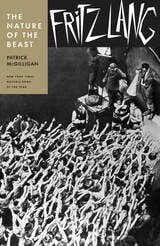
Fritz Lang
The Nature of the BeastPatrick McGilligan
University of Minnesota Press, 2013
The name of Fritz Lang—the visionary director of Metropolis, M, Fury, The Big Heat, and thirty other unforgettable films—is hallowed the world over. But what lurks behind his greatest legends and his genius as a filmmaker? Patrick McGilligan, placed among “the front rank of film biographers” by the Washington Post, spent four years in Europe and America interviewing Lang’s dying contemporaries, researching government and film archives, and investigating the intriguing life story of Fritz Lang. This critically acclaimed biography—lauded as one of the year’s best nonfiction books by Publishers Weekly—reconstructs the compelling, flawed human being behind the monster with the monocle.
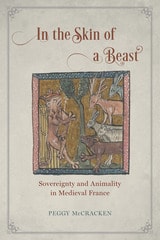
In the Skin of a Beast
Sovereignty and Animality in Medieval FrancePeggy McCracken
University of Chicago Press, 2017
Peggy McCracken discusses a range of literary texts and images from medieval France, including romances in which animal skins appear in symbolic displays of power, fictional explorations of the wolf’s desire for human domestication, and tales of women and snakes converging in a representation of territorial claims and noble status. These works reveal that the qualities traditionally used to define sovereignty—lineage and gender among them—are in fact mobile and contingent. In medieval literary texts, as McCracken demonstrates, human dominion over animals is a disputed model for sovereign relations among people: it justifies exploitation even as it mandates protection and care, and it depends on reiterations of human-animal difference that paradoxically expose the tenuous nature of human exceptionalism.
Man and Beast, Volume 15
Elizabeth Weed and Ellen Rooney, eds.
Duke University Press, 0
The contributors to Man and Beast, writing from an array of academic disciplines, collectively rethink human relationships with other animals. Pointing to the ethical implications of taxonomic classifications and distinctions drawn by the natural sciences, one essay argues that these categories are neither as abstract nor as neutral as commonly assumed. Another essay offers a historicizing study of species barriers to examine the way in which zoological classifications have been breached, relegating some humans to the category of “animal” or, alternately, including in the human circle nonhuman species. Other essays consider the attribution of a human speech impediment to such famous talking cartoon animals as Porky Pig, read the social implications of such popular animal-human hybrids as “Bat Boy” of the tabloid press, and examine the representation of animals as moral agents in fables dating to Aesop, noting the appearance of such tales during periods of social upheaval and instability. All of these suggest that the category of “beast,” like that of human being, has never been either homogeneous or stable.
Contributors. Howard Bloch, Judith L. Goldstein, Harriet Ritvo, Marc Shell, Barbara Herrnstein Smith
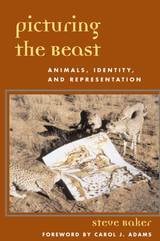
Picturing the Beast
Animals, Identity, and RepresentationSteve Baker
University of Illinois Press, 1993
Baker provides an animated discussion of how animals enter into the iconography of power through wartime depictions of the enemy, political cartoons, and sports symbolism. He examines a phenomenon he calls the "disnification" of animals, meaning a reduction of the animal to the trivial and stupid, and shows how books featuring talking animals underscore human superiority. He also discusses how his findings might inform the strategies of animal rights advocates seeking to call public attention to animal suffering and abuse. Until animals are extricated from the baggage of imposed images, Baker maintains, neither they nor their predicaments can be clearly seen.
For this edition, Baker provides a new introduction, specifically addressing an American audience, that touches on such topics as the Cow Parade, animal imagery in the presidential race, and animatronic animals in recent films.
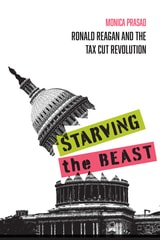
Starving the Beast
Ronald Reagan and the Tax Cut RevolutionMonica Prasad
Russell Sage Foundation, 2018
Drawing on never-before seen archival documents, Prasad traces the history of the 1981 tax cut—the famous “supply side” tax cut, which became the cornerstone for the next several decades of Republican domestic economic policy. She demonstrates that the main impetus behind this tax cut was not business group pressure, racial animus, or a belief that tax cuts would pay for themselves.
Rather, the tax cut emerged because in America--unlike in the rest of the advanced industrial world—progressive policies are not embedded within a larger political economy that is favorable to business. Since the end of World War II, many European nations have combined strong social protections with policies to stimulate economic growth such as lower taxes on capital and less regulation on businesses than in the United State. Meanwhile, the United States emerged from World War II with high taxes on capital and some of the strongest regulations on business in the advanced industrial world. This adversarial political economy could not survive the economic crisis of the 1970s.
Starving the Beast suggests that taking inspiration from the European model of progressive policies embedded in market-promoting political economy could serve to build an American economy that works better for all.
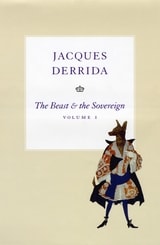
The Beast and the Sovereign, Volume I
Jacques Derrida
University of Chicago Press, 2009
When he died in 2004, Jacques Derrida left behind a vast legacy of unpublished material, much of it in the form of written lectures. With The Beast and the Sovereign, Volume 1, the University of Chicago Press inaugurates an ambitious series, edited by Geoffrey Bennington and Peggy Kamuf, translating these important works into English.
The Beast and the Sovereign, Volume 1 launches the series with Derrida’s exploration of the persistent association of bestiality or animality with sovereignty. In this seminar from 2001–2002, Derrida continues his deconstruction of the traditional determinations of the human. The beast and the sovereign are connected, he contends, because neither animals nor kings are subject to the law—the sovereign stands above it, while the beast falls outside the law from below. He then traces this association through an astonishing array of texts, including La Fontaine’s fable “The Wolf and the Lamb,” Hobbes’s biblical sea monster in Leviathan, D. H. Lawrence’s poem “Snake,” Machiavelli’s Prince with its elaborate comparison of princes and foxes, a historical account of Louis XIV attending an elephant autopsy, and Rousseau’s evocation of werewolves in The Social Contract.
Deleuze, Lacan, and Agamben also come into critical play as Derrida focuses in on questions of force, right, justice, and philosophical interpretations of the limits between man and animal.
The Beast and the Sovereign, Volume II
Jacques Derrida
University of Chicago Press, 2011
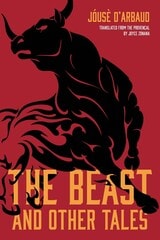
The Beast, and Other Tales
Jóusè d'Arbaud; Translated from the Provençal by Joyce Zonana
Northwestern University Press, 2020
Winner of the Global Humanities Prize
A classic of modern Provençal literature, Jóusè d’Arbaud’s 1926 masterpiece “The Beast of Vacarés” (also known as “The Beast of Vaccarès”) is a haunting parable. Set during the fifteenth century, the tale is narrated by a solitary bull herder—known as a gardian—who stumbles upon a starving creature that is half man, half goat. Terrified, the gardian is nonetheless drawn to the eloquent Beast, a dying demigod who laments the loss of his glorious past even as he wields power over the animals around him. Torn between pity and fear, unable to understand his experiences and afraid he will be condemned for heresy, the gardian records his encounters in a journal, hoping that one day readers will make sense of what he cannot.
Set in the vast, lonely landscape of the Camargue delta, where the Rhône meets the Mediterranean, The Beast seamlessly melds fantasy with naturalistic detail about the region’s flora and fauna. Three additional stories—“The Caraco,” “Pèire Guilhem’s Remorse,” and “The Longline”—explore the lives of twentieth-century gardians in the region. Each man succumbs to fears and social pressure, tragically losing what he most loves.
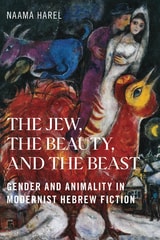
The Jew, the Beauty, and the Beast
Gender and Animality in Modernist Hebrew FictionNaama Harel
Rutgers University Press, 2026
The Jew, the Beauty, and the Beast critically explores the tangled interplay between Jewishness, gender, and animality and its manifestation in modernist Hebrew fiction. Through interdiscursive analysis and close readings, the effeminate Jew is examined vis-à-vis the animalized woman. Intertwining cutting-edge theoretical frameworks of posthumanism and animal studies with established scholarship of Hebrew literature, Jewish studies, and gender studies, Naama Harel offers new Hebrew literary historiography and innovative perspectives on canonical works by Shmuel Yosef Agnon, Devorah Baron, Micha Yosef Berdichevsky, Yosef Haim Brenner, Uri Nissan Gnessin, and David Vogel.
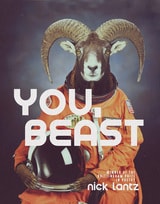
You, Beast
PoemsNick Lantz
University of Wisconsin Press, 2017