Results by title
10 books match the query 'Beautiful'
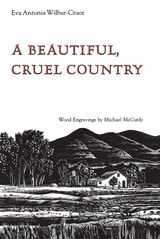
A Beautiful, Cruel Country
Eva Antonia Wilbur-Cruce
University of Arizona Press, 1987
Eva Antonia Wilbur inherited a unique affinity for the land. Granddaughter of a Harvard-educated physician who came to the Territory in the 1860s, she was the firstborn child of a Mexican mother and Anglo father who instilled in her an appreciation for both cultures. Little Toña learned firsthand the responsibilities of ranching—an education usually reserved for boys—and also experienced the racial hostility that occurred during those final years before the Tohono O'odham were confined to a reservation.
Begun as a reminiscence to tell younger family members about their "rawhide tough and lonely" life at the turn of the century, Mrs. Wilbur-Cruce's book is rich with imagery and dialogue that brings the Arivaca area to life. Her story is built around the annual cycle of ranch life—its spring and fall round-ups, planting and harvesting—and features a cavalcade of border characters, anecdotes about folk medicine, and recollections of events that were most meaningful in a young girl's life. Her account constitutes a valuable primary source from a region about which nothing similar has been previously published, while the richness of her story creates a work of literature that will appeal to readers of all ages.
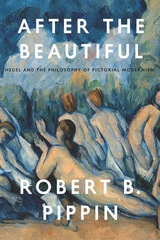
After the Beautiful
Hegel and the Philosophy of Pictorial ModernismRobert B. Pippin
University of Chicago Press, 2013
While Hegel could never engage modernist painting, he did have an understanding of modernity, and in it, art—he famously asserted—was “a thing of the past,” no longer an important vehicle of self-understanding and no longer an indispensable expression of human meaning. Pippin offers a sophisticated exploration of Hegel’s position and its implications. He also shows that had Hegel known how the social institutions of his day would ultimately fail to achieve his own version of genuine equality, a mutuality of recognition, he would have had to explore a different, new role for art in modernity. After laying this groundwork, Pippin goes on to illuminate the dimensions of Hegel’s aesthetic approach in the path-breaking works of Manet, the “grandfather of modernism,” drawing on art historians T. J. Clark and Michael Fried to do so. He concludes with a look at Cézanne, the “father of modernism,” this time as his works illuminate the relationship between Hegel and the philosopher who would challenge Hegel’s account of both modernity and art—Martin Heidegger.
Elegantly inter-weaving philosophy and art history, After the Beautiful is a stunning reassessment of the modernist project. It gets at the core of the significance of modernism itself and what it means in general for art to have a history. Ultimately, it is a testament, via Hegel, to the distinctive philosophical achievements of modernist art in the unsettled, tumultuous era we have inherited.
Desiring the Beautiful
Filip Ivanovic
Catholic University of America Press, 2019
Plato's Sophist
Part II of The Being of the BeautifulPlato
University of Chicago Press, 1986
"Seth Benardete is one of the very few contemporary classicists who combine the highest philological competence with a subtlety and taste that approximate that of the ancients. At the same time, he as set himself the entirely modern hermeneutical task of uncovering what the ancients preferred to keep veiled, of making explicit what they indicated, and hence...of showing the naked ugliness of artificial beauty."—Stanley Rose, Graduate Faculty Philosophy Journal
Seth Benardete (1930-2001) was professor of classics at New York University. He was the author or translator of many books, most recently The Argument of the Action, Plato's "Laws," and Plato's "Symposium," all published by the University of Chicago Press.
Plato's Statesman
Part III of The Being of the BeautifulPlato
University of Chicago Press, 1986
Theaetetus is the first of a trilogy of Platonic dialogues that show Socrates formulating his conception of philosophy as he prepares the defense for his trial. This translation is particularly faithful to the original Greek, and it is accompanied by an introduction, extensive notes, and comprehensive commentary that puts the dialogue in context with Plato's thought and its influence over the centuries.
Seth Benardete (1930-2001) was professor of classics at New York University.
Plato's Theaetetus
Part I of The Being of the BeautifulPlato
University of Chicago Press, 1986
"Seth Benardete is one of the very few contemporary classicists who combine the highest philological competence with a subtlety and taste that approximate that of the ancients. At the same time, he as set himself the entirely modern hermeneutical task of uncovering what the ancients preferred to keep veiled, of making explicit what they indicated, and hence...of showing the naked ugliness of artificial beauty."—Stanley Rose, Graduate Faculty Philosophy Journal
Seth Benardete (1930-2001) was professor of classics at New York University. He was the author or translator of many books, most recently The Argument of the Action, Plato's "Laws," and Plato's "Symposium," all published by the University of Chicago Press.
The Beautiful, The True and the Good
Robert E. Wood
Catholic University of America Press, 2015
The Being of the Beautiful
Plato's Theaetetus, Sophist, and StatesmanPlato
University of Chicago Press, 1984
“The translations are masterpieces of literalness. . . . They are honest, accurate, and give the reader a wonderful sense of the Greek.”—Drew A. Hyland, Review of Metaphysics
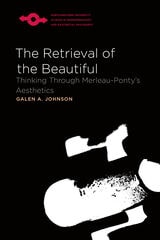
The Retrieval of the Beautiful
Thinking Through Merleau-Ponty’s AestheticsGalen A. Johnson
Northwestern University Press, 2010
In this elegant new study Galen Johnson retrieves the concept of the beautiful through the framework of Merleau-Ponty’s aesthetics. Although Merleau-Ponty seldom spoke directly of beauty, his philosophy is essentially about the beautiful.
In Johnson’s formulation, the ontology of Flesh as element and the ontology of the Beautiful as elemental are folded together, for Desire, Love, and Beauty are part of the fabric of the world’s element, Flesh itself, the term at which Merleau-Ponty arrived to replace Substance, Matter, or Life as the name of Being.
Merleau-Ponty’s Eye and Mind is at the core of the book, so Johnson engages, as Merleau-Ponty did, the writings and visual work of Paul Cézanne, Auguste Rodin, and Paul Klee, as well as Rilke’s commentary on Cézanne and Rodin. From these widely varying aesthetics emerge the fundamental themes of the retrieval of the beautiful: desire, repetition, difference, rhythm, and the sublime. The third part of Johnson’s book takes each of these up in turn, bringing Merleau-Ponty’s aesthetic thinking into dialogue with classical philosophy as well as Sartre, Heidegger, Nietzsche, and Deleuze. Johnson concludes his final chapter with a direct dialogue with Kant and Merleau-Ponty, and also Lyotard, on the subject of the beautiful and the sublime. As we experience with Rodin’s Balzac, beauty and the sublime blend into one another when the beautiful grows powerful, majestic, mysterious, and transcendent.
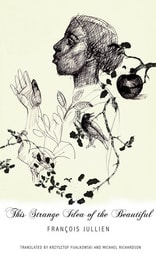
This Strange Idea of the Beautiful
François Jullien
Seagull Books, 2016
An exploration of what it means when we say something is beautiful.
Bringing together ideas of beauty from both Eastern and Western philosophy, François Jullien challenges the assumptions underlying our commonly agreed-upon definition of what is beautiful and offers a new way of beholding art. Jullien argues that the Western concept of beauty was established by Greek philosophy and became consequently embedded within the very structure of European languages. And due to its relationship to language, this concept has determined ways of thinking about beauty that often go unnoticed or unchecked in discussions of Western aesthetics. Moreover, through globalization, Western ideals of beauty have even spread to cultures whose ancient traditions are based upon radically different aesthetic foundations; yet, these cultures have adopted such views without question and without recognizing the cultural assumptions they contain.