Results by title
4 books match the query 'Beauty shops'

Black behind the Ears
Dominican Racial Identity from Museums to Beauty ShopsGinetta E. B. Candelario
Duke University Press, 2007
Black behind the Ears is an innovative historical and ethnographic examination of Dominican identity formation in the Dominican Republic and the United States. For much of the Dominican Republic’s history, the national body has been defined as “not black,” even as black ancestry has been grudgingly acknowledged. Rejecting simplistic explanations, Ginetta E. B. Candelario suggests that it is not a desire for whiteness that guides Dominican identity discourses and displays. Instead, it is an ideal norm of what it means to be both indigenous to the Republic (indios) and “Hispanic.” Both indigeneity and Hispanicity have operated as vehicles for asserting Dominican sovereignty in the context of the historically triangulated dynamics of Spanish colonialism, Haitian unification efforts, and U.S. imperialism. Candelario shows how the legacy of that history is manifest in contemporary Dominican identity discourses and displays, whether in the national historiography, the national museum’s exhibits, or ideas about women’s beauty. Dominican beauty culture is crucial to efforts to identify as “indios” because, as an easily altered bodily feature, hair texture trumps skin color, facial features, and ancestry in defining Dominicans as indios.
Candelario draws on her participant observation in a Dominican beauty shop in Washington Heights, a New York City neighborhood with the oldest and largest Dominican community outside the Republic, and on interviews with Dominicans in New York City, Washington, D.C., and Santo Domingo. She also analyzes museum archives and displays in the Museo del Hombre Dominicano and the Smithsonian Institution as well as nineteenth- and early-twentieth-century European and American travel narratives.
[more]
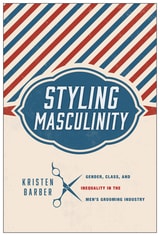
Styling Masculinity
Gender, Class, and Inequality in the Men's Grooming IndustryBarber, Kristen
Rutgers University Press, 2016
The twenty-first century has seen the emergence of a new style of man: the metrosexual. Overwhelmingly straight, white, and wealthy, these impeccably coiffed urban professionals spend big money on everything from facials to pedicures, all part of a multi-billion-dollar male grooming industry. Yet as this innovative study reveals, even as the industry encourages men to invest more in their appearance, it still relies on women to do much of the work.
Styling Masculinity investigates how men’s beauty salons have persuaded their clientele to regard them as masculine spaces. To answer this question, sociologist Kristen Barber goes inside Adonis and The Executive, two upscale men’s salons in Southern California. Conducting detailed observations and extensive interviews with both customers and employees, she shows how female salon workers not only perform the physical labor of snipping, tweezing, waxing, and exfoliating, but also perform the emotional labor of pampering their clients and pumping up their masculine egos.
Letting salon employees tell their own stories, Barber not only documents occasions when these workers are objectified and demeaned, but also explores how their jobs allow for creativity and confer a degree of professional dignity. In the process, she traces the vast network of economic and social relations that undergird the burgeoning male beauty industry.
[more]
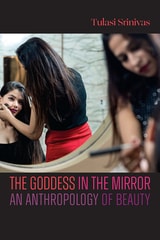
The Goddess in the Mirror
An Anthropology of BeautyTulasi Srinivas
Duke University Press, 2025
In The Goddess in the Mirror, Tulasi Srinivas offers a pathbreaking ethnography of contemporary Indian beauty parlors in Bangalore. Exploring the gendered world of beauty in the intimate spaces of the salon, whose popularity has exploded amid an urban tech revolution, Srinivas invites readers to consider what beauty is and what it does. Visiting diverse salons that cater to various classes, castes, and queer sexualities, she tracks the relationships between clients and workers, revealing the beauty industry’s painful political, religious, and economic stakes. Embodiment, religion, and narrative intersect as clients and beauticians tell well-known stories of beautiful Hindu goddesses, heroines, queens, and apsaras, thereby weaving their own ethical subjectivities every day. Following the goddess’s allure, radiance, woundedness, fluidity, and fertility, Srinivas situates ideas of beauty within a larger moral and political context where beauty is both a fleeting pursuit and a rich resource for navigating a patriarchal present.
[more]
Three Faces of Beauty
Casablanca, Paris, CairoSusan Ossman
Duke University Press, 2002
Three Faces of Beauty offers a unique approach to understanding globalization and cultural change based on a comparative, ethnographic study of a nearly universal institution: the beauty salon. Susan Ossman traces the images and words of the beauty industry as they developed historically between Paris, Cairo, and Casablanca and then vividly demonstrates how such images are embodied today in salons located in each city.
By examining how images from fashion magazines, film, and advertising are enacted in beauty salons, Ossman demonstrates how embodiment is able to display and rework certain hierarchies. While offering the possibility of freedom from the tethers of status, nation, religion, and nature, beauty is created by these very categories and values, Ossman shows. Drawing on hundreds of interviews, she documents the various rituals of welcome, choice-making, pricing practices, and spatial arrangements in multiple salons . She also reveals ways in which patrons in all three cities imagine and co-opt looks they believe are fashionable in the other cities. By observing salons as scenes of instruction, Ossman reveals that beautiful bodies evolve within the intertwining contexts of media, modernity, location, time, postcolonialism, and male expectation.
By examining how images from fashion magazines, film, and advertising are enacted in beauty salons, Ossman demonstrates how embodiment is able to display and rework certain hierarchies. While offering the possibility of freedom from the tethers of status, nation, religion, and nature, beauty is created by these very categories and values, Ossman shows. Drawing on hundreds of interviews, she documents the various rituals of welcome, choice-making, pricing practices, and spatial arrangements in multiple salons . She also reveals ways in which patrons in all three cities imagine and co-opt looks they believe are fashionable in the other cities. By observing salons as scenes of instruction, Ossman reveals that beautiful bodies evolve within the intertwining contexts of media, modernity, location, time, postcolonialism, and male expectation.
[more]