Results by title

12 books match the query 'Beckett, Samuel'
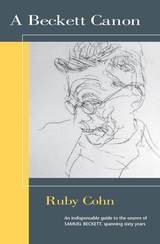
cover of A Beckett Canon

A Beckett Canon

Ruby Cohn

University of Michigan Press, 2005

Samuel Beckett is unique in literature. Born and educated in Ireland, he lived most of his life in Paris. His literary output was rendered in either English or French, and he often translated one to the other, but there is disagreement about the contents of his bilingual corpus. A Beckett Canon by renowned theater scholar Ruby Cohn offers an invaluable guide to the entire corpus, commenting on Beckett's work in its original language.
Beginning in 1929 with Beckett's earliest work, the book examines the variety of genres in which he worked: poems, short stories, novels, plays, radio pieces, teleplays, reviews, and criticism. Cohn grapples with the difficulties in Beckett's work, including the opaque erudition of the early English verse and fiction, and the searching depths and syntactical ellipsis of the late works.
Specialist and nonspecialist readers will find A Beckett Canon valuable for its remarkable inclusiveness. Cohn has examined the holdings of all of the major Beckett depositories, and is thus able to highlight neglected manuscripts and correct occasional errors in their listings. Intended as a resource to accompany the reading of Beckett's writing--in English or French, published or unpublished, in part or as a whole--the book offers context, information, and interpretation of the work of one of the last century's most important writers.
Ruby Cohn is Professor Emerita of Comparative Drama, University of California, Davis. She is author or editor of many books, including Anglo-American Interplay in Recent Drama; Retreats from Realism in Recent English Drama; From Desire to Godot; and Just Play: Beckett's Theater.
[more]
cover of Beckett after Wittgenstein

Beckett after Wittgenstein

Andre Furlani

Northwestern University Press, 2015

Among the best-represented authors in Samuel Beckett’s library was Ludwig Wittgenstein, yet the philosopher’s relevance to the Nobel laureate’s work is scarcely acknowledged and seldom elucidated. Beckett after Wittgenstein is the first book to examine Beckett’s formative encounters with, and profound affinities to, Wittgenstein’s thought, style, and character.

While a number of influential critics, including the philosopher Alain Badiou, have discerned a transition in Beckett’s work beginning in the late 1950s, Furlani is the first to identify and clarify how this change occurs in conjunction with the writer’s sustained engagement with Wittgenstein’s thought on, for example, language, cognition, subjectivity, alterity, temporality, belief, hermeneutics, logic, and perception. Drawing on a wealth of Beckett’s archival materials, much of it unpublished, Furlani’s study reveals the extent to which Wittgenstein fostered Beckett’s views and emboldened his purposes.
[more]
cover of Beckett’s Happy Days: A Manuscript Study

Beckett’s Happy Days

A Manuscript Study

S. E. Gontarski

The Ohio State University Press, 2017

Beckett’s Happy Days:  A Manuscript Study by S. E. Gontarski traces the development of Samuel Beckett’s final two-act play, composed in English between October 1960 and May 1961, through annotated and bedoodled manuscript notebooks, holographs, and typescript drafts to the final published and performed text. The analysis details Beckett’s most salient alterations and revisions, including his development of the work’s tapestry of fragmented, half-remembered literary allusions.
The current reissue of Beckett’s Happy Days comes at a timely moment not only in Beckett studies but also in the general growth in programs of book history and digital humanities. Gontarski’s study is not just a look back to origins. It traces an arc of research that developed over forty years as the Samuel Beckett archive at the University of Reading matured, as the fields of genetic and textual research grew, and as book history reemerged on a grand, international scale. In this timeframe, the Beckett Digital Manuscript and Library Projects responded to interest in Beckett studies and archival studies, taking textual production, genetic study, and book history into the twenty-first century with their emphasis on electronic access and digital collation. At The Ohio State University, the Rare Books and Manuscripts archive held papers central to Gontarski’s study. Beckett’s Happy Days is thus a fundamental, even seminal, part of that forty-year scholarly trajectory, and in its current edition, is readily accessible to individual students and scholars alike.

 
[more]
cover of Directing Beckett

Directing Beckett

Lois Oppenheim

University of Michigan Press, 1997

In Directing Beckett, Lois Oppenheim presents interviews and essays with twenty-two prominent international directors of Samuel Beckett's work, many of whom worked closely with Beckett, assisting him with his productions or acting under his direction before directing his work themselves. Here they speak openly of their experiences of working with him, and comment on various productions that, in taking great liberties with his work, have raised a number of fascinating legal and aesthetic questions.
In exploring this key figure in the history of theater, Oppenheim's interviews--with such directors as JoAnne Akalaitis, Edward Albee, Herbert Blau, Joseph Chaikin, and Carey Perloff--also address many of the complexities of the director's role, such as the meaning of directorial integrity and fidelity to the playwright's vision--an issue of particular relevance to a playwright whose exactitude, with respect to stage directions, is well documented. Additional highlights include photographs from many of the productions; the unpublished text of a lecture by the late Alan Schneider, Beckett's most accomplished American director; and an interview with the late Roger Blin, the very first director of Beckett's work.
"Directing Beckett is a rare thing--a book both pleasant to read and useful to have . . . it is like listening to the ideal panel, everyone who should be there there and all at their articulate best." --Toby Silverman Zinman, Theatre Journal
"Anyone intending to direct or act in a work by Beckett, or to write about his work, must read this book." --Choice
Lois Oppenheim is Professor of French, Montclair State University

[more]
cover of First Love: The Affections of Modern Fiction

First Love

The Affections of Modern Fiction

Maria DiBattista

University of Chicago Press, 1991

All of us remember our First Love. In this brilliant and often passionate book, Maria DiBattista shows that the yearning for the freshness of First Love, and the sadness of that yearning, are central to modern literature. DiBattista offers a sweeping and wholly original reinterpretation of modern fiction, allowing us to see the romantic affections that lie behind the seemingly most ironic of modernist texts.

DiBattista argues that modernity reinvented First Love as a myth of creative initiative, as its characteristic response to a pervasive sense of historical belatedness. Anxious that its own creations can never be more than diminished forms of mightier originals, modernity idolizes First Love as the beginning that can never be repeated. First Love hence epitomizes the dream of a new self-incarnation. From Turgenev's First Love to the formative works of Virginia Woolf, Gertrude Stein, E. M. Forster, and Vladimir Nabokov, First Love confirms the birth of an artistic vocation. For modern men and women intent on becoming the original authors of their own lives, First Love becomes paradigmatic of those life-altering moments that transform the undifferentiated sequence of days into a fateful narrative.

DiBattista focuses on the enunciation of First Love in the fiction of Thomas Hardy, D. H. Lawrence, James Joyce, and Samuel Beckett. In reading their works, DiBattista dramatically revises the accepted view of irony as the dominant tone of modernism. First Love constitutes, she shows, a new apprehension of the world characterized not by the frigid distances of irony but by a belief in the creative individual who may begin the world anew, as if for the first time.
[more]
cover of Hamletics: Shakespeare, Kafka, Beckett

Hamletics

Shakespeare, Kafka, Beckett

Massimo Cacciari

Seagull Books, 2023

One of Italy's best-known contemporary philosophers and leftists offers a literature-informed take on our contemporary political situation.

During the dramatic course of the twentieth century, amid the clash of the titans which marked that era, humanity could still think in terms of partisan struggles in which large masses took sides against one another. The new millennium, by contrast, appears to have opened under the guise of generalized insecurity, which pertains not only to the historical and social situation, or to one’s personal psychological predicament, but to our very being. The Earth’s current faltering and the twilight of every convention that might govern it—where roles, images, and languages become confused by a lack of direction and distance—were already powerfully prophesied in Shakespeare’s Hamlet, and later in the works of Kafka and Beckett. In Hamletics, Massimo Cacciari, one of Italy’s foremost philosophers and leftist political figures, establishes a dialogue between these fateful authors, exploring the relationship between European nihilism and the aporias of action in the present.
[more]
cover of Proust among the Nations: From Dreyfus to the Middle East

Proust among the Nations

From Dreyfus to the Middle East

Jacqueline Rose

University of Chicago Press, 2011

 Known for her far-reaching examinations of psychoanalysis, literature, and politics, Jacqueline Rose has in recent years turned her attention to the Israel-Palestine conflict, one of the most enduring and apparently intractable conflicts of our time. In Proust among the Nations, she takes the development of her thought on this crisis a stage further, revealing it as a distinctly Western problem.

In a radical rereading of the Dreyfus affair through the lens of Marcel Proust in dialogue with Freud, Rose offers a fresh and nuanced account of the rise of Jewish nationalism and the subsequent creation of Israel. Following Proust’s heirs, Beckett and Genet, and a host of Middle Eastern writers, artists, and filmmakers, Rose traces the shifting dynamic of memory and identity across the crucial and ongoing cultural links between Europe and Palestine. A powerful and elegant analysis of the responsibility of writing, Proust among the Nations makes the case for literature as a unique resource for understanding political struggle and gives us new ways to think creatively about the violence in the Middle East.
[more]
cover of Reflections on Beckett: A Centenary Celebration

Reflections on Beckett

A Centenary Celebration

Anna McMullan and S. E. Wilmer, Editors. Foreword by Dennis Kennedy

University of Michigan Press, 2009

The essays in this collection were originally delivered as part of the esteemed lecture series at Trinity College Dublin, Samuel Beckett's alma mater. The eminent contributors shed new light on Beckett's enigmatic theater, taking up an engaging array of topics. Included are new perspectives on Beckett's use of language and silence, on his attitudes toward the body, on those who influenced him and on those he has influenced (including Suzan-Lori Parks and Femi Osofisan), and on Beckett and the art of self-collaboration. Each contributor places the playwright into a network of genealogies and legacies and his work into important historical, cultural, and aesthetic contexts. Together, the essays demonstrate Beckett's impact on theater, performance, and visual arts during the latter half of the twentieth century and serve to open up new directions for Beckett studies well into the twenty-first. This is an indispensable volume for anyone interested in Beckett, whether scholar, student, or enthusiast.
[more]
cover of Sails of the Herring Fleet: Essays on Beckett

Sails of the Herring Fleet

Essays on Beckett

Herbert Blau

University of Michigan Press, 2003

 
Sails of the Herring Fleet traces esteemed director and theorist Herbert Blau's encounters with the work of Samuel Beckett. Blau directed Beckett's plays when they were still virtually unknown, and for more than four decades has remained one of the leading interpreters of his work. In addition to now-classic essays, the collection includes early program notes and two remarkable interviews -- one from Blau's experience directing Waiting for Godot at San Quentin prison, and one from his last visit with Beckett, just before the playwright's death.
Herbert Blau is Byron W. and Alice L. Lockwood Professor of the Humanities, University of Washington.
[more]
cover of Saying I No More: Subjectivity and Consciousness in the Prose of Samuel Beckett

Saying I No More

Subjectivity and Consciousness in the Prose of Samuel Beckett

Daniel Katz

Northwestern University Press, 1999
In recent criticism, Samuel Beckett's prose has been increasingly described as a labor of refusal: not only of what traditionally has made possible narrative and the novel but also of the major conventional suppositions concerning the primacy of consciousness, subjectivity, and expression for the artistic act. Beginning from the premise that Beckett never betrays his belief in "the impossibility to express," Saying I No More explores the Beckettian refusal. Katz posits that the expression of voicelessness in Beckett is not silence, that the negativity and negation so evident in the great writer's work are not simply affirmed, but that the valorization of abnegation, emptiness, impotence, or the "no" can all too easily become itself an affirmation of power or an inverted imposition of force.
[more]
cover of The Work of Poverty: Samuel Beckett's Vagabonds and the Theater of Crisis

The Work of Poverty

Samuel Beckett's Vagabonds and the Theater of Crisis

Lance Duerfahrd

The Ohio State University Press, 2013
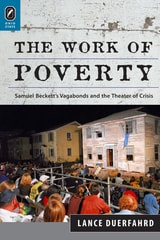
How did Samuel Beckett’s Waiting for Godot come to be performed in such places as San Quentin Prison, Mississippi during the Civil Rights Movement, Sarajevo under military siege, New Orleans’s Lower Ninth Ward after Hurricane Katrina, and Zuccotti Park during the Occupy Wall Street protests? The Work of Poverty: Samuel Beckett’s Vagabonds and the Theater of Crisis studies the appeal of Godot to audiences in settings of historical crisis and suffering. Lance Duerfahrd argues that these circumstances transform the performance and the reception of the play, thereby illuminating a cathartic and political dimension of Beckett’s work that goes unseen in traditional performance contexts.
 
The resonance of one of the most canonical plays of the twentieth century within landscapes of disaster fulfills the aesthetic of “ultimate penury” that Beckett hones in his work. Here the subtractive and reductive dynamic of the Nobel Prize–winning author’s craft comes into clearer view, echoing with the despondent condition beyond the stage. In developing an aesthetic of penury, The Work of Poverty brings together the dispossessed characters in Godot; the derelict narrators of Beckett’s Molloy,Malone Dies, and the Unnamable; and the formal experimentation in poverty witnessed in his Endgame and Worstward Ho. Beckett forged increasingly destitute forms of theater and prose on the periphery of writing. Duerfahrd illustrates how this work speaks to our age by emphasizing characters on the periphery of society.
[more]
cover of Theatre of the Real: Yeats, Beckett, and Sondheim

Theatre of the Real

Yeats, Beckett, and Sondheim

Gina Masucci MacKenzie

The Ohio State University Press, 2008

The Theatre of the Real: Yeats, Beckett, and Sondheim traces the thread of jouissance (the simultaneous experience of radical pleasure and pain) through three major theatre figures of the twentieth century. Gina Masucci MacKenzie’s work engages theatrical text and performance in dialogue with the Lacanian Real, so as to re-envision modern theatre as the cultural site where author, actor, and audience come into direct contact with personal and collective traumas. By showing how a transgressively free subject may be formed through theatrical experience, MacKenzie concludes that modern theatre can liberate the individual from the socially constructed self.
 
The Theatre of the Real revises views of modern theatre by demonstrating how it can lead to a collaborative effort required for innovative theatrical work. By foregrounding Yeats’s “dancer” plays, the author shows how these intimate pieces contribute to the historical development of musical as well as modern theatre. Beckett’s universal dramas then pave the way for Sondheim’s postmodern cacophonies of idea and spirit as they introduce comic abjection into modernism’s tragic mode. This exciting work from a new author will leave readers with fresh insight to theatrical performance and its necessity in our lives.
 
 
[more]