Results by title
10 books match the query 'Beethoven, Ludwig van'
Beethoven for a Later Age
Living with the String QuartetsEdward Dusinberre
University of Chicago Press, 2016
Beethoven’s sixteen string quartets are some of the most extraordinary and challenging pieces of music ever written. Originally composed and performed between 1798 and 1826, they have inspired artists of all kinds—not only musicians—and have been subject to endless reinterpretation. But what is it like to personally take up the challenge of these compositions, not only as a musician, but as a member of a quartet, where each player has ideas about style and expression? To answer this question, Edward Dusinberre, first violinist of the renowned Takács Quartet, offers a rare peek inside the workings of his ensemble, while providing an insightful history of the compositions and their performance.
Founded in Hungary in 1975 and now based in Boulder, Colorado, the Takács is one of the world’s preeminent string quartets, and performances of Beethoven have been at the center of their work together for over forty years. Using the history of both the Takács Quartet and the Beethoven quartets as a foundation, Beethoven for a Later Age provides a backstage look at the daily life of a quartet, showing the necessary creative tension between individual and group and how four people can at the same time forge a lasting artistic connection and enjoy making music together over decades. The key, Dusinberre reveals, to a quartet crafting its own sound is in balancing continuity with change and experimentation—a theme that lies at the heart of Beethoven’s remarkable compositions. In an accessible style, suitable for novices and chamber music enthusiasts alike, Dusinberre illuminates the variety and contradictions of Beethoven's quartets, which were composed against the turbulent backdrop of the Napoleonic Wars and their aftermath, and he brings the technical aspects of the music to life.
Beethoven for a Later Age vividly shows that creative engagement with Beethoven’s radical and brilliant quartets continues to be as stimulating now as it was for its first performers and audiences. Musicians and music lovers will be intrigued by Dusinberre’s exploration of the close collaboration at the heart of any great performance.
[more]
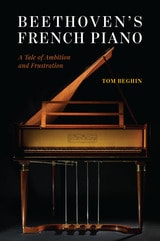
Beethoven's French Piano
A Tale of Ambition and FrustrationTom Beghin
University of Chicago Press, 2022
Using a replica of Beethoven’s Erard piano, scholar and performer Tom Beghin launches a striking reinterpretation of a key period of Beethoven’s work.
In 1803 Beethoven acquired a French piano from the Erard Frères workshop in Paris. The composer was “so enchanted with it,” one visitor reported, “that he regards all the pianos made here as rubbish by comparison.” While Beethoven loved its sound, the touch of the French keyboard was much heavier than that of the Viennese pianos he had been used to. Hoping to overcome this drawback, he commissioned a local technician to undertake a series of revisions, with ultimately disappointing results. Beethoven set aside the Erard piano for good in 1810.
Beethoven’s French Piano returns the reader to this period of Beethoven’s enthusiasm for all things French. What traces of the Erard’s presence can be found in piano sonatas like his “Waldstein” and “Appassionata”? To answer this question, Tom Beghin worked with a team of historians and musicians to commission the making of an accurate replica of the Erard piano. As both a scholar and a recording artist, Beghin is uniquely positioned to guide us through this key period of Beethoven’s work. Whether buried in archives, investigating the output of the French pianists who so fascinated Beethoven, or seated at the keyboard of his Erard, Beghin thinks and feels his way into the mind of the composer, bringing startling new insights into some of the best-known piano compositions of all time.
[more]

Beethoven's Ninth
A Political HistoryEsteban Buch
University of Chicago Press, 2003
Who hasn't been stirred by the strains of Beethoven's Ninth Symphony? That's a good question, claims Esteban Buch. German nationalists and French republicans, communists and Catholics have all, in the course of history, embraced the piece. It was performed under the direction of Leonard Bernstein at a concert to mark the fall of the Berlin Wall, yet it also serves as a ghastly and ironic leitmotif in Stanley Kubrick's A Clockwork Orange. Hitler celebrated his birthdays with it, and the government of Rhodesia made it their anthem. And played in German concentration camps by the imprisoned, it also figured prominently at Mitterand's 1981 investiture.
In his remarkable history of one of the most popular symphonic works of the modern period, Buch traces such complex and contradictory uses—and abuses—of Beethoven's Ninth Symphony since its premier in 1824. Buch shows that Beethoven consciously drew on the tradition of European political music, with its mix of sacred and profane, military and religious themes, when he composed his symphony. But while Beethoven obviously had his own political aspirations for the piece—he wanted it to make a statement about ideal power—he could not have had any idea of the antithetical political uses, nationalist and universalist, to which the Ninth Symphony has been put since its creation. Buch shows us how the symphony has been "deployed" throughout nearly two centuries, and in the course of this exploration offers what was described by one French reviewer as "a fundamental examination of the moral value of art." Sensitive and fascinating, this account of the tangled political existence of a symphony is a rare book that shows the life of an artwork through time, shifted and realigned with the currents of history.
In his remarkable history of one of the most popular symphonic works of the modern period, Buch traces such complex and contradictory uses—and abuses—of Beethoven's Ninth Symphony since its premier in 1824. Buch shows that Beethoven consciously drew on the tradition of European political music, with its mix of sacred and profane, military and religious themes, when he composed his symphony. But while Beethoven obviously had his own political aspirations for the piece—he wanted it to make a statement about ideal power—he could not have had any idea of the antithetical political uses, nationalist and universalist, to which the Ninth Symphony has been put since its creation. Buch shows us how the symphony has been "deployed" throughout nearly two centuries, and in the course of this exploration offers what was described by one French reviewer as "a fundamental examination of the moral value of art." Sensitive and fascinating, this account of the tangled political existence of a symphony is a rare book that shows the life of an artwork through time, shifted and realigned with the currents of history.
[more]
Beethoven's Symphonies
Nine Approaches to Art and IdeasMartin Geck
University of Chicago Press, 2017
In the years spanning from 1800 to 1824, Ludwig van Beethoven completed nine symphonies, now considered among the greatest masterpieces of Western music. Yet despite the fact that this time period, located in the wake of the Enlightenment and at the peak of romanticism, was one of rich intellectual exploration and social change, the influence of such threads of thought on Beethoven’s work has until now remained hidden beneath the surface of the notes. Beethoven’s Symphonies presents a fresh look at the great composer’s approach and the ideas that moved him, offering a lively account of the major themes unifying his radically diverse output.
Martin Geck opens the book with an enthralling series of cultural, political, and musical motifs that run throughout the symphonies. A leading theme is Beethoven’s intense intellectual and emotional engagement with the figure of Napoleon, an engagement that survived even Beethoven’s disappointment with Napoleon’s decision to be crowned emperor in 1804. Geck also delves into the unique ways in which Beethoven approached beginnings and finales in his symphonies, as well as his innovative use of particular instruments. He then turns to the individual symphonies, tracing elements—a pitch, a chord, a musical theme—that offer a new way of thinking about each work and will make even the most devoted fans of Beethoven admire the symphonies anew.
Offering refreshingly inventive readings of the work of one of history’s greatest composers, this book shapes a fascinating picture of the symphonies as a cohesive oeuvre and of Beethoven as a master symphonist.
[more]
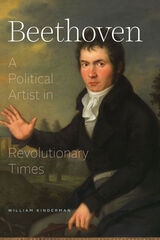
Beethoven
A Political Artist in Revolutionary TimesWilliam Kinderman
University of Chicago Press, 2021
We have long regarded Beethoven as a great composer, but we rarely appreciate that he was also an eminently political artist. This book unveils the role of politics in his oeuvre, elucidating how the inherently political nature of Beethoven’s music explains its power and endurance.
William Kinderman presents Beethoven as a civically engaged thinker faced with severe challenges. The composer lived through many tumultuous events—the French Revolution, the rise and fall of Napoleon Bonaparte, and the Congress of Vienna among them. Previous studies of Beethoven have emphasized the importance of his personal suffering and inner struggles; Kinderman instead establishes that musical tensions in works such as the Eroica, the Appassionata, and his final piano sonata in C minor reflect Beethoven’s attitudes toward the political turbulence of the era. Written for the 250th anniversary of his birth, Beethoven takes stock of the composer’s legacy, showing how his idealism and zeal for resistance have ensured that masterpieces such as the Ninth Symphony continue to inspire activists around the globe. Kinderman considers how the Fifth Symphony helped galvanize resistance to fascism, how the Sixth has energized the environmental movement, and how Beethoven’s civic engagement continues to inspire in politically perilous times. Uncertain times call for ardent responses, and, as Kinderman convincingly affirms, Beethoven’s music is more relevant today than ever before.
William Kinderman presents Beethoven as a civically engaged thinker faced with severe challenges. The composer lived through many tumultuous events—the French Revolution, the rise and fall of Napoleon Bonaparte, and the Congress of Vienna among them. Previous studies of Beethoven have emphasized the importance of his personal suffering and inner struggles; Kinderman instead establishes that musical tensions in works such as the Eroica, the Appassionata, and his final piano sonata in C minor reflect Beethoven’s attitudes toward the political turbulence of the era. Written for the 250th anniversary of his birth, Beethoven takes stock of the composer’s legacy, showing how his idealism and zeal for resistance have ensured that masterpieces such as the Ninth Symphony continue to inspire activists around the globe. Kinderman considers how the Fifth Symphony helped galvanize resistance to fascism, how the Sixth has energized the environmental movement, and how Beethoven’s civic engagement continues to inspire in politically perilous times. Uncertain times call for ardent responses, and, as Kinderman convincingly affirms, Beethoven’s music is more relevant today than ever before.
[more]
From the Ruins of Enlightenment
Beethoven and Schubert in Their SolitudeRichard Kramer
University of Chicago Press, 2023
Richard Kramer follows the work of Beethoven and Schubert from 1815 through to the final months of their lives, when each were increasingly absorbed in iconic projects that would soon enough inspire notions of “late style.”
Here is Vienna, hosting a congress in 1815 that would redraw national boundaries and reconfigure the European community for a full century. A snapshot captures two of its citizens, each seemingly oblivious to this momentous political environment: Franz Schubert, not yet twenty years old and in the midst of his most prolific year—some 140 songs, four operas, and much else; and Ludwig van Beethoven, struggling through a midlife crisis that would yield the song cycle An die ferne Geliebte, two strikingly original cello sonatas, and the two formidable sonatas for the “Hammerklavier,” opp. 101 and 106. In Richard Kramer’s compelling reading, each seemed to be composing “against”—Beethoven, against the Enlightenment; Schubert, against the looming presence of the older composer even as his own musical imagination took full flight.
From the Ruins of Enlightenment begins in 1815, with the discovery of two unique projects: Schubert’s settings of the poems of Ludwig Hölty in a fragmentary cycle and Beethoven’s engagement with a half dozen poems by Johann Gottfried Herder. From there, Kramer unearths previously undetected resonances and associations, illuminating the two composers in their “lonely and singular journeys” through the “rich solitude of their music.”
[more]
Hearing Beethoven
A Story of Musical Loss and DiscoveryRobin Wallace
University of Chicago Press, 2018
Wallace demystifies the narratives of Beethoven’s approach to his hearing loss and instead explores how Beethoven did not "conquer" his deafness; he adapted to life with it.
We’re all familiar with the image of a fierce and scowling Beethoven, struggling doggedly to overcome his rapidly progressing deafness. That Beethoven continued to play and compose for more than a decade after he lost his hearing is often seen as an act of superhuman heroism. But the truth is that Beethoven’s response to his deafness was entirely human. And by demystifying what he did, we can learn a great deal about Beethoven’s music. Perhaps no one is better positioned to help us do so than Robin Wallace, who not only has dedicated his life to the music of Beethoven but also has close personal experience with deafness. One day, Wallace’s late wife, Barbara, found she couldn’t hear out of her right ear—the result of radiation administered to treat a brain tumor early in life. Three years later, she lost hearing in her left ear as well. Over the eight and a half years that remained of her life, despite receiving a cochlear implant, Barbara didn’t overcome her deafness or ever function again like a hearing person.
Wallace shows here that Beethoven didn’t do those things, either. Rather than heroically overcoming his deafness, Beethoven accomplished something even more challenging: he adapted to his hearing loss and changed the way he interacted with music, revealing important aspects of its very nature in the process. Wallace tells the story of Beethoven’s creative life, interweaving it with his and Barbara’s experience to reveal aspects that only living with deafness could open up. The resulting insights make Beethoven and his music more accessible and help us see how a disability can enhance human wholeness and flourishing.
[more]
The Beethoven Violin Sonatas
History, Criticism, PerformanceEdited by Lewis Lockwood and Mark Kroll
University of Illinois Press, 2004
Beethoven's ten violin sonatas have long been cornerstones of the chamber music repertoire. The "Spring" and "Kreutzer" sonatas are the best known of these works, which stand at the pinnacle of music for violin and piano.
Lewis Lockwood and Mark Kroll's volume The Beethoven Violin Sonatas is the first scholarly book in English devoted exclusively to the Beethoven sonatas, and deals with them in unprecedented depth. It presents seven critical and historical essays by some of the most important American and European Beethoven specialists of our time. The authors examine the sonatas within the history of the genre, the social and cultural context in which they were written, their significance within Beethoven's life and works, and the issues they raise regarding performance practices of the period.
Lewis Lockwood and Mark Kroll's volume The Beethoven Violin Sonatas is the first scholarly book in English devoted exclusively to the Beethoven sonatas, and deals with them in unprecedented depth. It presents seven critical and historical essays by some of the most important American and European Beethoven specialists of our time. The authors examine the sonatas within the history of the genre, the social and cultural context in which they were written, their significance within Beethoven's life and works, and the issues they raise regarding performance practices of the period.
[more]

The Composer Embalmed
Relic Culture from Piety to KitschAbigail Fine
University of Chicago Press, 2025
The first granular study of nineteenth-century composer devotion—a network of devotees who preserved tangible traces of composers through relics, rituals, pilgrimage, exhumation, and embalming.
During the nineteenth century, music institutions promoted artworks they deemed timeless and made composers into figureheads of a lasting Western canon. Alongside this institutional face of the canon was a more intimate impulse to preserve, touch, and embrace the residues of the dead. In Germany and Austria between 1870 and 1930, music lovers venerated the bodies, houses, and belongings of composers as relics, shrines, and talismans. In The Composer Embalmed, Abigail Fine documents the vernacular and eccentric ways that composers have been remembered.
Fine navigates a wealth of unknown archival material to recover the stories of devotees: from pilgrims who felt time stop in historic houses to music-loving doctors who made skulls into sacred specimens, dilettantes who displayed Beethoven’s mask as a relic of the “beautiful death,” and interwar critics of those dilettantes who disparaged piety as a false religion, a kitsch replica. In isolation, these practices may look like simple acts of affection. But in the aggregate, Fine asserts, acts of devotion constituted what we might broadly understand as relic culture—a culture that sought to possess the body of the departed genius, and that superimposed habits of anthropological collecting onto artifacts of Austro-German heritage. By excavating objects, ephemera, amateur lyric, visitors’ books, letters, and travelogues, The Composer Embalmed reveals the underbelly of the canon, where guilty pleasures blur the boundary between sanctity and desecration.
[more]
The String Quartets of Beethoven
Edited by William Kinderman
University of Illinois Press, 2020
"We do not understand music--it understands us." This aphorism by Theodor W. Adorno expresses the quandary and the fascination many listeners have felt in approaching Beethoven's late quartets. No group of compositions occupies a more central position in chamber music, yet the meaning of these works continues to stimulate debate. William Kinderman's The String Quartets of Beethoven stands as the most detailed and comprehensive exploration of the subject. It collects new work by leading international scholars who draw on a variety of historical sources and analytical approaches to offer fresh insights into the aesthetics of the quartets, probing expressive and structural features that have hitherto received little attention. This volume also includes an appendix with updated information on the chronology and sources of the quartets and a detailed bibliography.
[more]