Results by title
5 books match the query 'Behavior modification'
Communication Incompetencies
A Theory of Training Oral Performance BehaviorGerald M. Phillips
Southern Illinois University Press, 1991
Gerald M. Phillips draws on his twenty-five-year, five-thousand-client experience with the Pennsylvania State University Reticence Program to present a new theory of modification of “inept” communication behavior.
That experience has convinced Phillips that communication is arbitrary and rulebound rather than a process of inspiration. He demonstrates that communication problems can be described as errors that can be detected and classified in order to fit a remediation pattern. Regardless of the source of error, the remedy is to train the individual to avoid or eliminate errors—thus, orderly procedure will result in competent performance.
Inept communicators must be made aware of the obligations and constraints imposed by deep structures that require us to achieve a degree of formal order in our language, without which our discourse becomes incomprehensible.
Elements of Discipline
Nine Principles for Teachers and ParentsStephen Greenspan
Temple University Press, 2012
Elements of Discipline is a timely and helpful book for teachers, parents, and day-care professionals that provides a simple set of rules for managing—successfully and humanely—a wide range of discipline situations and challenges. A well-respected child development specialist, Stephen Greenspan outlines his “ABC Theory of Discipline.” He combines an Affective approach, a Behavioral approach, and a Cognitive approach that, when used in a coordinated fashion, will contribute to greater child compliance and family/classroom harmony.
Greenspan suggests that, using his matrix, caregivers can provide the warmth, tolerance, and influence that will help children become competent in three socio-emotional domains—happiness, boldness, and niceness. He recommends caregivers pick and choose from the discipline literature in a manner that best suits their individual style and values.
Elements of Discipline is a lively guide to effective classroom or family management.
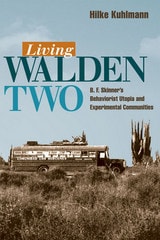
Living Walden Two
B. F. Skinner's Behaviorist Utopia and Experimental CommunitiesHilke Kuhlmann
University of Illinois Press, 2004
In the novel, behavioral engineers use positive reinforcement in organizing and "gently guiding" all aspects of society, leaving the rest of the citizens "free" to lead happy and carefree lives. Among the real-world communities, a recurrent problem in moving past the planning stages was the nearly ubiquitous desire among members to be gentle guides, coupled with strong resistance to being guided.
In an insightful and often hilarious narrative, Hilke Kuhlmann explores the dynamics of the communities, with an in-depth examination of the two surviving Skinnerian communities: Comunidad Los Horcones in Mexico, and Twin Oaks in Virginia. Drawing on extensive interviews with the founders and key players in the Walden Two communities, Kuhlmann redefines the criteria for their success by focusing on the tension between utopian blueprints for a new society and communal experiments' actual effects on individual lives.
Pain and Shock in America
Politics, Advocacy, and the Controversial Treatment of People with DisabilitiesJan Nisbet
Brandeis University Press, 2021
For more than forty years, professionals in the field of disability studies have engaged in debates over the use of aversive interventions (such as electric shock) like the ones used at the Judge Rotenberg Center. Advocates and lawyers have filed complaints and lawsuits to both use them and ban them, scientists have written hundreds of articles for and against them, and people with disabilities have lost their lives and, some would say, lived their lives because of them. There are families who believe deeply in the need to use aversives to control their children’s behavior. There are others who believe the techniques used are torture. All of these families have children who have been excluded from numerous educational and treatment programs because of their behaviors. For most of the families, placement at the Judge Rotenberg Center is the last resort.
This book is a historical case study of the Judge Rotenberg Center, named after the judge who ruled in favor of keeping its doors open to use aversive interventions. It chronicles and analyzes the events and people involved for over forty years that contributed to the inability of the state of Massachusetts to stop the use of electric shock, and other severe forms of punishment on children and adults with disabilities. It is a long story, sad and tragic, complex, filled with intrigue and questions about society and its ability to protect and support its most vulnerable citizens.
Supervision & Management
A Guide to Modifying Work BehaviorMARR JOHN
University of Arkansas Press, 1994