Results by title
2 books match the query 'Behrman, Jere R.'
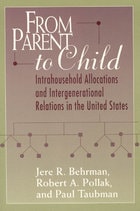
From Parent to Child
Intrahousehold Allocations and Intergenerational Relations in the United StatesJere R. Behrman, Robert A. Pollak, and Paul Taubman
University of Chicago Press, 1995
How do parents allocate human capital among their children? To what extent do parental decisions about resource allocation determine children's eventual economic success?
The analyses in From Parent to Child explore these questions by developing and testing a model in which the earnings of children with different genetic endowments respond differently to investments in human capital. Behrman, Pollak, and Taubman use this model to investigate issues such as parental bias in resource allocations based on gender or birth order; the extent of intergenerational mobility in income, earnings, and schooling in the United States; the relative importance of environmental and genetic factors in determining variations in schooling; and whether parents' distributions offset the intended effects of government programs designed to subsidize children. In allocating scarce resources, parents face a trade-off between equity and efficiency, between the competing desires to equalize the wealth of their children and to maximize the sum of their earnings.
Building on the seminal work of Gary Becker, From Parent to Child integrates careful modeling of household behavior with systematic empirical testing, and will appeal to anyone interested in the economics of the family.
[more]
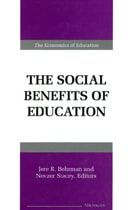
The Social Benefits of Education
Jere R. Behrman and Nevzer Stacey, Editors
University of Michigan Press, 1997
For decades, the primary argument in justifying education has been based on its direct economic effects. Yet education also provides "social benefits" for individuals and society at large, including a better way of taking care of ourselves, and consequently creating a better society to live in. Though it is difficult to quantify these social benefits, a more systematic analysis would improve our understanding of the full effects of education and provide a basis for considering related policies. The Office of Research of the United States Department of Education commissioned a series of papers on measuring these effects of education.
Those papers, revised and updated, are collected here. Kenneth J. Arrow provides perspective on education and preference formation, and Jere R. Behrman considers general conceptual and measurement issues in assessing the social benefits of education and policies related to education. These issues are taken up by experts in four fields--health, parenting, the environment, and crime. Themes addressed include measurement issues regarding what we mean by education and its benefits; basic analytical issues in assessing the impact of education on these social benefits using behavioral data; and whether the social benefits of education justify public policy interventions.
Jere R. Behrman is William R. Kenan Jr. Professor of Economics, University of Pennsylvania. Nevzer G. Stacey is Senior Research Analyst, Office of Educational Research, U.S. Department of Education.
[more]