Results by title
2 books match the query 'Bell, David A.'

Africana Thought, Volume 108
Grant Farred, ed.
Duke University Press, 0
One essay reveals the intricate richness of Africana thought, moving through psychoanalysis, folktales, Western metaphysics, and a critique of the political. Another essay offers a cautionary tale about the prospects for black life in the United States, even in the wake of Barack Obama’s historic political victory. A third essay argues that a “dead zone”—a place where black lives are lost, where hopes are dashed, where history has failed the black subject—exists between the black elite and the disenfranchised black underclass. Still another essay addresses how the discourse about the political has triumphed over everything else in considerations of colonialism and its aftermath and proposes that a turn to culture might offer a new thinking of black futures.
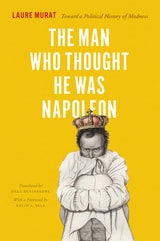
The Man Who Thought He Was Napoleon
Toward a Political History of MadnessLaure Murat
University of Chicago Press, 2014
From those two components, Laure Murat embarks on an exploration of the surprising relationship between history and madness. She uncovers countless stories of patients whose delusions seem to be rooted in the historical or political traumas of their time, like the watchmaker who believed he lived with a new head, his original having been removed at the guillotine. In the troubled wake of the Revolution, meanwhile, French physicians diagnosed a number of mental illnesses tied to current events, from “revolutionary neuroses” and “democratic disease” to the “ambitious monomania” of the Restoration. How, Murat asks, do history and psychiatry, the nation and the individual psyche, interface?
A fascinating history of psychiatry—but of a wholly new sort—The Man Who Thought He Was Napoleon offers the first sustained analysis of the intertwined discourses of madness, psychiatry, history, and political theory.