Results by title
23 books match the query 'Below'
Beijing from Below
Stories of Marginal Lives in the Capital's CenterHarriet Evans
Duke University Press, 2020
Below the Line
Producers and Production Studies in the New Television EconomyVicki Mayer
Duke University Press, 2011
Below the Stars
How the Labor of Working Actors and Extras Shapes Media ProductionBy Kate Fortmueller
University of Texas Press, 2021
Longlisted for the 2022 Kraszna-Krausz Book Award, Moving Image Category
Despite their considerable presence in Hollywood, extras and working actors have received scant attention within film and media studies as significant contributors to the history of the industry. Looking not to the stars but to these supporting players in film, television, and, recently, streaming programming, Below the Stars highlights such actors as precarious laborers whose work as freelancers has critically shaped the entertainment industry throughout the twentieth and twenty-first centuries. By addressing ordinary actors as a labor force, Kate Fortmueller proposes a media industry history that positions underrepresented and quotidian experiences as the structural elements of the culture and business of Hollywood.
Resisting a top-down assessment, Fortmueller explores the wrangling of labor unions and guilds that advocated for collective action for everyday actors and helped shape professional norms. She pulls from archival research, in-person interviews, and firsthand observation to examine a history that cuts across industry boundaries and situates actors as a labor group at the center of industrial and technological upheavals, with lasting implications for race, gender, and labor relations in Hollywood.
Biopolitics from Below
Crisis, Conjuncture, RuptureRanabir Samaddar
Central European University Press, 2025
The current social turmoil enveloping the world has produced knee jerk reactions and a plethora of policy declarations. At the same time, the scenario is marked with response of those with low socioeconomic status to the worldwide chaos and precarious living conditions. In this context, how do we make sense of what is being described variously as a breakdown of democracy, its exhaustion, and the new challenges in the form of an alternative politics of life or a phenomenon that we may term as “biopolitics from below”?
The theme of the book is crisis, conjuncture, and rupture. It relates to the question of correlation of social and political forces in the emergence of certain events, presents certain events as illustrations, and takes a historiographical-analytical route to argue why certain things happen in the way they happen. Usually, crisis is the explanatory factor. This book seeks to go deeper and find out why some crises and not all produce unexpected outcomes. Or, as this book puts it differently, the essential gradient of a crisis is the correlation of forces at a particular time - and thus the question of conjuncture. The book seeks to open up to new adventures in thought, imagining new openings, and creating exits from the situation we find ourselves in.
Citizenship from Below
Erotic Agency and Caribbean FreedomMimi Sheller
Duke University Press, 2012
Attending to the hidden linkages among intimate realms and the public sphere, Sheller explores specific struggles for freedom, including women's political activism in Jamaica; the role of discourses of "manhood" in the making of free subjects, soldiers, and citizens; the fiercely ethnonationalist discourses that excluded South Asian and African indentured workers; the sexual politics of the low-bass beats and "bottoms up" moves in the dancehall; and the struggle for reproductive and LGBT rights and against homophobia in the contemporary Caribbean. Through her creative use of archival sources and emphasis on the connections between intimacy, violence, and citizenship, Sheller enriches critical theories of embodied freedom, sexual citizenship, and erotic agency in all post-slavery societies.
Decentralization and Popular Democracy
Governance from Below in BoliviaJean-Paul Faguet
University of Michigan Press, 2013
Bolivia decentralized in an effort to deepen democracy, improve public services, and make government more accountable. Unlike many countries, Bolivia succeeded. Over the past generation, public investment shifted dramatically toward primary services and resource distribution became far more equitable, partly due to the creation of new local governments. Many municipalities responded to decentralization with transparent, accountable government, yet others suffered ineptitude, corruption, or both. Why? Jean-Paul Faguet combines broad econometric data with deep qualitative evidence to investigate the social underpinnings of governance. He shows how the interaction of civic groups and business interests determines the quality of local decision making.
In order to understand decentralization, Faguet argues, we must understand governance from the ground up. Drawing on his findings, he offers an evaluation of the potential benefits of decentralization and recommendations for structuring successful reform.
Globalization From Below
Transnational Activists And Protest NetworksDonatella della Porta Della Porta
University of Minnesota Press, 2006
Presenting the first systematic empirical research on the global justice movement, Globalization from Below analyzes a movement from the viewpoints of the activists, organizers, and demonstrators themselves. The authors traveled to Genoa with anti-G8 protesters and collected data from more than 800 participants. A year later, they surveyed 2,400 activists at the European Social Forum in Florence. To understand how this cycle of global protest emerged, they examine the interactions between challengers and elites, and discuss how these new models of activism fit into current social movement work.
Globalization from Below places the protests within larger debates, revealing and investigating the forces that led to a clash between demonstrators and the Italian government, which responded with violence.
Donatella della Porta is professor of political science; Massimiliano Andretta is a researcher in political science and sociology; Lorenzo Mosca is a researcher in information and communication technologies; Herbert Reiter is a researcher in history, all at the European University Institute.
Humanitarianism from Below?
Universalism and the Politics of InhumanityEdited by Till Mostowlansky and Elmira Muratova
University College London, 2026
The first global comparative analysis of the role of humanitarianism from below in political and social change.
Drawing on original ethnographic and historical research, Humanitarianism from Below? addresses a wide audience of scholars and students in humanitarian and development studies, anthropology, and political science. Drawing from timely case studies on the war in Ukraine, the Ebola pandemic in West Africa, the 2023 Turkey-Syria earthquakes, and the global flows of aid from Arab states to the Persian Gulf, the book considers humanitarianism’s multiple histories and offers a profound reassessment of humanitarian pluralism today. It critically discusses humanitarianism as a historically, politically, and culturally contingent phenomenon that entails unequal relations of power and multiple forms of universalism, as well as issues of dehumanization and inhumanity.
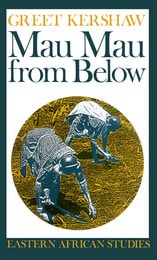
Mau Mau From Below
Eastern African StudiesGreet Kershaw
Ohio University Press, 1996
John Lonsdale says in his introduction:
“This is the oral evidence of the Kikuyu villagers with whom Greet Kershaw lived as an aid worker during the Mau Mau ‘Emergency’ in the 1950s, and which is now totally irrecoverable in any form save in her own field notes.
Professor Kershaw has uncovered long local histories of social tension which could have been revealed by no other means than patient enquiry, of both her neighbour’s memory and government archives…
Nobody, whether Kikuyu participant, Kenyan or European scholar, has provided such startlingly authoritative ethnographic insights into the values, fears and expectations of Kikuyu society and thus of the motivation of Kikuyu action…
Her data suggests, as other scholars have also accepted, that there never was a single such movement and that none of its members, even those who supposed themselves to be its leaders, ever saw it whole, not because they did not have a political aim, but because that agenda was contested within different political circles over which they had no control and of which they may scarcely have had any knowledge.
And why is this finding important? It is because others, including almost all the movement’s enemies, did see Mau Mau whole in order to try to comprehend it, a first step towards defeating it.”
Neoliberalism from Below
Popular Pragmatics and Baroque EconomiesVerónica Gago
Duke University Press, 2017

Planetarity from Below
Decolonial Ecopoetics of Migration and DiasporaEmily Yu Zong
University of Michigan Press, 2026
Through short stories, memoirs, speculative fiction, poetry, and documentary films, Zong unpacks a decolonial migrant ecopoetics, revealing a pluralist method of worldmaking—from Australia’s oceanic refugee camps, Indigenous Canadian land, and Chinese migrant worker sweatshops, to climate futures. These migrant ecologies imagine freedom “from below” not simply as individual survival or assimilation but as an unruly and contingent process of shared creativity with animals, waters, minerals, waste, and technology.
Shifting environmental ethics from individual morality to a political ecology of sustaining life in precarity, Zong introduces decolonial knowledges, imaginations, and praxes that help us expand justice and freedom beyond the human, asking how borderland subjectivities can open new possibilities for multispecies flourishing.
Politics of Writing Studies
Reinventing Our Universities from BelowRobert Samuels
Utah State University Press, 2017
A friendly critique of the field, The Politics of Writing Studies examines a set of recent pivotal texts in composition to show how writing scholarship, in an effort to improve disciplinary prestige and garner institutional resources, inadvertently reproduces structures of inequality within American higher education. Not only does this enable the exploitation of contingent faculty, but it also puts writing studies—a field that inherently challenges many institutional hierarchies—in a debased institutional position and at odds with itself.
Instead of aligning with the dominant paradigm of research universities, where research is privileged over teaching, theory over practice, the sciences over the humanities, and graduate education over undergraduate, writing studies should conceive itself in terms more often associated with labor. By identifying more profoundly as workers, as a collective in solidarity with contingent faculty, writing professionals can achieve solutions to the material problems that the field, in its best moments, wants to address. Ultimately, the change compositionists want to see in the university will not come from high theory or the social science research agenda; it must come from below.
Offering new insight into a complex issue, The Politics of Writing Studies will be of great interest to writing studies professionals, university administrators, and anyone interested in the political economy of education and the reform of institutions of higher education in America.

Sciences from Below
Feminisms, Postcolonialities, and ModernitiesSandra Harding
Duke University Press, 2008
Describing the work of the post-Kuhnian science studies scholars Bruno Latour, Ulrich Beck, and the team of Michael Gibbons, Helga Nowtony, and Peter Scott, Harding reveals how, from different perspectives, they provide useful resources for rethinking the modernity versus tradition binary and its effects on the production of scientific knowledge. Yet, for the most part, they do not take feminist or postcolonial critiques into account. As Harding demonstrates, feminist science studies and postcolonial science studies have vital contributions to make; they bring to light not only the male supremacist investments in the Western conception of modernity and the historical and epistemological bases of Western science but also the empirical knowledge traditions of the global South. Sciences from Below is a clear and compelling argument that modernity studies and post-Kuhnian, feminist, and postcolonial sciences studies each have something important, and necessary, to offer to those formulating socially progressive scientific research and policy.

Seeing Like a Smuggler
Borders from BelowMahmoud Keshavarz and Shahram Khosravi
Pluto Press, 2022
Stories of smuggling as acts of resistance and decolonization.
'This conceptually vivid book refreshes our vision' - Ruth Wilson Gilmore
The word smuggler often unleashes a simplified, negative image painted by the media and the authorities. Such state-centric perspectives hide many social, political, and economic relations generated by smuggling. This book looks at the practice through the eyes of the smugglers, revealing how their work can be productive, subversive, and deeply sociopolitical.
By tracing the illegalized movement of people and goods across borders, Seeing Like a Smuggler shows smuggling as a contradiction within the nation-state system, and in a dialectical relation with the national order of things. It raises questions about how smuggling engages and unsettles the ethics, materialities, visualities, histories, and the colonial power relations that form borders and bordering.
Covering a wide spectrum of approaches from personal reflections and ethnographies to historical accounts, cultural analysis, and visual essays, the book spans the globe from Colombia to Ethiopia, Singapore to Guatemala, Afghanistan to Zimbabwe, and from Kurdistan to Bangladesh, to show how people deal with global inequalities and the restrictions of poverty and immobility.
Sub(e)merging
Experiences, Practices and Politics from BelowEdited by Marie Sophie Beckmann and Petra Löffler
Diaphanes, 2025
Whether it is the ocean, the ground, or soil, a metaphorical or symbolic underworld, or a political figure of thought, the subsurface intervenes in recent debates about ecological, social, and postcolonial conflicts and power inequalities in the humanities and beyond. However, turning to the unstable grounds of the subterranean always involves a conceptual or methodological movement and a practice of submersion, and thus a critical reflection on the conditions, technologies, aesthetics, and politics of knowledge production.
It is precisely at this point that this volume picks up with approaches from the fields of artistic practice as well as media studies, art history, queer theory, and decolonial studies. From this transdisciplinary perspective, this anthology explores the medial, aesthetic, and material aspects of sub(e)merging, as well as its potential as a resistant practice and figure of thought: from submerging to emerging.
The City on the Hill From Below
The Crisis of Prophetic Black PoliticsAuthored by Stephen Marshall
Temple University Press, 2012
Within the discipline of American political science and the field of political theory, African American prophetic political critique as a form of political theorizing has been largely neglected. Stephen Marshall, in The City on the Hill from Below, interrogates the political thought of David Walker, Frederick Douglass, W. E. B. DuBois, James Baldwin, and Toni Morrison to reveal a vital tradition of American political theorizing and engagement with an American political imaginary forged by the City on the Hill.
Originally articulated to describe colonial settlement, state formation, and national consolidation, the image of the City on the Hill has been transformed into one richly suited to assessing and transforming American political evil. The City on the Hill from Below shows how African American political thinkers appropriated and revised languages of biblical prophecy and American republicanism.
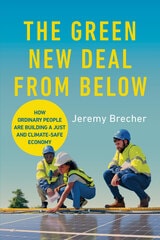
The Green New Deal from Below
How Ordinary People Are Building a Just and Climate-Safe EconomyJeremy Brecher
University of Illinois Press, 2024
A visionary program for national renewal, the Green New Deal aims to protect the earth’s climate while creating good jobs, reducing injustice, and eliminating poverty. Its core principle is to use the necessity for climate protection as a basis for realizing full employment and social justice.
Jeremy Brecher goes beyond the national headlines and introduces readers to the community, municipal, county, state, tribal, and industry efforts advancing the Green New Deal across the United States. Brecher illustrates how such programs from below do the valuable work of building constituencies and providing proofs of concept for new ideas and initiatives. Block by block, these activities have come together to form a Green New Deal built on a strong foundation of small-scale movements and grassroots energy.
A call for hope and a better tomorrow, The Green New Deal from Below offers a blueprint for reconstructing society on new principles to avoid catastrophic climate change.
The People beside Paul
The Philippian Assembly and History from BelowJoseph A. Marchal
SBL Press, 2015
Who are the people beside Paul, and what can we know about them?
This volume brings together an international and interdisciplinary group of scholars with a broad range of expertise and a common interest: Philippi in antiquity. Each essay engages one set of contextual particularities for Paul and the ordinary people of the Philippian assembly, while simultaneously placing them in wider settings. This 'people's history' uses both traditional and more cutting-edge methods to reconsider archaeology and architecture, economy and ethnicity, prisons and priestesses, slavery, syncretism, stereotypes of Jews, the colony of Philippi, and a range of communities. The contributors are Valerie Abrahamsen, Richard S. Ascough, Robert L. Brawley, Noelle Damico, Richard A. Horsley, Joseph A. Marchal, Mark D. Nanos, Peter Oakes, Gerardo Reyes Chavez, Angela Standhartinger, Eduard Verhoef, and Antoinette Clark Wire.
Features
- An examination of the social forms and forces that shaped and affected the Philippian church
- Essays offer insight into standard questions about the letter s hymn and audience, Paul's 'opponents,' and the sites of the community and of Paul's imprisonment
- A focused exploration of more marginalized topics and groups, including women, slaves, Jews, and members of localized cults

The Servant's Hand
English Fiction from BelowBruce W. Robbins
Duke University Press, 1993
The Solutions are Already Here
Strategies of Ecological Revolution from BelowPeter Gelderloos
Pluto Press, 2022
Across the world, grassroots networks of local communities are working to realize their visions of an alternative revolutionary response to planetary destruction, often pitted against the new megaprojects promoted by greenwashed alternative energy infrastructures and the neocolonialist, technocratic policies that are the forerunners of the Green New Deal.
Gelderloos interviews food sovereignty activists in Venezuela, Indigenous communities reforesting their lands in Brazil and anarchists fighting biofuel plantations in Indonesia, looking at the battles that have cancelled airports, stopped pipelines, and helped the most marginalized to fight borders and environmental racism, to transform their cities, to win a dignified survival.
Urban Latin America
The Political Condition from Above and BelowBy Alejandro Portes and John Walton
University of Texas Press, 1976
Much research on the city in developing societies has focused mainly on one of three areas—planning, demography, or economics—and has emphasized either power elites or the masses, but not both. The published literature on Latin America has reflected these interests and has so far failed to provide a comprehensive view of Latin American urbanization. Urban Latin America is an attempt to integrate research on Latin American social organization within a single theoretical framework: development as fundamentally a political problem. Alejandro Portes and John Walton have included material on both elites and marginal populations and on the three major areas of research in order to formulate and address some of the key questions about the structure of urban politics in Latin America.
Following an introduction that delineates the scope of Latin American urban studies, Portes discusses the Latin American city as a creation of European colonialism. He goes on to examine political behavior among the poor, with central reference to system support and countersystem potential. Walton provides material for a comparative study of four cities: Monterrey and Guadalajara in Mexico and Medellín and Cali in Colombia. He also summarizes a large number of urban elite studies and develops a theoretical interpretation of their collective results, based on class structure and vertical integration. Material in each chapter is cross-referenced to other chapters, and the authors have used a common methodological approach in synthesizing and interpreting the research literature. In the final chapter they generalize current findings, elaborating on the interface between elite and mass politics in the urban situation. They make some observations on approaching changes and pinpoint possible research strategies for the future.
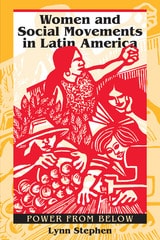
Women and Social Movements in Latin America
Power from BelowBy Lynn Stephen
University of Texas Press, 1997
Women's grassroots activism in Latin America combines a commitment to basic survival for women and their children with a challenge to women's subordination to men. Women activists insist that issues such as rape, battering, and reproductive control cannot be divorced from women's concerns about housing, food, land, and medical care.
This innovative, comparative study explores six cases of women's grassroots activism in Mexico, El Salvador, Brazil, and Chile. Lynn Stephen communicates the ideas, experiences, and perceptions of women who participate in collective action, while she explains the structural conditions and ideological discourses that set the context within which women act and interpret their experiences. She includes revealing interviews with activists, detailed histories of organizations and movements, and a theoretical discussion of gender, collective identity, and feminist anthropology and methods.