Results by title
3 books match the query 'Belting, Hans'
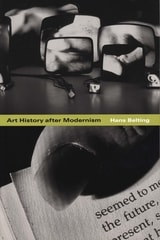
Art History after Modernism
Hans Belting
University of Chicago Press, 2003
"Art history after modernism" does not only mean that art looks different today; it also means that our discourse on art has taken a different direction, if it is safe to say it has taken a direction at all.
So begins Hans Belting's brilliant, iconoclastic reconsideration of art and art history at the end of the millennium, which builds upon his earlier and highly successful volume, The End of the History of Art?. "Known for his striking and original theories about the nature of art," according to the Economist, Belting here examines how art is made, viewed, and interpreted today. Arguing that contemporary art has burst out of the frame that art history had built for it, Belting calls for an entirely new approach to thinking and writing about art. He moves effortlessly between contemporary issues—the rise of global and minority art and its consequences for Western art history, installation and video art, and the troubled institution of the art museum—and questions central to art history's definition of itself, such as the distinction between high and low culture, art criticism versus art history, and the invention of modernism in art history. Forty-eight black and white images illustrate the text, perfectly reflecting the state of contemporary art.
With Art History after Modernism, Belting retains his place as one of the most original thinkers working in the visual arts today.
[more]
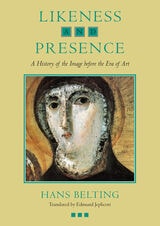
Likeness and Presence
A History of the Image before the Era of ArtHans Belting
University of Chicago Press, 1993
Before the Renaissance and Reformation, holy images were treated not as "art" but as objects of veneration which possessed the tangible presence of the Holy. In this magisterial book, Hans Belting traces the long history of the sacral image and its changing role in European culture.
Likeness and Presence looks at the beliefs, superstitions, hopes, and fears that come into play as people handle and respond to sacred
images, and presents a compelling interpretation of the place of the image in Western history.
"A rarity within its genre—an art-historical analysis of iconography which is itself iconoclastic. . . . One of the most intellectually exciting and historically grounded interpretations of Christian iconography." —Graham Howes, Times Literary Supplement
"Likeness and Presence offers the best source to survey the facts of what European Christians put in their churches. . . . An impressively detailed contextual analysis of medieval objects." —Robin Cormack, New York Times Book Review
"I cannot begin to describe the richness or the imaginative grandeur of Hans Belting's book. . . . It is a work that anyone interested in art, or in the history of thought about art, should regard as urgent reading. It is a tremendous achievement."—Arthur C. Danto, New Republic
[more]
The Invisible Masterpiece
Hans Belting
University of Chicago Press, 2001
The "invisible masterpiece" is an unattainable ideal, a work of art into which a dream of absolute art is incorporated but can never be realized. Using this metaphor borrowed from Balzac, Hans Belting explores the history of "the masterpiece" and how its status and meaning have been elevated and denigrated since the early nineteenth century. Before 1800, works of art were either imitative (portraits and landscapes) or narrative (history painting). But under the influence of Romantic modernity, the physical object—a painted canvas, for example, or a sculpture—came to be seen as visible testimony of the artist's attempt to achieve absolute or ultimate art; in short, the impossible. This revolution in interpretation coincided with the establishment of the first public art museums, in which classical and Renaissance works were presented as the "real" masterpieces, timeless art of such quality that no modern artist could possibly hope to achieve. The Mona Lisa and other celebrated paintings preoccupied artists who felt burdened by this cult of the masterpiece as it came to be institutionalized.
Belting explores and explains how twentieth-century artists, following Duchamp, struggled with their personal dreams of absolute art. It was not until the 1960s that artists, such as Warhol, finally began to reject the idea of the individual, totemic work of art and its permanent exhibition, as well as the related concept of the "masterpiece" and the outmoded art market that fed off it.
Belting explores and explains how twentieth-century artists, following Duchamp, struggled with their personal dreams of absolute art. It was not until the 1960s that artists, such as Warhol, finally began to reject the idea of the individual, totemic work of art and its permanent exhibition, as well as the related concept of the "masterpiece" and the outmoded art market that fed off it.
[more]