Results by title

8 books match the query 'Benefits'
cover of Assets for the Poor: The Benefits of Spreading Asset Ownership

Assets for the Poor

The Benefits of Spreading Asset Ownership

Thomas M. Shapiro

Russell Sage Foundation, 2001
Over the past three decades, average household wealth in the United States has declined among all but the richest families, with a near 80 percent drop among the nation's poorest families. Although the national debate about inequality has focused on income, it is wealth—the private assets amassed and passed on within families—that provides the extra economic cushion needed to move beyond mere day-to-day survival. Assets for the Poor is the first full-scale investigation into the importance of family wealth and the need for policies to encourage asset-building among the poor. Assets for the Poor shows how institutional mechanisms designed to encourage acquisition of capital and property favor middle-class and high-income families. For example, the aggregate value of home mortgage tax deductions far outweighs the dollar amount of the subsidies provided by Section 8 rental vouchers and public housing. Banking definitions of creditworthiness largely exclude minorities, and welfare rules have made it nearly impossible for single mothers to accumulate savings, let alone stocks or real estate. Due to persistent residential segregation, even those minority families who do own homes are often denied equal access to better schools and public services. The research in this volume shows that the poor do make use of the assets they have. Cash gifts—although small in size—are frequent within families and often lead to such positive results as homebuying and debt reduction, while tangible assets such as tools and cars help increase employment prospects. Assets for the Poor examines policies such as Individual Development Account tax subsidies to reward financial savings among the poor, and more liberal credit rules to make borrowing easier and less costly. The contributors also offer thoughtful advice for bringing the poor into mainstream savings institutions and warn against developing asset building policies at the expense of existing safety net programs. Asset-building for low-income families is a powerful idea that offers hope to families searching for a way out of poverty. Assets for the Poor challenges current thinking regarding poverty reduction policies and proposes a major shift in the way we think about families and how they make a better life. A Volume in the Ford Foundation Series on Asset Building
[more]
cover of Do Prisons Make Us Safer?: The Benefits and Costs of the Prison Boom

Do Prisons Make Us Safer?

The Benefits and Costs of the Prison Boom

Steven Raphael

Russell Sage Foundation, 2009
The number of people incarcerated in U.S. prisons and jails more than quadrupled between 1975 and 2005, reaching the unprecedented level of over two million inmates today. Annual corrections spending now exceeds 64 billion dollars, and many of the social and economic burdens resulting from mass incarceration fall disproportionately on minority communities. Yet crime rates across the country have also dropped considerably during this time period. In Do Prisons Make Us Safer? leading experts systematically examine the complex repercussions of the massive surge in our nation's prison system. Do Prisons Make Us Safer? asks whether it makes sense to maintain such a large and costly prison system. The contributors expand the scope of previous analyses to include a number of underexplored dimensions, such as the fiscal impact on states, effects on children, and employment prospects for former inmates. Steven Raphael and Michael Stoll assess the reasons behind the explosion in incarceration rates and find that criminal behavior itself accounts for only a small fraction of the prison boom. Eighty-five percent of the trend can be attributed to "get tough on crime" policies that have increased both the likelihood of a prison sentence and the length of time served. Shawn Bushway shows that while prison time effectively deters and incapacitates criminals in the short term, long-term benefits such as overall crime reduction or individual rehabilitation are less clear cut. Amy Lerman conducts a novel investigation into the effects of imprisonment on criminal psychology and uncovers striking evidence that placement in a high security penitentiary leads to increased rates of violence and anger—particularly in the case of first time or minor offenders. Rucker Johnson documents the spill-over effects of parental incarceration—children who have had a parent serve prison time exhibit more behavioral problems than their peers. Policies to enhance the well-being of these children are essential to breaking a devastating cycle of poverty, unemployment, and crime. John Donohue's economic calculations suggest that alternative social welfare policies such as education and employment programs for at-risk youth may lower crime just as effectively as prisons, but at a much lower human cost. The cost of hiring a new teacher is roughly equal to the cost of incarcerating an additional inmate. The United States currently imprisons a greater proportion of its citizens than any other nation in the world. Until now, however, we've lacked systematic and comprehensive data on how this prison boom has affected families, communities, and our nation as a whole. Do Prisons Make Us Safer? provides a highly nuanced and deeply engaging account of one of the most dramatic policy developments in recent U.S. history.
[more]
cover of Greening China: The Benefits of Trade and Foreign Direct Investment

Greening China

The Benefits of Trade and Foreign Direct Investment

Ka Zeng and Joshua Eastin

University of Michigan Press, 2011

“The authors make some very critical interventions in this debate and scholars engaged in the environmental ‘pollution haven’ and ‘race to the bottom’ debates will need to take the arguments made here seriously, re-evaluating their own preferred theories to respond to the insightful theorizing and empirically rigorous testing that Zeng and Eastin present in the book.”
—Ronald Mitchell, University of Oregon
China has earned a reputation for lax environmental standards that allegedly attract corporations more interested in profit than in moral responsibility and, consequently, further negate incentives to raise environmental standards. Surprisingly, Ka Zeng and Joshua Eastin find that international economic integration with nation-states that have stringent environmental regulations facilitates the diffusion of corporate environmental norms and standards to Chinese provinces. At the same time, concerns about “green” tariffs imposed by importing countries encourage Chinese export-oriented firms to ratchet up their own environmental standards. The authors present systematic quantitative and qualitative analyses and data that not only demonstrate the ways in which external market pressure influences domestic environmental policy but also lend credence to arguments for the ameliorative effect of trade and foreign direct investment on the global environment.
[more]
cover of On Benefits

On Benefits

Lucius Annaeus Seneca

University of Chicago Press, 2011

Lucius Annaeus Seneca (4 BCE–65 CE) was a Roman Stoic philosopher, dramatist, statesman, and advisor to the emperor Nero, all during the Silver Age of Latin literature. The Complete Works of Lucius Annaeus Seneca is a fresh and compelling series of new English-language translations of his works in seven accessible volumes. Edited by world-renowned classicists Elizabeth Asmis, Shadi Bartsch, and Martha C. Nussbaum, this engaging collection restores Seneca—whose works have been highly praised by modern authors from Desiderius Erasmus to Ralph Waldo Emerson—to his rightful place among the classical writers most widely studied in the humanities.

On Benefits, written between 56 and 64 CE, is a treatise addressed to Seneca’s close friend Aebutius Liberalis. The longest of Seneca’s works dealing with a single subject—how to give and receive benefits and how to express gratitude appropriately—On Benefits is the only complete work on what we now call “gift exchange” to survive from antiquity. Benefits were of great personal significance to Seneca, who remarked in one of his later letters that philosophy teaches, above all else, to owe and repay benefits well.
[more]
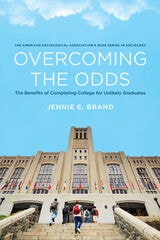
cover of Overcoming the Odds: The Benefits of Completing College for Unlikely Graduates

Overcoming the Odds

The Benefits of Completing College for Unlikely Graduates

Jennie E. Brand

Russell Sage Foundation, 2023

Each year, millions of high school students consider whether to continue their schooling and attend and complete college. Despite evidence showing that a college degree yields far-reaching benefits, critics of higher education increasingly argue that college “does not pay off” and some students - namely, disadvantaged prospective college goers - would be better served by forgoing higher education. But debates about the value of college often fail to carefully consider what is required to speak knowledgeably about the benefits –what a person’s life might look like had they not completed college, or their college counterfactual. In Overcoming the Odds sociologist Jennie E. Brand reveals the benefits of completing college by comparing life outcomes of college graduates with their college counterfactuals.  
 
Drawing on two cohorts of nationally representative data from the Bureau of Labor Statistics National Longitudinal Surveys program, Brand uses matching and machine learning methods to estimate the effects of college completion across students with varying likelihoods of completing four-year degrees. To illustrate her findings, Brand describes outcomes using matched vignettes of college and non-college graduates. Brand shows that four-year college completion enables graduates to increase wages and household income, while also circumventing unemployment, low-wage work, job instability, poverty, and social assistance. Completing college also increases civic engagement. Most of these benefits are larger for disadvantaged than for more advantaged students, rendering arguments that college has limited benefits for unlikely graduates as flawed. Brand concludes that greater long-term earnings, and less job instability and unemployment, and thus more tax revenue, less reliance on public assistance, and high levels of volunteering indicate that public investment in higher education for students from disadvantaged backgrounds yields far-reaching collective benefits. She asserts that it is better for our society when more people complete college.
 
Overcoming the Odds is an innovative and enlightening exploration of how college can transform lives.



[more]
cover of Perceptions of Technological Risks and Benefits

Perceptions of Technological Risks and Benefits

Leroy C. Gould

Russell Sage Foundation, 1988

The election of Ronald Reagan in 1980 was said to herald a new mood of opposition to government regulation. But at the same time, large and vocal segments of the population have been demanding that corporations and regulatory agencies address public concerns about technological safety. What do we really know about people's perceptions of technological risk and their judgments about appropriate levels of technological regulation? Perceptions of Technological Risks and Benefits analyzes the results of a unique body of survey data—the only large-scale, representative survey of public attitudes about risk management in such technologies as nuclear power, handguns, auto travel, and industrial chemicals. The findings demonstrate that public judgments are not simply anti-technological or irrational, but rather the product of a complex set of factors that includes an awareness of benefits as well as a sensitivity to the "qualitative" aspects of risk (how catastrophic, dreaded, or poorly understood a hazard seems to be). This volume offers striking evidence that whatever Americans may think about government regulation in general, they are remarkably consistent in desiring stricter regulation of technological safety. These conclusions suggest that the current trend away from regulation of technology reflects a less than perfect reading of public sentiment.
[more]
cover of Special Needs, Special Horses: A Guide to the Benefits of Therapeutic Riding

Special Needs, Special Horses

A Guide to the Benefits of Therapeutic Riding

Naomi Scott

University of North Texas Press, 2005
[more]
cover of The Costs and Benefits of Price Stability

The Costs and Benefits of Price Stability

Edited by Martin Feldstein

University of Chicago Press, 1999

In recent years, the Federal Reserve and central banks worldwide have enjoyed remarkable success in their battle against inflation. The challenge now confronting the Fed and its counterparts is how to proceed in this newly benign economic environment: Should monetary policy seek to maintain a rate of low-level inflation or eliminate inflation altogether in an effort to attain full price stability?

In a seminal article published in 1997, Martin Feldstein developed a framework for calculating the gains in economic welfare that might result from a move from a low level of inflation to full price stability. The present volume extends that analysis, focusing on the likely costs and benefits of achieving price stability not only in the United States, but in Germany, Spain, and the United Kingdom as well. The results show that even small changes in already low inflation rates can have a substantial impact on the economic performance of different countries, and that variations in national tax rules can affect the level of gain from disinflation.

[more]