Results by title

5 books match the query 'Benelux Countries (Belgium, Netherlands, Luxembourg)'
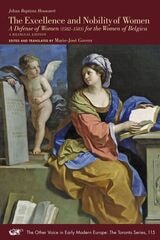
cover of On the Excellence and Nobility of Women: A Defense of Women (1582–1583) for the Women of Belgica. A Bilingual Edition

On the Excellence and Nobility of Women

A Defense of Women (1582–1583) for the Women of Belgica. A Bilingual Edition

Jehan Baptista Houwaert

Iter Press, 2025

The first published defense of women by a Netherlandish author.

Jehan Baptista Houwaert’s Excellence and Nobility of Women constitutes the eighth book of his Plain of the Nine Muses, or The Pleasure Garden of Virtuous Women (1582–1583), an immense conduct book for women in rhymed verse based on the many querelle texts of the French and Burgundian tradition but especially, in its French translation, on the pathbreaking Declamation on the Nobility and Preeminence of the Female Sex (1529) by Henricus Cornelius Agrippa von Nettesheim. 

Like its model, Houwaert’s work asserts not merely the equality but the superiority of women. It is unique in that it is addressed not to a wealthy noblewoman or princess, as were most such defenses, but more democratically to the “girls, unmarried women, wives, and widows of Belgica”—all of them!

 
[more]
cover of Paul Hymans: Belgium

Paul Hymans

Belgium

Sally Marks

Haus Publishing, 2010

Paul Hymans was the champion of the small states in the League of Nations Commission at the Paris Peace Conference and was rewarded by becoming the League's first president. He thereby brought about Belgium's transition from the status of sheltered child to full participation in much great-power diplomacy.
[more]
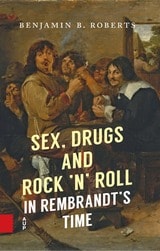
cover of Sex, Drugs and Rock ’n’ Roll in Rembrandt’s Time

Sex, Drugs and Rock ’n’ Roll in Rembrandt’s Time

Benjamin B. Roberts

Amsterdam University Press, 2024

Sex, Drugs and Rock 'n' Roll in Rembrandt’s Time focuses on the generation of rich young men that grew up in the seventeenth century in the Dutch Republic. These men had more money to spend on clothes, music, and recreation than the generation before them. This fascinating account of male adolescence in the Dutch Republic reveals how young men including Rembrandt van Rijn disregarded conservative values and rebelled against the older generation, and consequently created a new youth culture that was similar to the one of the 1960s. They had long hair, wore colorful and extravagant clothing, and started taking drugs. Theirs was the first generation in European history to smoke tobacco. Moreover, they defied conventional norms and values with their promiscuity and by singing lewd songs in their free time.

With his engaging storytelling-style filled with humorous anecdotes, Roberts convincingly shows how deviant male youth behavior is a feature of all ages, especially in periods when youngsters have too much free time and money.
[more]
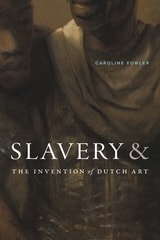
cover of Slavery and the Invention of Dutch Art

Slavery and the Invention of Dutch Art

Caroline Fowler

Duke University Press, 2025

In Slavery and the Invention of Dutch Art, Caroline Fowler examines the fundamental role of the transatlantic slave trade in the production and evolution of seventeenth-century Dutch art. Whereas the sixteenth-century image debates in Europe engaged with crises around the representation of divinity, Fowler argues that the rise of the transatlantic slave trade created a visual field of uncertainty around picturing the transformation of life into property. Fowler demonstrates how the emergence of landscape, maritime, and botanical painting were deeply intertwined with slavery’s economic expansion. Moreover, she considers how the development of one of the first art markets was inextricable from the trade in human lives as chattel property. Reading seventeenth-century legal theory, natural history, inventories, and political pamphlets alongside contemporary poetry, theory, and philosophy from Black feminism and the African diaspora, Fowler demonstrates that ideas about property, personhood, and citizenship were central to the oeuvres of artists such as Rembrandt van Rijn, Hercules Segers, Frans Post, Johannes Vermeer, and Maria Sibylla Merian and therefore inescapably within slavery’s grasp.
[more]
cover of The Assassination of Theo van Gogh: From Social Drama to Cultural Trauma

The Assassination of Theo van Gogh

From Social Drama to Cultural Trauma

Ron Eyerman

Duke University Press, 2008

In November 2004, the controversial Dutch filmmaker Theo van Gogh was killed on a busy street in Amsterdam. A twenty-six-year-old Dutch citizen of Moroccan descent shot van Gogh, slit his throat, and pinned a five-page indictment of Western society to his body. The murder set off a series of reactions, including arson against Muslim schools and mosques. In The Assassination of Theo van Gogh, Ron Eyerman explores the multiple meanings of the murder and the different reactions it elicited: among the Amsterdam-based artistic and intellectual subculture, the wider Dutch public, the local and international Muslim communities, the radical Islamic movement, and the broader international community. After meticulously analyzing the actions and reputations of van Gogh and others in his milieu, the motives of the murderer, and the details of the assassination itself, Eyerman considers the various narrative frames the mass media used to characterize the killing.

Eyerman utilizes theories of social drama and cultural trauma to evaluate the reactions to and effects of the murder. A social drama is triggered by a public transgression of taken-for-granted norms; one that threatens the collective identity of a society may develop into a cultural trauma. Eyerman contends that the assassination of Theo van Gogh quickly became a cultural trauma because it resonated powerfully with the postwar psyche of the Netherlands. As part of his analysis of the murder and reactions to it, he discusses significant aspects of twentieth-century Dutch history, including the country’s treatment of Jews during the German occupation, the loss of its colonies in the wake of World War II, its recruitment of immigrant workers, and the failure of Dutch troops to protect Muslims in Srebrenica in 1995.

[more]