Results by title
6 books match the query 'Benjamin'
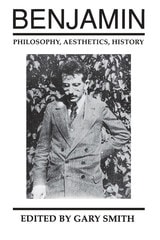
Benjamin
Philosophy, Aesthetics, HistoryEdited by Gary Smith
University of Chicago Press, 1989
A balance of original work by Benjamin and important commentary on his works, this volume includes the crucial chapter from Benjamin's magnum opus The Arcades Project, his "Program of the Coming Philosophy," and "Central Park," as well as essays by leading scholars (including Theodor W. Adorno, Leo Lowenthal, and Rolf Tiedemann) that treat single philosophical themes and relate his ideas to those of other thinkers such as Gadamer, Goodmann, and Rosenzweig. Gary Smith's introduction to the volume provides an extremely useful and sophisticated entrée for readers unaccustomed to the breadth of Benjamin's philosophical allusions, as well as an informative summation of the contents of the volume. This book will be of interest to philosophers, literary theorists, art historians, anthropologists, and other social scientists.

Icons of the Left
Benjamin and Eisenstein, Picasso and Kafka after the Fall of CommunismOtto Karl Werckmeister
University of Chicago Press, 1999
Focusing on some of the most celebrated instances of traditional "Western Marxism," Werckmeister shows how such "icons of the Left" have been progressively detached from their political roots in communist activism to the safe distance of utopian or revolutionary speculations. He assesses some recent critiques of "Western Marxism" in popular culture such as Soderbergh's film Kafka, pointing out the historic fallacies that underlie such wholesale repudiations. With this analysis, Werckmeister seeks to clear the ground for a coherent cultural policy of the Left that responds to the continuing crisis of society.
Saul, Benjamin, and the Emergence of Monarchy in Israel
Biblical and Archaeological PerspectivesJoachim J. Krause
SBL Press, 2020
Ponder questions of the united monarchy under Saul and David in light of current historical and archaeological evidence
Reconstructing the emergence of the Israelite monarchy involves interpreting historical research, approaching questions of ancient state formation, synthesizing archaeological research from sites in the southern Levant, and reexamining the biblical traditions of the early monarchy embedded in the books of Samuel and Kings. Integrating these approaches allows for a nuanced and differentiated picture of one of the most crucial periods in the history of ancient Israel. Rather than attempting to harmonize archaeological data and biblical texts or to supplement the respective approach by integrating only a portion of data stemming from the other, both perspectives come into their own in this volume presenting the results of an interdisciplinary Tübingen–Tel Aviv Research Colloquium.
Features:
- Essays on Israel's monarchy by experts in biblical archaeology and biblical studies
- Methods for integrating archaeology and biblical traditions in reconstructing ancient Israel's history
- New research on the sociopolitical process of state formation in Israel and Judah
Shelley with Benjamin
A Critical MosaicMathelinda Nabugodi
University College London, 2023
Shelley with Benjamin is an experiment in comparative reading. Born a century apart, Percy Bysshe Shelley and Walter Benjamin are separated by time, language, temperament, and genre. One is a Romantic poet known for his revolutionary politics and delicate lyricism, and the other is a melancholy intellectual who pioneered a dialectical method of thinking in constellations. Yet, taken together, their ideas are mutually illuminating.
In a series of close readings that are by turns playful, erotic, and violent, Mathelinda Nabugodi unveils affinities between two writers whose works are simultaneously interventions in literary history and blueprints for an emancipated future. In addition to offering fresh interpretations of both major and minor writings, she elucidates the personal and ethical stakes of literary criticism. The book will appeal to readers of Shelley and Benjamin as well as those with an interest in comparative literature, literary theory, romantic poetics, and creative critical writing.

Street Scenes
Brecht, Benjamin and BerlinNicolas Whybrow
Intellect Books, 2004
Bertolt Brecht, meanwhile, stands as one of the principal thinkers about art and politics in the 20th century. The "Street Scene" model, which was the foundation for his theory of an epic theatre, relied precisely on establishing a connection between art's functioning and everyday life. His preoccupation with the ceaselessness of change, an impulse implying rupture and movement as the key characteristics informing the development of a democratic cultural identity, correlates resonantly with the notion of an ever-evolving city.
Premised on an understanding of performance as the articulation of movement in space, Street Scenes interrogates what kind of "life" is permitted to "flow" in the "new Berlin." Central to this method is the flaneur figure, a walker of streets who provides detached observations on the revealing "detritus of modern urban existence." Walter Benjamin, himself a native of Berlin as well as friend and seminal critic of Brecht, exercised the practice in exemplary form in his portrait of the city One-Way Street.
Street Scenes offers various points of entry for the reader, including those interested in: theatre, performance, visual art, architecture, theories of everyday life and culture, and the politics of identity. Ultimately, it is an interdisciplinary book, which strives to establish the 'porosity' of areas of theory and practice rather than hard boundaries.
The Saving Line
Benjamin, Adorno, and the Caesuras of HopeMárton Dornbach
Northwestern University Press, 2021
Walter Benjamin and Theodor Adorno both turned to canonical literary narratives to determine why the Enlightenment project was derailed and how this failure might be remedied. The resultant works, Benjamin’s major essay on Goethe’s Elective Affinities and Adorno’s meditation on the Odyssey in Dialectic of Enlightenment, are centrally concerned with the very act of narration. Márton Dornbach’s groundbreaking book reconstructs a hitherto unnoticed, wide-ranging dialogue between these foundational texts of the Frankfurt School.
At the heart of Dornbach’s argument is a critical model that Benjamin built around the concept of caesura, a model Adorno subsequently reworked. Countering an obscurantism that would become complicit in the rise of fascism, the two theorists aligned moments of arrest in narratives mired in unreason. Although this model responded to a specific historical emergency, it can be adapted to identify utopian impulses in a variety of works.
The Saving Line throws fresh light on the intellectual exchange and disagreements between Benjamin and Adorno, the problematic conjunction of secular reason and negative theology in their thinking, and their appropriations of ancient and modern legacies. It will interest scholars of philosophy and literature, critical theory, German Jewish thought, classical reception studies, and narratology.