Results by title
7 books match the query 'Bentham, Jeremy'
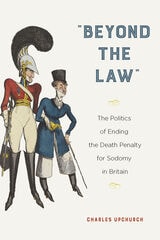
"Beyond the Law"
The Politics of Ending the Death Penalty for Sodomy in BritainCharles Upchurch
Temple University Press, 2021
In nineteenth-century England, sodomy was punishable by death; even an accusation could damage a man’s reputation for life. The last executions for this private, consensual act were in 1835, but the effort to change the law that allowed for those executions was intense and precarious, and not successful until 1861. In this groundbreaking book, “Beyond the Law,” noted historian Charles Upchurch pieces together fragments from history and uses a queer history methodology to recount the untold story of the political process through which the law allowing for the death penalty for sodomy was almost ended in 1841.
Upchurch recounts the legal and political efforts of reformers like Jeremy Bentham and Lord John Russell—the latter of whom argued that the death penalty for sodomy was “beyond the law and above the law.” He also reveals that a same-sex relationship linked the families of the two men responsible for co-sponsoring the key legislation. By recovering the various ethical, religious, and humanitarian arguments against punishing sodomy, “Beyond the Law” overturns longstanding assumptions of nineteenth-century British history. Upchurch demonstrates that social change came from an amalgam of reformist momentum, family affection, elitist politics, class privilege, enlightenment philosophy, and personal desires.
Correspondence of Jeremy Bentham Volume 5
January 1794 to December 1797Jeremy Bentham, edited by Alexander Taylor Milne, and series edited by J.H. Burns
University College London, 2017
Correspondence of Jeremy Bentham, Volume 1
1752 to 1776Jeremy Bentham, edited by Timothy L. S. Sprigge, and series edited by J.H. Burns
University College London, 2017
Correspondence of Jeremy Bentham, Volume 2
1777 to 1780Jeremy Bentham, edited by Timothy L. S. Sprigge, and series edited by J.H. Burns
University College London, 2017
Correspondence of Jeremy Bentham, Volume 3
January 1781 to October 1788Jeremy Bentham, edited by Ian R. Christie, and series edited by J.H. Burns
University College London, 2017
Correspondence of Jeremy Bentham, Volume 4
October 1788 to December 1793Jeremy Bentham, edited by Alexander Taylor Milne, and general editor John R. Dinwiddy
University College London, 2017
Imagining Interest in Political Thought
Origins of Economic RationalityStephen G. Engelmann
Duke University Press, 2003
Tracing the development of monistic interest from its origins in Reformation political theory and theology through late-twentieth-century neoliberalism, Engelmann reconceptualizes the history of liberalism as consisting of phases in the history of monistic interest or economic government. He describes how monistic interest, as formulated by Bentham, is made up of the individual’s imagined expectations, which are constructed by the very regime that maximizes them. He asserts that this construction of interests is not the work of a self-serving manipulative state. Rather, the state, which is itself subject to strict economic regulation, is only one cluster of myriad "public" and "private" agencies that produce and coordinate expectations. In place of a liberal vision in which government appears only as a protector of the free pursuit of interest, Engelmann posits that the free pursuit of interest is itself a mode of government, one that deploys individual imagination and choice as its agents.