Results by title
2 books match the query 'Berkeley, George'
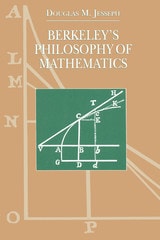
Berkeley's Philosophy of Mathematics
Douglas M. Jesseph
University of Chicago Press, 1993
Jesseph begins with Berkeley's radical opposition to the received view of mathematics in the philosophy of the late seventeenth and early eighteenth centuries, when mathematics was considered a "science of abstractions." Since this view seriously conflicted with Berkeley's critique of abstract ideas, Jesseph contends that he was forced to come up with a nonabstract philosophy of mathematics. Jesseph examines Berkeley's unique treatments of geometry and arithmetic and his famous critique of the calculus in The Analyst.
By putting Berkeley's mathematical writings in the perspective of his larger philosophical project and examining their impact on eighteenth-century British mathematics, Jesseph makes a major contribution to philosophy and to the history and philosophy of science.

Berkeley
Critical and Interpretive EssaysColin Turbayne, Editor
University of Minnesota Press, 1982
Berkeley was first published in 1982. Minnesota Archive Editions uses digital technology to make long-unavailable books once again accessible, and are published unaltered from the original University of Minnesota Press editions.
In contemporary philosophy the works of George Berkeley are considered models of argumentative discourse; his paradoxes have a further value to teachers because, like Zeno's, they challenge a beginning student to find the submerged fallacy. And as a final, triumphant perversion of Berkeley's intent, his central contribution is still commonly viewed as an argument for skepticism - the very position he tried to refute. This limited approach to Berkeley has obscured his accomplishments in other areas of thought - his account of language, his theories of meaning and reference, his philosophy of science. These subjects and others are taken up in a collection of twenty essays, most of them given at a conference in Newport, Rhode Island, commemorating the 250th anniversary of Berkeley's American sojourn of 1728–31. The essays constitute a broad survey of problems tackled by Berkeley and still of interest to philosophers, as well as topics of historical interest less familiar to modern readers. Its comprehensive scope will make this book appropriate for text use.