Results by title

4 books match the query 'Berlin Wall'

cover of A Generation Divided: German Children and the Berlin Wall

A Generation Divided

German Children and the Berlin Wall

Thomas A. Davey

Duke University Press, 1987

An inquiry into the lives of children of similar, if not identical, historical an cultural heritage who today find themselves in radically opposed ideological worlds, regarding one another across the concrete manifestation of their considerable differences, the Berlin Wall. Under these circumstances, what are the significant factors that contribute to the development in children of feelings of loyalty to or alienation from their nation? How do they view not only themselves, but the "other" Germans as well? How do they come to terms, emotionally and cognitively, with a unique, frequently painful, and frustrating reality? What are the lessons intended for them by their societies, and what lessons do they in fact learn? How do these children persist as Germans while at the same time becoming something else -- "communists? or "capitalists"?

Thomas Davey conducted interviews with children both sides of the Wall, participated in their daily lives, collected their drawings, talked with their teachers and families and grew aware of just how attentive children can be to moral and political subtleties of national life. The result is a revealing and dramatic portrait of a young generation coming to terms with complex national and historical circumstances of the two cites of East and West Berlin.

[more]
cover of After the Berlin Wall: A History of the EBRD, Volume 1

After the Berlin Wall

A History of the EBRD, Volume 1

Andrew Kilpatrick

Central European University Press, 2020

After the Berlin Wall tells the inside story of an international financial institution, the European Bank for Reconstruction and Development (EBRD), created in the aftermath of communism to help the countries of central and eastern Europe transition towards open market-oriented democratic economies. 

The first volume of a history in two parts, After the Berlin Wall charts the EBRD’s life from a fledgling high-risk start-up investing in former socialist countries from 1991 to become an established member of the international financial community, which (as of April 2020) operates in almost 40 countries across three continents. 

This volume describes the multilateral negotiations that created this cosmopolitan institution with a ‘European character’ and the emergence of the EBRD’s unique business model: a focus on the private sector and a mission to deliver development impact with sustainable financial returns. The author recounts the challenges that ‘transition’ countries faced in moving from a defunct to a functioning economic system and maps the EBRD’s response to critical events, from the dissolution of the Soviet Union, to the safe confinement of the Chernobyl disaster site, the debt default in Russia and the onset of the global financial crisis in 2008.

[more]
cover of Image Critique and the Fall of the Berlin Wall

Image Critique and the Fall of the Berlin Wall

Sunil Manghani

Intellect Books, 2008
Although we are now accustomed to watching history unfold live on the air, the fall of the Berlin Wall was one of the first instances when history was produced on television. Inspired by the Wall and its powerful resonances, Sunil Manghani’s breakthrough study presents the new critical concept of “image critique,” a method of critiquing images while simultaneously using them as a means to engage with contemporary culture. Manghani examines current debates surrounding visual culture, ranging from such topics as Francis Fukuyama’s end of history thesis to metapictures and East German film. The resulting volume is an exhilarating interweaving of history, politics, and visual culture.
 
“Sunil Manghani’s Image Critique & the Fall of the Berlin Wall is the best sort of scholarly book—an intellectually grounded and theoretically adventurous critical performance. Through his concept of image critique, Manghani makes a virtue out of the many attributes of images that bedevil visual cultural studies, rightly insisting that rather than domesticating images for the tyranny of the word, scholars must do visual studies from the ground of images, in the process reconceptualizing theory and criticism. Manghani adeptly anchors his insights in close engagements with images, most notably images from the event of the fall of the Berlin Wall.  If heeded, Manghani’s book will change the trajectory of visual cultural studies by making critique a performance with force in the world.”—Kevin  DeLuca, University of Georgia


[more]
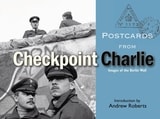
cover of Postcards from Checkpoint Charlie: Images of the Berlin Wall

Postcards from Checkpoint Charlie

Images of the Berlin Wall

Edited by the Bodleian Library

Bodleian Library Publishing, 2008

Between 1945 and 1961, an estimated 2.5 million people fled East Germany in search of the political and economic freedom offered by West Germany. To thwart this tide of defections, on the morning of August 13, 1961, hundreds of East German troops began erecting the Berlin wall—a barrier that would take nearly twenty years to complete and would eventually span 166 kilometers. In Postcards from Checkpoint Charlie, the Bodleian Library assembles a stunning collection of images to document the wall’s impact worldwide.
The postcards in this fascinating volume trace the development of the wall—from its beginnings as a simple stretch of barbed wire to the daunting final structure made of concrete and containing over 300 watchtowers. The images capture scenes of tension and urgency, such as those at Checkpoint Charlie, where we see Allied and East German soldiers coldly observing one another through binoculars. Others document the wall’s ties with American history, including pictures of John F. Kennedy in 1963 when he declared his solidarity with all Berliners and a picture of Ronald Regan when he implored Mikhail Gorbachev to tear down the wall. Also included are images from the toppling of the wall, when thousands of joyful East Germans realized the fulfillment of their personal dreams and marked the conclusion of the cold war.
An intimate look at one of the most visible manifestations of the postwar divide, Portraits from Checkpoint Charlie presents a key location in twentieth-century history through the eyes of those on the scene.     
 
[more]