Results by title
3 books match the query 'Berlin Wall, Berlin, Germany, 1961-1989'
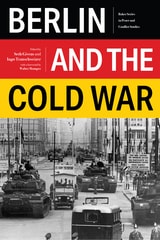
Berlin and the Cold War
Seth Givens; Ingo Trauschweizer
Ohio University Press, 2024
The Cold War is back in the news. So is history, in the sense of past geopolitical confrontations that for a span of a few decades were thought to be largely decoupled from present-day political developments. Of course, such reflexive reactions lack nuance and, until the Russian invasion of Ukraine in February 2022, tended to refer more to tensions between the United States and China. We should neither see Russia’s aggressive war in Ukraine immediately as part of a new cold war—though it could certainly become one of its foundation pieces—nor define history simply in terms of warfare and conflict. Yet such history has great appeal in efforts to understand the dizzying and depressing events of recent years. For example, correspondents and commentators have likened the delivery of weapons systems, protective gear, and humanitarian aid to a beleaguered Ukraine to the Berlin Airlift of 1948–49. But relying on history as a guide may mislead as much as enlighten. No city symbolizes the Cold War quite as Berlin does. When we think of the Cold War and of Berlin, we tend to emphasize the crises—the 1948–49 blockade and airlift, perhaps the 1953 East German workers’ uprising, surely the 1958–61 crisis, during which the Berlin Wall was built—and the climactic ending of the Cold War in Europe when the wall came down. Berlin may conjure up iconic moments and tropes, from a statement attributed to Nikita Khrushchev in 1963 that Berlin was “the testicles of the West,” to John F. Kennedy’s insistence that all free men had to be invested in the defense of Berlin, to Ronald Reagan’s exhortation to Mikhail Gorbachev to “tear down this wall.” For American presidents (or presidential hopefuls), Berlin and the Brandenburg Gate have remained powerful images, even in the twenty-first century. A presence in Berlin signals strong leadership in the West, even though the proximate reasons why the West, as a political construct, emerged in the first place may be gone. In that sense, Berlin also stands for overcoming the past: first, West Berlin as the counterpoint not only to eastern communism but also to defeated fascism, and second, the new Berlin as the capital of a unified Germany and as a symbol that the West has won.
[more]
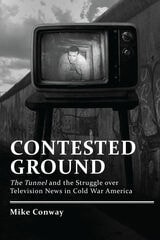
Contested Ground
The Tunnel and the Struggle over Television News in Cold War AmericaMike Conway
University of Massachusetts Press, 2019
In 1962, an innovative documentary on a Berlin Wall tunnel escape brought condemnation from both sides of the Iron Curtain during one of the most volatile periods of the Cold War. The Tunnel, produced by NBC's Reuven Frank, clocked in at ninety minutes and prompted a range of strong reactions. While the television industry ultimately awarded the program three Emmys, the U.S. Department of State pressured NBC to cancel the program, and print journalists criticized the network for what they considered to be a blatant disregard of journalistic ethics.
It was not just The Tunnel's subject matter that sparked controversy, but the medium itself. The surprisingly fast ascendance of television news as the country's top choice for information threatened the self-defined supremacy of print journalism and the de facto cooperation of government officials and reporters on Cold War issues. In Contested Ground, Mike Conway argues that the production and reception of television news and documentaries during this period reveals a major upheaval in American news communications.
It was not just The Tunnel's subject matter that sparked controversy, but the medium itself. The surprisingly fast ascendance of television news as the country's top choice for information threatened the self-defined supremacy of print journalism and the de facto cooperation of government officials and reporters on Cold War issues. In Contested Ground, Mike Conway argues that the production and reception of television news and documentaries during this period reveals a major upheaval in American news communications.
[more]
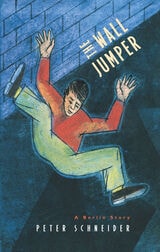
The Wall Jumper
A Berlin StoryPeter Schneider
University of Chicago Press, 1998
A classic novel that Werner Herzog called “the ultimate depiction” of the Berlin Wall and that Salman Rushdie said was “marvelous”
When the Berlin Wall was still the most tangible representation of the Cold War, Peter Schneider made this political and ideological symbol into something personal, that could be perceived on a human level, from more than one side. In Schneider's Berlin, real people cross the Wall not to defect but to quarrel with their lovers, see Hollywood movies, and sometimes just because they can't help themselves—the Wall has divided their emotions as much as it has their country. This unforgettable novel, originally published in 1982, takes us back to a time when the Cold War seemed to have no end in sight and the Wall loomed over everyday life on both sides of Berlin.
[more]