Results by title
4 books match the query 'Berlioz, Hector'

Berlioz and His Century
An Introduction to the Age of RomanticismJacques Barzun
University of Chicago Press, 1982
In this abridgment of his monumental study, Berlioz and the Romantic Century, Jacques Barzun recounts the events and extraordinary achievements of the great composer's life against the background of the romantic era. As the author eloquently demonstrates, Berloiz was an archetype whose destiny was the story of an age, the incarnation of an artistic style and a historical spirit. "In order to understand the nineteenth century, it is essential to understand Berlioz," notes W. H. Auden, "and in order to understand Berlioz, it is essential to read Professor Barzun."
[more]
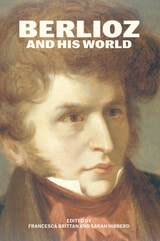
Berlioz and His World
Edited by Francesca Brittan and Sarah Hibberd
University of Chicago Press, 2024
A collection of essays and short object lessons on the composer Hector Berlioz, published in collaboration with the Bard Music Festival.
Hector Berlioz (1803–1869) has long been a difficult figure to place and interpret. Famously, in Richard Wagner’s estimation, he hovered as a “transient, marvelous exception,” a composer woefully and willfully isolated. In the assessment of German composer Ferdinand Hiller, he was a fleeting comet who “does not belong in our musical solar system,” the likes of whom would never be seen again. For his contemporaries, as for later critics, Berlioz was simply too strange—and too noisy, too loud, too German, too literary, too cavalier with genre and form, and too difficult to analyze. He was, in many ways, a composer without a world.
Berlioz and His World takes a deep dive into the composer’s complex legacy, tracing lines between his musical and literary output and the scientific, sociological, technological, and political influences that shaped him. Comprising nine essays covering key facets of Berlioz’s contribution and six short “object lessons” meant as conversation starters, the book reveals Berlioz as a richly intersectional figure. His very difficulty, his tendency to straddle the worlds of composer, conductor, and critic, is revealed as a strength, inviting new lines of cross-disciplinary inquiry and a fresh look at his European and American reception.
[more]
Critical Questions
On Music and Letters, Culture and Biography, 1940-1980Jacques Barzun
University of Chicago Press, 1982
This collection of writings allows the reader a rare opportunity to see Barzun's lively, engaging, rich, and original mind at work on several strategic areas of cultural inquiry: music and the musical life, esthetics, biography, criticism, and social commentary. Barzun makes use of a variety of contexts as a forum for evidence and opinion, including essays, program notes, letters, and reviews. And he approaches a wide variety of particular and general questions. What is it like to sit in on a recording session with a great orchestra? What is the role of the piano in Western culture? What is art in relation to objective reality and to the perceiving mind? Can one translate music into words? What is cultural history?
For anyone unfamiliar with Barzun's work, Critical Questions will serve as a valuable introduction to one of the most important cultural historians of our time. Others will be glad to have these pieces—most of them no longer easily available—brought together in a single volume. Uniformly insightful, provocative, and a pleasure to read, they show the consistency of Barzun's thought even as they exhibit diversity.
For anyone unfamiliar with Barzun's work, Critical Questions will serve as a valuable introduction to one of the most important cultural historians of our time. Others will be glad to have these pieces—most of them no longer easily available—brought together in a single volume. Uniformly insightful, provocative, and a pleasure to read, they show the consistency of Barzun's thought even as they exhibit diversity.
[more]
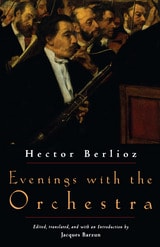
Evenings with the Orchestra
Hector Berlioz
University of Chicago Press, 1999
During the performances of fashionable operas in an unidentified but "civilized" town in northern Europe, the musicians (with the exception of the conscientious bass drummer) tell tales, read stories, and exchange gossip to relieve the tedium of the bad music they are paid to perform. In this delightful and now classic narrative written by the brilliant composer and critic Hector Berlioz, we are privy to twenty-five highly entertaining evenings with a fascinating group of distracted performers. As we near the two-hundredth anniversary of Berlioz's birth, Jacques Barzun's pitch-perfect translation of Evenings with the Orchestra —with a new foreword by Berlioz scholar Peter Bloom—testifies to the enduring pleasure found in this most witty and amusing book.
[more]