Results by title
3 books match the query 'Bethlehem'

The Stable Boy
The First Witness Tells His StoryShirley A. Taylor
Parkhurst Brothers, Inc., 2012
"Shirley Taylor's story gives readers and hearers insight into the town of Bethlehem at the time of the birth of Christ. Wendell Hall's illustrations help us imagine that scene wonderfully. The young homeless boy touches our hearts and imaginations. Not just for children, this is a read aloud book for all ages." - Lauretta Phillips, Storyteller, Author, Radio & TV Host
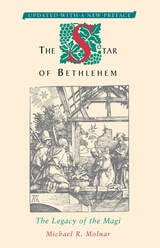
The Star of Bethlehem
The Legacy of the MagiMolnar, Michael R.
Rutgers University Press, 2013
Could the $50 purchase of an ancient coin by a Rutgers astronomer have unlocked the mystery of the Christmas Star? For years, scientists have looked, with little success, to astronomical records for an explanation of the magical star that guided the Magi to Christ’s manger. Intrigued by the image he found on the latest addition to his coin collection, Michael Molnar thought there might be more to learn by looking, instead, at the teachings of ancient astrologers.
Molnar argues in his book that the Star of Bethlehem was not a star at all, but rather a regal portent centering around the planet Jupiter that was eclipsed by the moon. He bases this theory on the actual beliefs of astrologers, such as the Magi, who lived around the time of Christ. Molnar found some intriguing clues to the mystery while researching the meaning of astrological symbols he found an ancient coin, which bore the image of Aries looking back at a star. He found that Aries was a symbol of Judea at the time, and that ancient astrologers believed that a new king would be born when the moon passed in front of Jupiter. Molnar wondered, could the coin have been issued as a response to the Great Messianic Portent, the Star of Bethlehem?
To match the story of the appearance of the Christmas star, Molnar also knew the event had to happen when Jupiter was “in the east.” Using these criteria and a computer program, he was able to chart an eclipse of Jupiter in Aries on April 17, 6 B.C., a day when Jupiter was precisely “in the east,” which confirmed his theory. Moreover, he found that a Roman astrologer described the conditions of that day as fitting the birth of a “divine and immortal” person.
According to Harvard University Professor Owen Gingerich, “this is the most original and important contribution of the entire 20th century” about the Magi’s star. Using clues from astronomy, astrology, and history, Molnar has created a provocative, fascinating theory on the Christmas Star. He weaves together an intriguing scientific detective story which resolves one of the world’s greatest mysteries: The Star of Bethlehem at the birth of Christ.
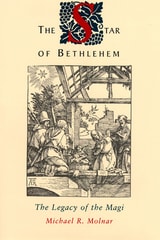
The Star of Bethlehem
The Legacy of the MagiMolnar, Michael R.
Rutgers University Press, 1999
Could the $50 purchase of an ancient coin by a Rutgers astronomer have unlocked the mystery of the Christmas Star? For years, scientists have looked, with little success, to astronomical records for an explanation of the magical star that guided the Magi to Christ’s manger. Intrigued by the image he found on the latest addition to his coin collection, Michael Molnar thought there might be more to learn by looking, instead, at the teachings of ancient astrologers.
Molnar argues in his book that the Star of Bethlehem was not a star at all, but rather a regal portent centering around the planet Jupiter that was eclipsed by the moon. He bases this theory on the actual beliefs of astrologers, such as the Magi, who lived around the time of Christ. Molnar found some intriguing clues to the mystery while researching the meaning of astrological symbols he found an ancient coin, which bore the image of Aries looking back at a star. He found that Aries was a symbol of Judea at the time, and that ancient astrologers believed that a new king would be born when the moon passed in front of Jupiter. Molnar wondered, could the coin have been issued as a response to the Great Messianic Portent, the Star of Bethlehem?
To match the story of the appearance of the Christmas star, Molnar also knew the event had to happen when Jupiter was “in the east.” Using these criteria and a computer program, he was able to chart an eclipse of Jupiter in Aries on April 17, 6 B.C., a day when Jupiter was precisely “in the east,” which confirmed his theory. Moreover, he found that a Roman astrologer described the conditions of that day as fitting the birth of a “divine and immortal” person.
According to Harvard University Professor Owen Gingerich, “this is the most original and important contribution of the entire 20th century” about the Magi’s star. Using clues from astronomy, astrology, and history, Molnar has created a provocative, fascinating theory on the Christmas Star. He weaves together an intriguing scientific detective story which resolves one of the world’s greatest mysteries: The Star of Bethlehem at the birth of Christ.