Results by title

7 books match the query 'Better World'

cover of A COVID Charter, A Better World

A COVID Charter, A Better World

Toby Miller

Rutgers University Press, 2021

With unprecedented speed, scientists have raced to develop vaccines to bring the COVID-19 pandemic under control and restore a sense of normalcy to our lives. Despite the havoc and disruption the pandemic has caused, it’s exposed exactly why we should not return to life as we once knew it. Our current profit-driven healthcare systems have exacerbated global inequality and endangered public health, and we must take this opportunity to construct a new social order that understands public health as a basic human right.  
 
A COVID Charter, A Better World outlines the steps needed to reform public policies and fix the structural vulnerabilities that the current pandemic has made so painfully clear. Leading scholar Toby Miller argues that we must resist neoliberalism’s tendency to view health in terms of individual choices and market-driven solutions, because that fails to preserve human rights. He addresses the imbalance of geopolitical power to explain how we arrived at this point and shows that the pandemic is more than just a virus—it’s a social disease. By examining how the U.S., Britain, Mexico, and Colombia have responded to the COVID-19 crisis, Miller investigates corporate, scientific, and governmental decision-making and the effects those decisions have had on disadvantaged local communities. Drawing from human rights charters ratified by various international organizations, he then proposes a COVID charter, calling for a new world that places human lives above corporate profits.

[more]
cover of Banking for a Better World: Nanno Kleiterp in Conversation with Marijn Wiersma

Banking for a Better World

Nanno Kleiterp in Conversation with Marijn Wiersma

Nanno Kleiterp

Amsterdam University Press, 2017

When we look at all the challenges facing the world, including inequality, population migration, and climate change, we can see a role for development banking in nearly all of them. But will that role be played for good or ill? This book brings together two people who collectively draw on their forty-five years of experience in that world to argue that development banking can-and must-play a constructive role. We only need to read the news to find public outrage at tales of short-sighted greed in the financial world. But what happens when banks invest in long-term sustainability? Readers will find a fascinating example in the journey of the Dutch development bank FMO. At times global in perspective, at other moments intimately personal, Banking for a Better World interweaves candid anecdotes with development history, as well as banking lessons with client interviews, to deliver a powerful argument for a business model that generates profit through impact, and impact through profit. This is an important and accessible must-read for anyone involved in banking, business, policy making, and civil society as a whole. Banking for a Better World challenges us to start finding overlaps between our own lives and global issues and to bridge the distance between our personal needs and those of our planet.
[more]
cover of For a Better World: The Winnipeg General Strike and the Workers' Revolt

For a Better World

The Winnipeg General Strike and the Workers' Revolt

James Naylor

University of Manitoba Press, 2022

[more]
cover of For a Just and Better World: Engendering Anarchism in the Mexican Borderlands, 1900-1938

For a Just and Better World

Engendering Anarchism in the Mexican Borderlands, 1900-1938

Sonia Hernandez

University of Illinois Press, 2021

Caritina Piña Montalvo personified the vital role played by Mexican women in the anarcho-syndicalist movement. Sonia Hernández tells the story of how Piña and other Mexicanas in the Gulf of Mexico region fought for labor rights both locally and abroad in service to the anarchist ideal of a worldwide community of workers. An international labor broker, Piña never left her native Tamaulipas. Yet she excelled in connecting groups in the United States and Mexico. Her story explains the conditions that led to anarcho-syndicalism's rise as a tool to achieve labor and gender equity. It also reveals how women's ideas and expressions of feminist beliefs informed their experiences as leaders in and members of the labor movement.

A vivid look at a radical activist and her times, For a Just and Better World illuminates the lives and work of Mexican women battling for labor rights and gender equality in the early twentieth century.

[more]
cover of Making a Better World: Public Housing, the Red Scare, and the Direction of Modern Los Angeles

Making a Better World

Public Housing, the Red Scare, and the Direction of Modern Los Angeles

Don Parson

University of Minnesota Press, 2005
During the 1990s, Los Angeles - like many other cities across America - began demolishing public housing projects that had come to symbolize decades of failed urban policies. But public housing was not always regarded with such disdain. In the years surrounding World War II, it had been a popular New Deal program, viewed as a force for positive social change and supported by a broad coalition of civic, labor, religious, and community organizations. Socially conscious architects and planners developed innovative and livable projects that embodied the latest theories in urban design. With sharp historical perspective, Making a Better World traces the rise and fall of a public housing ethic in Los Angeles and its impact on the city's built environment. In the caustic political atmosphere of Joseph McCarthy's America, public housing opponents accused the city's housing authority of communist infiltration, effectively eliminating the left from debates over the city's development. In place of public housing, conservative forces promoted a pro-private growth agenda that redefined urban renewal and reshaped modern Los Angeles. No conventional public housing projects have been constructed in Los Angeles since 1955. In this era of skyrocketing housing prices, especially in urban areas, Don Parson's examination not only gives us the recent history of a city, but also opens up a new debate on a current national crisis in providing shelter for low-income Americans.
[more]
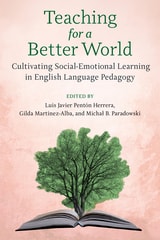
cover of Teaching for a Better World: Cultivating Social-Emotional Learning in English Language Pedagogy

Teaching for a Better World

Cultivating Social-Emotional Learning in English Language Pedagogy

Edited by Luis Javier Pentón Herrera, Gilda Martínez-Alba, and Michal B. Paradowski

University of Michigan Press, 2026

In a world where language connects people across cultures, Teaching for a Better World invites readers to imagine classrooms where words do more than teach grammar; they build empathy, resilience, and understanding. This groundbreaking volume is the first to focus on the integration of social-emotional learning (SEL) into English language teaching from a global perspective, bringing together educators and researchers from diverse cultural and educational contexts. Through conceptual discussions, research, and practical examples, the authors demonstrate how English lessons can also be lessons in compassion, collaboration, and global citizenship.

Organized into three sections—Conceptual Pieces, Empirical Studies, and Practical Examples—the book offers a comprehensive examination of SEL’s theoretical foundations, evidence-based practices, and real-world classroom applications. Contributors explore SEL through lenses such as culturally responsive pedagogy, trauma-sensitive practices, teacher and student well-being, ecolinguistics, and intercultural dialogue. Readers will find innovative and practical ways to create inclusive, culturally responsive classrooms; support student and teacher well-being; and use English as a bridge for intercultural dialogue. Accessible and inspiring, this book’s combination of conceptual depth, empirical rigor, and applied strategies position it as a foundational resource for advancing research and practice in SEL-informed English language pedagogy worldwide.

Readers of Teaching for a Better World will

  • Learn pedagogically sound ways to foster empathy and resilience while creating inclusive, culturally responsive classrooms.
  • Find ready-to-use lesson plans and activities.
  • Encounter diverse perspectives of educators from a range of contexts, including conflict-affected regions, refugee resettlement contexts, and higher education.
[more]
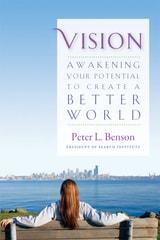
cover of Vision: Awakening Your Potential to Create a Better World

Vision

Awakening Your Potential to Create a Better World

Peter Benson

Templeton Press, 2009

According to Peter L. Benson, the capacity to generate vision is among life's most beautiful and unheralded gifts. To him, a vision is more than just a goal, more than just a dream of what could be—it is a summons, a pull towards the future, an inspired call to make real that which should be. In Vision: Awakening Your Potential to Create a Better World, Benson takes readers on an uplifting exploration of this powerful concept.

Starting with examples of great visionary moments in history, such as the drafting of the Declaration of Independence and Martin Luther King Jr.'s "I Have a Dream" speech, he crafts a working definition of "vision" and what it means to be visionary. He proceeds by profiling the personalities behind some of the great visions that have shaped our world, covering a diverse set of individuals ranging from presidents who pulled the country through tough times to children whose efforts helped put an end to child labor. Throughout, Benson shares personal insights on his own "big picture" vision and offers instructive questions and exercises that will help reflective readers craft their own visions.
 
This little book of practical inspiration makes it clear that vision is a necessary ingredient of meaningful change. Readers will appreciate Benson's warm and personal approach as well as his interactive approach, which will help anyone come to understand his or her own social and spiritual potential. Vision will be useful to those seeking to find their place and purpose in the world, whether they are new graduates, professionals, parents, or retirees.


[more]