Results by title
2 books match the query 'Bhattacharya, Himika'
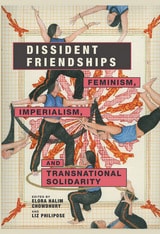
Dissident Friendships
Feminism, Imperialism, and Transnational SolidarityEdited by Elora Halim Chowdhury and Liz Philipose
University of Illinois Press, 2016
Often perceived as unbridgeable, the boundaries that divide humanity from itself--whether national, gender, racial, political, or imperial--are rearticulated through friendship. Elora Halim Chowdhury and Liz Philipose edit a collection of essays that express the different ways women forge hospitality in deference to or defiance of the structures meant to keep them apart. Emerging out of postcolonial theory, the works discuss instances when the authors have negotiated friendship's complicated, conflicted, and contradictory terrain; offer fresh perspectives on feminists' invested, reluctant, and selective uses of the nation; reflect on how the arts contribute to conversations about feminism, dissent, resistance, and solidarity; and unpack the details of transnational dissident friendships. Contributors: Lori E. Amy, Azza Basarudin, Himika Bhattacharya, Kabita Chakma, Elora Halim Chowdhury, Laurie R. Cohen, Esha Niyogi De, Eglantina Gjermeni, Glen Hill, Alka Kurian, Meredith Madden, Angie Mejia, Chandra T. Mohanty, A. Wendy Nastasi, Nicole Nguyen, Liz Philipose, Anya Stanger, Shreerekha Subramanian, and Yuanfang Dai.
[more]
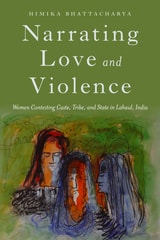
Narrating Love and Violence
Women Contesting Caste, Tribe, and State in Lahaul, IndiaBhattacharya, Himika
Rutgers University Press, 2017
Narrating Love and Violence is an ethnographic exploration of women’s stories from the Himalayan valley of Lahaul, in the region of Himachal Pradesh, India, focusing on how both, love and violence emerge (or function) at the intersection of gender, tribe, caste, and the state in India. Himika Bhattacharya privileges the everyday lives of women marginalized by caste and tribe to show how state and community discourses about gendered violence serve as proxy for caste in India, thus not only upholding these social hierarchies, but also enabling violence.
The women in this book tell their stories through love, articulated as rejection, redefinition and reproduction of notions of violence and solidarity. Himika Bhattacharya centers the women’s narratives as a site of knowledge—beyond love and beyond violence. This book shows how women on the margins of tribe and caste know both, love and violence, as agents wishing to re-shape discourses of caste, tribe and community.
The women in this book tell their stories through love, articulated as rejection, redefinition and reproduction of notions of violence and solidarity. Himika Bhattacharya centers the women’s narratives as a site of knowledge—beyond love and beyond violence. This book shows how women on the margins of tribe and caste know both, love and violence, as agents wishing to re-shape discourses of caste, tribe and community.
[more]