Results by title
3 books match the query 'Bibby, Michael'
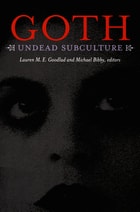
Goth
Undead SubcultureLauren M. E. Goodlad and Michael Bibby, eds.
Duke University Press, 2007
The volume’s editors provide a rich history of goth, describing its play of resistance and consumerism; its impact on class, race, and gender; and its distinctive features as an “undead” subculture in light of post-subculture studies and other critical approaches. The essays include an interview with the distinguished fashion historian Valerie Steele; analyses of novels by Anne Rice, Poppy Z. Brite, and Nick Cave; discussions of goths on the Internet; and readings of iconic goth texts from Bram Stoker’s Dracula to James O’Barr’s graphic novel The Crow. Other essays focus on gothic music, including seminal precursors such as Joy Division and David Bowie, and goth-influenced performers such as the Cure, Nine Inch Nails, and Marilyn Manson. Gothic sexuality is explored in multiple ways, the subjects ranging from the San Francisco queercore scene of the 1980s to the increasing influence of fetishism and fetish play. Together these essays demonstrate that while its participants are often middle-class suburbanites, goth blurs normalizing boundaries even as it appears as an everlasting shadow of late capitalism.
Contributors: Heather Arnet, Michael Bibby, Jessica Burstein, Angel M. Butts, Michael du Plessis, Jason Friedman, Nancy Gagnier, Ken Gelder, Lauren M. E. Goodlad, Joshua Gunn, Trevor Holmes, Paul Hodkinson, David Lenson, Robert Markley, Mark Nowak, Anna Powell, Kristen Schilt, Rebecca Schraffenberger, David Shumway, Carol Siegel, Catherine Spooner, Lauren Stasiak, Jeffrey Andrew Weinstock

Hearts and Minds
Bodies, Poetry, and Resistance in the Vietnam EraMichael Bibby
Rutgers University Press, 1996
The early 1960s to the mid-1970s was one of the most turbulent periods in American history. The U.S. military was engaged in its longest, costliest overseas conflict, while the home front was torn apart by riots, protests, and social activism. In the midst of these upheavals, an underground and countercultural press emerged, giving activists an extraordinary forum for a range of imaginative expressions. Poetry held a prominent place in this alternative media. The poem was widely viewed by activists as an inherently anti-establishment form of free expression, and poets were often in the vanguards of political activism.
Hearts and Minds is the first book-length study of the poems of the Black Liberation, Women's Liberation, and GI Resistance movements during the Vietnam era. Drawing on recent cultural and literary theories, Bibby investigates the significance of images, tropes, and symbols of human bodies in activist poetry. Many key political slogans of the period––"black is beautiful," "off our backs"––foreground the body. Bibby demonstrates that figurations of bodies marked important sites of social and political struggle.
Although poetry played such an important role in Vietnam-era activism, literary criticism has largely ignored most of this literature. Bibby recuperates the cultural-historical importance of Vietnam-era activist poetry, highlighting both its relevant contexts and revealing how it engaged political and social struggles that continue to motivate contemporary history. Arguing for the need to read cultural history through these "underground" texts, Hearts and Minds offers new grounds for understanding the recent history of American poetry and the role poetry has played as a medium of imaginative political expression.
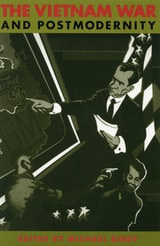
The Vietnam War and Postmodernity
Michael Bibby
University of Massachusetts Press, 1999
The longest war in the nation's history, the American military intervention in Vietnam dominated United States culture and politics from 1965 to 1975. In addition to causing immense devastation in Southeast Asia, the war transformed American society, with effects that continue to be felt today. Yet aside from a few cultural studies of the war's representations, scholars have tended to ignore the relationship between the American war in Vietnam and broader cultural developments in the West. Frederic Jameson once characterized the Vietnam War as “the first terrible postmodernist war,” suggesting that it embodied or reflected the sensibility of an emerging historical epoch. But does it make sense to place a military conflict within a category of cultural and aesthetic periodization? Is it possible to see the Vietnam War as an expression and reflection of postmodernity—what Jameson calls “the cultural logic of late capitalism?” These are some of the questions addressed in this volume. Ranging across a variety of disciplines, including philosophy, cultural studies, literary criticism, and film studies, the essays explore the war's discourses and technologies in relation to the post-modern condition. At the same time, they reinterpret key cultural representations of the war from a postmodern perspective. The result is a book that poses important challenges to both Vietnam War studies and postmodern studies, at once reshaping the ways postmodernity is conceived and reminding us of the war's enduring significance in contemporary cultural history. In addition to Michael Bibby, contributors are Philip D. Beidler, Michael Clark, Cynthia J. Fuchs, Brady Harrison, Tony Williams, Eric Gadzinski, Chris Hables Gray, and Douglas Kellner.