Results by title
2 books match the query 'Bicycle lanes'
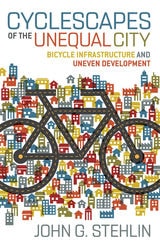
Cyclescapes of the Unequal City
Bicycle Infrastructure and Uneven DevelopmentJohn G. Stehlin
University of Minnesota Press, 2019
A critical look at the political economy of urban bicycle infrastructure in the United States
Not long ago, bicycling in the city was considered a radical statement or a last resort, and few cyclists braved the inhospitable streets of most American cities. Today, however, the urban cyclist represents progress and the urban “renaissance.” City leaders now undertake ambitious new bicycle infrastructure plans and bike share schemes to promote the environmental, social, and economic health of the city and its residents. Cyclescapes of the Unequal City contextualizes and critically examines this new wave of bicycling in American cities, exploring how bicycle infrastructure planning has become a key symbol of—and site of conflict over—uneven urban development.
John G. Stehlin traces bicycling’s rise in popularity as a key policy solution for American cities facing the environmental, economic, and social contradictions of the previous century of sprawl. Using in-depth case studies from San Francisco, Philadelphia, and Detroit, he argues that the mission of bicycle advocacy has converged with, and reshaped, the urban growth machine around a model of livable, environmentally friendly, and innovation-based urban capitalism. While advocates envision a more sustainable city for all, the deployment of bicycle infrastructure within the framework of the neoliberal city in many ways intensifies divisions along lines of race, class, and space.
Cyclescapes of the Unequal City speaks to a growing interest in bicycling as an urban economic and environmental strategy, its role in the politics of gentrification, and efforts to build more diverse coalitions of bicycle advocates. Grounding its analysis in both regional political economy and neighborhood-based ethnography, this book ultimately uses the bicycle as a lens to view major shifts in today’s American city.
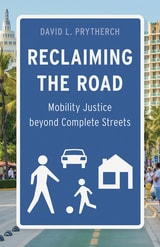
Reclaiming the Road
Mobility Justice beyond Complete StreetsDavid L Prytherch
University of Minnesota Press, 2025
Imagining equitable streets for all
For the past century, our roadways have been engineered as pipes for cars, but they offer vast potential as public spaces. From New York and Boston to Portland and Los Angeles, cities are rethinking their streets, going beyond sidewalks and bike lanes to welcome nonmotorists to share the asphalt roadway. Reclaiming the Road traces the historical evolution of America’s streets and explores contemporary movements to retake them from cars—temporarily and permanently—for diverse forms of mobility and community life. To share the street raises important questions of equity, in transportation and beyond. David L. Prytherch proposes a bold, intersectional vision of a more just street.
Reclaiming the Road connects cutting-edge theory, policy analysis, and firsthand accounts from those leading the charge in transforming our streets to advocate for changing how we think about and design roads. Prytherch features case studies of nine major cities in the United States to show how experiments in reclaiming streets accelerated during the Covid-19 pandemic to become lasting changes. Through in-depth interviews, he shares stories of how planners, transportation advocates, and community leaders have implemented innovative programs for slowing neighborhood streets, opening roads for walking and biking, and reconstructing roadways with public parklets and street plazas as social spaces for curbside conversation.
Examining movements to transform streets through the lenses of equity and justice, Reclaiming the Road tackles the conceptual challenge of defining mobility justice and the practicalities of planning a more just public street, offering a compelling vision for the future of America’s public spaces.
Retail e-book files for this title are screen-reader friendly with images accompanied by short alt text and/or extended descriptions.