Results by title
4 books match the query 'Big'
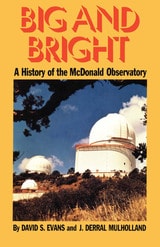
Big and Bright
A History of the McDonald ObservatoryBy David S. Evans and J. Derral Mulholland
University of Texas Press, 1986
By day, every year over 40,000 visitors pour in. Across the Rio Grande, a hundred miles away, Mexican mountaineers use the white domes as landmarks. By night, perched almost 7,000 feet above the sleeping, earthbound world, astronomers probe the secrets of the night sky. This is the University of Texas McDonald Observatory, one of the world's largest university-operated astronomical installations.
Big and Bright: A History of the McDonald Observatory is the story of a remarkable collaboration between two major universities, one a prestigious private school, the other a growing southwestern state institution. The University of Chicago had astronomers, but its Yerkes Observatory was aging and underfunded; the University of Texas had money for an observatory but no working astronomer to staff it. Out of their mutual need, they formed a thirty-year compact for a joint venture. Unusual in its day, the Yerkes-McDonald connection presaged the future. In this arrangement, one can see some of the beginnings of today's consortium "big science."
Now the McDonald Observatory's early history can be put in proper perspective. Blessed with a gifted and driving founding director, the world's (then) second-largest telescope, and an isolation that permitted it to be virtually the only major astronomical observatory that continued operations throughout World War II, the staff of McDonald Observatory helped lay the foundations of modern astrophysics during the 1940s. For over a decade after the war, a lonely mountaintop in West Texas was the mecca that drew nearly all the most important astronomers from all over the world.
Based on personal reminiscences and archival material, as well as published historical sources, Big and Bright is one of the few histories of a major observatory, unique in its focus on the human side of the story.
Co. Aytch, or a Side Show of the Big Show
A New Edition Introduced and Annotated by Philip LeighSam Watkins
Westholme Publishing, 2013
Co. Aytch, or a Side Show of the Big Show is perhaps the finest memoir of an ordinary Confederate soldier. According to Margaret Mitchell, “a better book there never was.” Sam Watkins served in Company H of the First Tennessee Infantry for the duration of the Civil War. Remarkably, he survived some of the most intense battles of the war, including Shiloh, Chickamauga, Kennesaw Mountain, Atlanta, and Franklin. He was one of only seven of the original members of Company H when it surrendered in April 1865. Watkins’s memoir was written in the winter of 1882–83. The humor and depth of writing at times rises to a level resembling Mark Twain; thus, twenty-first-century readers can still discover the everlasting treasures of Private Sam Watkins’s story just as it was. It is this reason that excerpts were featured frequently in Ken Burns’s documentary on the Civil War. However, since most of Sam’s original readers—or some of their family members—actually lived through the Civil War, much of the context for the narrative was common knowledge. But what was once received history has gradually disappeared, and presently only specialists can fully understand and appreciate Sam’s tale.
The chief aim for this new annotated edition of Co. Aytch—the first of its kind—is to amplify the experience for today’s readers by providing the missing context. Over 240 annotations clarify the situational backgrounds, personalities, and terminology that might not be familiar to most readers. The annotations also identify and explain errors mostly resulting from Sam’s occasionally faulty memory or limited perspective. Similarly, twentyfour battlefield and war theater maps enable readers to track Sam’s combat participation as well as his journeys while marching with the army. Finally fifteen photographs and prints illustrate some of the battles, people, towns, buildings, tools of war, and ruins that Sam witnessed. As someone once cleverly observed, “It’s not an adventure until something goes wrong.” If nothing else, Sam’s memoir is a foot soldier’s view of the resulting horrors, heroics, and healing humor when war planning routinely goes awry.
The Big No
Kennan Ferguson
University of Minnesota Press, 2021
What it means to celebrate the potential and the power of no
What does it mean to refuse? To not participate, to not build a better world, to not come up with a plan? To just say “no”? Against the ubiquitous demands for positive solutions, action-oriented policies, and optimistic compromises, The Big No refuses to play. Here leading scholars traverse the wide range of political action when “no” is in the picture, analyzing topics such as collective action, antisocialism, empirical science, the negative and the affirmative in Deleuze and Derrida, the “real” and the “clone,” Native sovereignty, and Afropessimism.
In his introduction, Kennan Ferguson sums up the concept of the “Big No,” arguing for its political importance. Whatever its form—he identifies various strains—the Big No offers power against systems of oppression. Joshua Clover argues for the importance of Marx and Fanon in understanding how people are alienated and subjugated. Theodore Martin explores the attractions of antisociality in literature and life, citing such novelists as Patricia Highsmith and Richard Wright. François Laruelle differentiates nonphilosophy from other forms of French critical theory. Katerina Kolozova applies this insight to the nature of reality itself, arguing that the confusion of thought and reality leads to manipulation, automation, and alienation. Using poetry and autobiography, Frank Wilderson shows how Black people—their bodies and being—are displaced in politics, replaced and erased by the subjectivities of violence, suffering, and absence. Andrew Culp connects these themes of negativity, comparing and contrasting the refusals of antiphilosophy and Afropessimism.
Thinking critically usually demands alternatives: how would you fix things? But, as The Big No shows, being absolutely critical—declining the demands of world-building—is one necessary response to wrong, to evil. It serves as a powerful reminder that the presumption of political action is always positive.
Contributors: Joshua Clover, U of California Davis and U of Copenhagen; Andrew Culp, California Institute of the Arts; Katerina Kolozova, Institute of Social Sciences and Humanities Skopje; Theodore Martin, U of California, Irvine; Anthony Paul Smith, La Salle U; Frank B. Wilderson III, U of California, Irvine.

The Business State
Empire and Big Business in the Twentieth-Century British StateIan Kumekawa
University of Chicago Press, 2027
Narrates how big business guided policy and expanded the state in early twentieth-century Britain.
During World War I, British businessmen streamed into government service. When Britain faced unprecedented economic challenges after the war’s end, civil servants turned to the same businessmen with whom they had worked. The result was a durable public-private network of both bureaucrats and executives: the business state.
In this book, Ian Kumekawa throws light on the previously obscured and hidden world of the business state and the economic thinking of its administrators. He breaks new methodological ground by treating the state and business together as a single entity. Twentieth-century states, he argues, were porous networks in which lines between business and governance were not clearly defined. In liberal democracies, the term “business-friendly” has long been understood as synonymous with laissez-faire. The Business State explores the historical limits of that assumption by focusing on Britain, the self-identified small, liberal state par excellence. In doing so, the book shows how a liberal democracy was effectively co-opted by private interests and explores how actively assisting big business became not just acceptable—but a political necessity.