Results by title
5 books match the query 'Binford, Leigh'

From Popular to Insurgent Intellectuals
Peasant Catechists in the Salvadoran RevolutionLeigh Binford
Rutgers University Press, 2023
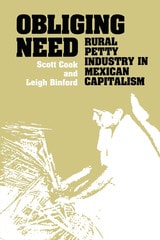
Obliging Need
Rural Petty Industry in Mexican CapitalismBy Scott Cook and Leigh Binford
University of Texas Press, 1990
For centuries throughout large portions of the globe, petty agriculturalists and industrialists have set their physical and mental energies to work producing products for direct consumption by their households and for exchange. This twofold household reproduction strategy, according to both Marxist and neoclassical approaches to development, should have disappeared from the global economy as labor was transformed into a producer as well as a consumer of capitalist commodities. But in fact, during the twentieth century, only the United States and Britain seem to have approximated this predicted scenario. Tens of millions of households in contemporary Asia, Africa, and Latin America and millions more in industrialized capitalist economies support themselves through petty commodity production alone or in combination with petty industry wage labor.
Obliging Need provides a detailed and comprehensive analysis of small-scale peasant and artisan enterprise in the Oaxaca Valley of Mexico. The authors show how commodity production is organized and operates in different craft industries, as well as the ways in which it combines with other activities such as household chores, agriculture, wage labor, and petty commerce. They demonstrate how—contrary to developmentalist dogma—small-scale capitalism develops from within Mexico's rural economy.
These findings will be important for everyone concerned with improving the lives and economic opportunities of countryfolk in the Third World. As the authors make clear, political mobilization in rural Mexico will succeed only as it addresses the direct producers' multiple needs for land, credit, more jobs, health insurance, and, most importantly, more equitable remuneration for their labor and greater rewards for their enterprise.

The El Mozote Massacre
Anthropology and Human RightsLeigh Binford
University of Arizona Press, 1996
Such reportage, argues anthropologist Leigh Binford, sustains the perception that the lives of Third World people are only newsworthy when some great tragedy strikes. He critiques the practices of journalists and human rights organizations for their dehumanizing studies of "subjects" and "victims." Binford suggests that such accounts objectify the people involved through statistical analyses and bureaucratic body counts while the news media sensationalize the motives and personalities of the perpetrators.
In relating the story of this tragic event, Binford restores a sense of history and social identity to the fallen people of this Salvadoran village. Drawing on interviews he conducted with El Mozote-area residents, he offers a rich ethnographic and personal account of their lives prior to the tragedy. He provides an overview of the history and culture of the area and tells how such a massacre could have happened, why it was covered up, and why it could happen again.

The El Mozote Massacre
Human Rights and Global Implications Revised and Expanded EditionLeigh Binford
University of Arizona Press, 2016
Almost two decades later, the consequences of the massacre continue to reverberate through the country’s legal and socioeconomic systems. The El Mozote Massacre, 2nd Edition brings together new evidence to address reconstruction, historical memory, and human rights issues resulting from what may be the largest massacre in modern Latin American history.
With a multitude of additions, including three new chapters, an extended chronology, discussion of the hearing and ruling of the Inter-American Court of Human Rights in 2012, and evidence gathered throughout half a dozen field trips made by the author, Binford presents a current perspective on the effects of this tragic moment in history. Thanks to geographically expanded fieldwork, Binford offers critical discussion of postwar social, economic, religious, and social justice in El Mozote, and adds important new regional, national, and global contexts.
The El Mozote Massacre, 2nd Edition maintains the crucial presence of the massacre in human rights discussions for El Salvador, Latin America, and the world.
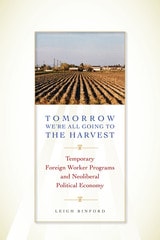
Tomorrow We're All Going to the Harvest
Temporary Foreign Worker Programs and Neoliberal Political EconomyBy Leigh Binford
University of Texas Press, 2013
From its inception in 1966, the Canadian Seasonal Agricultural Worker Program (SAWP) has grown to employ approximately 20,000 workers annually, the majority from Mexico. The program has been hailed as a model that alleviates human rights concerns because, under contract, SAWP workers travel legally, receive health benefits, contribute to pensions, are represented by Canadian consular officials, and rate the program favorably. Tomorrow We’re All Going to the Harvest takes us behind the ideology and examines the daily lives of SAWP workers from Tlaxcala, Mexico (one of the leading sending states), observing the great personal and family price paid in order to experience a temporary rise in a standard of living. The book also observes the disparities of a gutted Mexican countryside versus the flourishing agriculture in Canada, where farm labor demand remains high.
Drawn from extensive surveys and nearly two hundred interviews, ethnographic work in Ontario (destination of over 77 percent of migrants in the author’s sample), and quantitative data, this is much more than a case study; it situates the Tlaxcala-Canada exchange within the broader issues of migration, economics, and cultural currents. Bringing to light the historical genesis of “complementary” labor markets and the contradictory positioning of Mexican government representatives, Leigh Binford also explores the language barriers and nonexistent worker networks in Canada, as well as the physical realities of the work itself, making this book a complete portrait of a provocative segment of migrant labor.