Results by title
3 books match the query 'Bing, Peter'
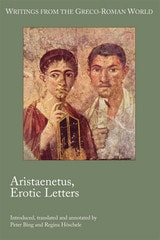
Aristaenetus, Erotic Letters
Peter Bing
SBL Press, 2014
The first complete English translation of Aristaenetus in nearly three centuries
Through allusion and adaption of earlier authors, Aristaenetus recounts tales that are the stuff of comedy, erotic poetry, and ancient novel. Here we read of lovers who use every trope of erotic literature to praise their beloveds in over-the-top speeches. Aristaenetus amazes us with tales of paramours hatching complicated schemes to achieve their desires, while wily go-betweens help smooth their way. He presents us with accounts of unfaithful spouses who barely avoid capture in the midst of hair-raising and amusing infidelities. This sixth century collection is perfect for anyone interested in classical and postclassical literature.
Features:
- English translation and Greek text on facing pages
- Introduction with history of the text
- Discussion of intertextual connections with Greco-Roman authors
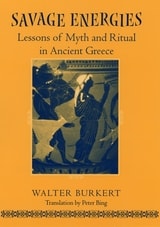
Savage Energies
Lessons of Myth and Ritual in Ancient GreeceWalter Burkert
University of Chicago Press, 2001
For example, in a much-cited essay on the Athenian religious festival of the Arrephoria, Burkert uncovers deep connections between this strange nocturnal ritual, in which two virgin girls carried sacred offerings into a cave and later returned with something given to them there, and tribal puberty initiations by linking the festival with the myth of the daughters of Kekrops. Other chapters explore the origins of tragedy in blood sacrifice; the role of myth in the ritual of the new fire on Lemnos; the ties between violence, the Athenian courts, and the annual purification of the divine image; and how failed political propaganda entered the realm of myth at the time of the Persian Wars.
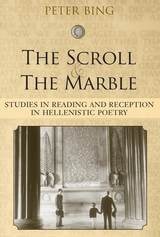
The Scroll and the Marble
Studies in Reading and Reception in Hellenistic PoetryPeter Bing
University of Michigan Press, 2010
---Benjamin Acosta-Hughes, Ohio State University
While people of previous ages relied on public performance as their chief means of experiencing poetry, the Hellenistic age developed what one may term a culture of reading. This was the first era in which poets consciously shaped their works with an eye toward publication and reception not just on the civic stage but in several media---in performance, on inscribed monuments, in scrolls. The essays in Peter Bing's collection explore how poetry accommodated various audiences and how these audiences in turn experienced the text in diverse ways. Over the years, Bing's essays have focused on certain Hellenistic authors and genres---particularly on Callimachus and Posidippus and on epigram. His themes, too, have been broadly consistent. Thus, although the essays in The Scroll and the Marble span some twenty years, they offer a coherent vision of Hellenistic poetics as a whole.
Peter Bing is Professor of Classics at Emory University and editor, most recently, of the Companion to Hellenistic Epigram: Down to Philip (coedited with Jon Steffen Bruss).
Jacket illustration: Film still from Mr. Smith Goes to Washington, directed by Frank Capra, Columbia Pictures 1939. Courtesy of Sony Pictures.