Results by title
5550 books match the query 'Biography & Autobiography' and 577 start with a
A Bag of Marbles
Joseph Joffo
University of Chicago Press, 2000
A Beautiful, Cruel Country
Eva Antonia Wilbur-Cruce
University of Arizona Press, 1987
Eva Antonia Wilbur inherited a unique affinity for the land. Granddaughter of a Harvard-educated physician who came to the Territory in the 1860s, she was the firstborn child of a Mexican mother and Anglo father who instilled in her an appreciation for both cultures. Little Toña learned firsthand the responsibilities of ranching—an education usually reserved for boys—and also experienced the racial hostility that occurred during those final years before the Tohono O'odham were confined to a reservation.
Begun as a reminiscence to tell younger family members about their "rawhide tough and lonely" life at the turn of the century, Mrs. Wilbur-Cruce's book is rich with imagery and dialogue that brings the Arivaca area to life. Her story is built around the annual cycle of ranch life—its spring and fall round-ups, planting and harvesting—and features a cavalcade of border characters, anecdotes about folk medicine, and recollections of events that were most meaningful in a young girl's life. Her account constitutes a valuable primary source from a region about which nothing similar has been previously published, while the richness of her story creates a work of literature that will appeal to readers of all ages.
A Beginner's Guide to Faults
A MemoirDenice Turner
University of Nevada Press, 2026
A bighearted memoir of fidelity and forgiveness, A Beginner’s Guide to Faults draws on the language of geology to explore fault lines in a long marriage—deep fractures formed by unmet needs, quiet betrayals, and the human longing for connection and freedom.
After twenty-five years of marriage, Denice is blindsided when her husband reveals his romance with a Las Vegas stripper. This latest move in their tit-for-tat game of infidelity is too much for her. She files for divorce and heads to South Dakota, where she hopes to fulfill her wildest fantasies. Instead, plagued by guilt about her own faults, she wrecks each new relationship, convinced that she is unforgivable.
Through fleeting romances and soul-deep self-reflection, Denice rebuilds a life and a family on her own terms. A Beginner’s Guide to Faults is a memoir of transformation—one that shows how love can change without ever being lost.
A Beginner's Guide to Faults
A MemoirDenice Turner
University of Nevada Press, 2026
A bighearted memoir of fidelity and forgiveness, A Beginner’s Guide to Faults draws on the language of geology to explore fault lines in a long marriage—deep fractures formed by unmet needs, quiet betrayals, and the human longing for connection and freedom.
After twenty-five years of marriage, Denice is blindsided when her husband reveals his romance with a Las Vegas stripper. This latest move in their tit-for-tat game of infidelity is too much for her. She files for divorce and heads to South Dakota, where she hopes to fulfill her wildest fantasies. Instead, plagued by guilt about her own faults, she wrecks each new relationship, convinced that she is unforgivable.
Through fleeting romances and soul-deep self-reflection, Denice rebuilds a life and a family on her own terms. A Beginner’s Guide to Faults is a memoir of transformation—one that shows how love can change without ever being lost.
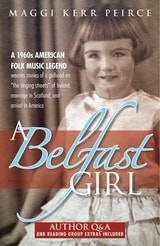
A Belfast Girl
A 1960s American folk music legend weaves stories of a girlhood on “the singing streets” of Ireland, marriage in Scotland, and arrival in AmericaMaggi Kerr Peirce
Parkhurst Brothers, Inc., 2013
A 1960s American folk music legend weaves stories of a girlhood on “the singing streets” of Ireland, marriage in Scotland, and arrival in America

A Biographical Dictionary of Actors, Volume 1, Abaco to Belfille
Actresses, Musicians, Dancers, Managers, and Other Stage Personnel in London, 1660-1800Philip H. Highfill, Jr., Kalman A. Burnim, and Edward A. Langhans
Southern Illinois University Press, 1973
Tobe completed in 12volumes, this monumental work here begins publication with the first two volumes—Abaco to Bertie and Bertin to Byzard. When completed, it is expected that the biographical dictionary will include information on more than 8,500 individuals.
Hundreds of printed sources have been searched for this project, and dozens of repositories combed, and the names of personnel listed have been filtered through parish registers whenever possible. From published and unpublished sources, from wills, archives of professional societies and guilds, from records of colleges, universities, and clubs, and from the contributions of selfless scholars, the authors have here assembled material which illuminates theatrical and musical activity in London in the 1660–1800 period.
The information here amassed will doubtless be augmented by other specialists in Restoration and eighteenth-century theatre and drama, but it is not likely that the number of persons now known surely or conjectured finally to have been connected with theatrical enterprise in this period will ever be increased considerably. Certainly, the contributions made here add immeasurably to existing knowledge, and in a number of instances correct standard histories or reference works.
The accompanying illustrations, estimated to be some 1,400 likenesses—at least one picture of each subject for whom a portrait exists—may prove to be a useful feature of the Work. The authors have gone beyond embellishment of the text, and have attempted to list all original portraits any knowledge of which is now recoverable, and have tried to ascertain the present location of portraits in every medium.
A Biographical Dictionary of Actors, Volume 10, M'Intosh to Nash
Actresses, Musicians, Dancers, Managers, and Other Stage Personnel in London, 1660-1800Philip H. Highfill, Jr.
Southern Illinois University Press, 1984
Those featured in Volume 10 include Margaret Martyr, a singer, actress, and dancer whose “conjugal virtues were often impeached,” according to the July 1792Thespian Magazine. The Dictionary describes this least constant of lovers as “of middling height, with a figure well-proportioned for breeches parts. [Her] black-haired, black-eyed beauty and clear soprano made her an immediate popular success in merry maids and tuneful minxes, the piquant and the pert, for a quarter century.”
A Biographical Dictionary of Actors, Volume 12, Pinner to Rizzo
Actresses, Musicians, Dancers, Managers, and Other Stage Personnel in London, 1660-1800Philip H. Highfill, Jr., Kalman A. Burnim, and Edward A. Langhans
Southern Illinois University Press, 1987
A Biographical Dictionary of Actors, Volume 13, Roach to H. Siddons
Actresses, Musicians, Dancers, Managers, and Other Stage Personnel in London, 1660-1800Philip H. Highfill, Jr., Kalman A. Burnim, and Edward A. Langhans
Southern Illinois University Press, 1991
Like the works already published, these latest volumes of the Biographical Dictionary deal with theatre people of every ilk, ranging from dressers and one-performance actors to trumpeter John Shore (inventor of the tuning fork) and the incomparable Sarah Siddons.
Also prominent is Susanna Rowson, a novelist, actress, and early female playwright. Although born into a British military family, Rowson often wrote plays that dealt with patriotic American themes and spent much of her career on the American stage.
The theatrical jewel of these volumes is the "divine Sarah" Siddons: "She raised the tragedy to the skies," wrote William Hazlitt, and "embodied to our imagination the fables of mythology, of the heroic and dignified mortals of elder time." She endured much tragedy herself, including a crippling debilitating illness and the deaths of five of her seven children. Siddons played major roles in both comedy and tragedy, not the least of which was a performance as Hamlet.
A Biographical Dictionary of Actors, Volume 14, S. Siddons to Thynne
Actresses, Musicians, Dancers, Managers, and Other Stage Personnel in London, 1660-1800Philip H. Highfill, Jr., Kalman A. Burnim, and Edward A. Langhans
Southern Illinois University Press, 1991
Like the works already published, these latest volumes of the Biographical Dictionary deal with theatre people of every ilk, ranging from dressers and one-performance actors to trumpeter John Shore (inventor of the tuning fork) and the incomparable Sarah Siddons.
Also prominent is Susanna Rowson, a novelist, actress, and early female playwright. Although born into a British military family, Rowson often wrote plays that dealt with patriotic American themes and spent much of her career on the American stage.
The theatrical jewel of these volumes is the "divine Sarah" Siddons: "She raised the tragedy to the skies," wrote William Hazlitt, and "embodied to our imagination the fables of mythology, of the heroic and dignified mortals of elder time." She endured much tragedy herself, including a crippling debilitating illness and the deaths of five of her seven children. Siddons played major roles in both comedy and tragedy, not the least of which was a performance as Hamlet.
A Biographical Dictionary of Actors, Volume 15, Tibbett to M. West
Actresses, Musicians, Dancers, Managers, and Other Stage Personnel in London, 1660-1800Philip H. Highfill, Jr., Kalman A. Burnim, and Edward A. Langhans
Southern Illinois University Press, 1993
A major project begun in 1973 reaches its conclusion with the publication of volumes 15 and 16 of the Biographical Dictionary, a series considered "a reference work of the first order" by Theatre and Performing Arts Collections.
Among performers highlighted in these last volumes is Catherine Tofts, a gifted singer whose popular acclaim was captured in lines by Samuel Phillips: "How are we pleas’d when beauteous Tofts appears, / To steal our Souls through our attentive Ears?’ / Ravish’d we listen to th’ inchanting Song, / And catch the falling Accents from her Tongue." The first singer of English birth to master the form of Italian opera, Tofts frequently won leading roles over native Italian singers. Her salary—£400 to £500 a season—was one of the highest in the theatre. Her popularity declined, however, as her demands for payment increased—a situation captured in an epigram Alexander Pope may have penned: "So bright is thy beauty, so charming thy song, / As had drawn both the beasts and their Orpheus along; /But such is thy avarice, and such is thy pride, / That the beasts must have starved, and the poets have died."
John Vanbrugh, whose play The Relapse is ranked as one of the best comedies of the Restoration period, became a subordinate crown architect under Sir Christopher Wren in 1702. In 1703, Vanbrugh began plans for the Queen’s Theatre in the Haymarket, an enterprise endorsed by the Kit Cat Club (of which Vanbrugh was a member). Even though his lavish design was acoustically defective, restructuring helped correct the problem and the theatre eventually became the exclusive center for opera in London.
A Biographical Dictionary of Actors, Volume 16, W. West to Zwingman
Actresses, Musicians, Dancers, Managers, and Other Stage Personnel in London, 1660-1800Philip H. Highfill, Jr., Kalman A. Burnim, and Edward A. Langhans
Southern Illinois University Press, 1993
A major project begun in 1973 reaches its conclusion with the publication of volumes 15 and 16 of the Biographical Dictionary, a series considered "a reference work of the first order" by Theatre and Performing Arts Collections.
Among performers highlighted in these last volumes is Catherine Tofts, a gifted singer whose popular acclaim was captured in lines by Samuel Phillips: "How are we pleas’d when beauteous Tofts appears, / To steal our Souls through our attentive Ears?’ / Ravish’d we listen to th’ inchanting Song, / And catch the falling Accents from her Tongue." The first singer of English birth to master the form of Italian opera, Tofts frequently won leading roles over native Italian singers. Her salary—£400 to £500 a season—was one of the highest in the theatre. Her popularity declined, however, as her demands for payment increased—a situation captured in an epigram Alexander Pope may have penned: "So bright is thy beauty, so charming thy song, / As had drawn both the beasts and their Orpheus along; /But such is thy avarice, and such is thy pride, / That the beasts must have starved, and the poets have died."
John Vanbrugh, whose play The Relapse is ranked as one of the best comedies of the Restoration period, became a subordinate crown architect under Sir Christopher Wren in 1702. In 1703, Vanbrugh began plans for the Queen’s Theatre in the Haymarket, an enterprise endorsed by the Kit Cat Club (of which Vanbrugh was a member). Even though his lavish design was acoustically defective, restructuring helped correct the problem and the theatre eventually became the exclusive center for opera in London.
A Biographical Dictionary of Actors, Volume 2, Belfort to Byzand
Actresses, Musicians, Dancers, Managers, and Other Stage Personnel in London, 1660-1800Philip H. Highfill, Jr., Kalman A. Burnim, and Edward A. Langhans
Southern Illinois University Press, 1973
Tobe completed in 12volumes, this monumental work here begins publication with the first two volumes—Abaco to Bertie and Bertin to Byzard. When completed, it is expected that the biographical dictionary will include information on more than 8,500 individuals.
Hundreds of printed sources have been searched for this project, and dozens of repositories combed, and the names of personnel listed have been filtered through parish registers whenever possible. From published and unpublished sources, from wills, archives of professional societies and guilds, from records of colleges, universities, and clubs, and from the contributions of selfless scholars, the authors have here assembled material which illuminates theatrical and musical activity in London in the 1660–1800 period.
The information here amassed will doubtless be augmented by other specialists in Restoration and eighteenth-century theatre and drama, but it is not likely that the number of persons now known surely or conjectured finally to have been connected with theatrical enterprise in this period will ever be increased considerably. Certainly, the contributions made here add immeasurably to existing knowledge, and in a number of instances correct standard histories or reference works.
The accompanying illustrations, estimated to be some 1,400 likenesses—at least one picture of each subject for whom a portrait exists—may prove to be a useful feature of the Work. The authors have gone beyond embellishment of the text, and have attempted to list all original portraits any knowledge of which is now recoverable, and have tried to ascertain the present location of portraits in every medium.
A Biographical Dictionary of Actors, Volume 3, Cabanel to Cory
Actresses, Musicians, Dancers, Managers, and Other Stage Personnel in London, 1660-1800Philip H. Highfill, Jr., Kalman A. Burnim, and Edward A. Langhans
Southern Illinois University Press, 1975
Volumes three and four of this monumental work include full entries for all such illustrious names as those of the Cibbers—Colley, Theophilus, and Susanna Maria—Kitty Clive, and Charlotte Charke, George Colman, the Elder, and the Younger, William Davenant, and De Loutherboug. But here also are full entries for dozens of important secondary figures and of minor ones whose stories have never been told, as well as a census (and at least a few recoverable facts) for even the most inconsiderable performers and servants of the theatres.
As in the previous volumes in this distinguished series, the accompanying illustrations include at least one picture of each subject for whom a portrait exists.
A Biographical Dictionary of Actors, Volume 4, Corye to Dynion
Actresses, Musicians, Dancers, Managers, and Other Stage Personnel in London, 1660-1800Philip H. Highfill, Jr., Kalman A. Burnim, and Edward A. Langhans
Southern Illinois University Press, 1975
Volumes three and four of this monumental work include full entries for all such illustrious names as those of the Cibbers—Colley, Theophilus, and Susanna Maria—Kitty Clive, and Charlotte Charke, George Colman, the Elder, and the Younger, William Davenant, and De Loutherboug. But here also are full entries for dozens of important secondary figures and of minor ones whose stories have never been told, as well as a census (and at least a few recoverable facts) for even the most inconsiderable performers and servants of the theatres.
As in the previous volumes in this distinguished series, the accompanying illustrations include at least one picture of each subject for whom a portrait exists.
A Biographical Dictionary of Actors, Volume 5, Eagan to Garrett
Actresses, Musicians, Dancers, Managers, and Other Stage Personnel in London, 1660-1800Philip H. Highfill, Jr., Kalman A. Burnim, and Edward A. Langhans
Southern Illinois University Press, 1978
In contrast to each other, Volume 5 is a sociological portrait of mostly little people in their tragic and comic efforts to achieve fame on the London stage during the Restoration and eighteenth century, whereas Volume 6 is dominated by the glamour of David Garrick, Nell Gwyn, and Joseph Grimaldi, the celebrated clown. Some 250 portraits individualize the great and small of the theatres of London.
A Biographical Dictionary of Actors, Volume 6, Garrick to Gyngell
Actresses, Musicians, Dancers, Managers, and Other Stage Personnel in London 1660-1800Philip H. Highfill, Jr., Kalman A. Burnim, and Edward A. Langhans
Southern Illinois University Press, 1978
In contrast to each other, Volume 5 is a sociological portrait of mostly little people in their tragic and comic efforts to achieve fame on the London stage during the Restoration and eighteenth century, whereas Volume 6 is dominated by the glamour of David Garrick, Nell Gwyn, and Joseph Grimaldi, the celebrated clown. Some 250 portraits individualize the great and small of the theatres of London.
A Biographical Dictionary of Actors, Volume 7, Habgood to Houbert
Actresses, Musicians, Dancers, Managers, and Other Stage Personnel in London, 1660-1800Philip H. Highfill, Jr., Kalman A. Burnim, and Edward A. Langhans
Southern Illinois University Press, 1982
Volume 7 includes such notables as the composers Handel and Haydn and the alluring actress Elizabeth Hartley.
A Biographical Dictionary of Actors, Volume 8, Hough to Keyse
Actresses, Musicians, Dancers, Managers, and Other Stage Personnel in London, 1660-1800Philip H. Highfill, Jr., Kalman A. Burnim, and Edward A. Langhans
Southern Illinois University Press, 1982
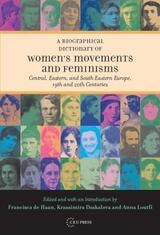
A Biographical Dictionary of Women's Movements and Feminisms
Central, Eastern, and South Eastern Europe, 19th and 20th CenturiesAnna Loutfi
Central European University Press, 2006
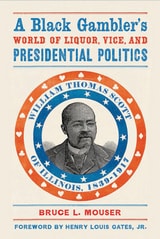
A Black Gambler’s World of Liquor, Vice, and Presidential Politics
William Thomas Scott of Illinois, 1839–1917Bruce L. Mouser
University of Wisconsin Press, 2014
Scott helped build the National Negro Liberty Party to forward economic, political, and legal rights for his race. But the hustling that had brought him business success proved his undoing as a national political figure. He was the NNLP's initial presidential nominee, only to be replaced by a better-educated and more socially acceptable candidate, George Edwin Taylor.
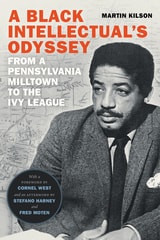
A Black Intellectual's Odyssey
From a Pennsylvania Milltown to the Ivy LeagueMartin Kilson
Duke University Press, 2021
He gives a sweeping sociological tour of Ambler as a multiethnic, working-class company town while sketching the social, economic, and racial elements that marked everyday life. From narrating the area's history of persistent racism and the racial politics in the integrated schools to describing the Black church's role in buttressing the town's small Black community, Kilson vividly renders his experience of northern small-town life during the 1930s and 1940s.
At Lincoln University, Kilson's liberal political views coalesced as he became active in the local NAACP chapter. While at Lincoln and during his graduate work at Harvard, Kilson observed how class, political, and racial dynamics influenced his peers' political engagement, diverse career paths, and relationships with white people. As a young professor, Kilson made a point of assisting Harvard's African American students in adapting to life at a white institution.
Throughout his career, Kilson engaged in pioneering scholarship while mentoring countless students. A Black Intellectual's Odyssey features contributions from three of his students: a foreword by Cornel West and an afterword by Stefano Harney and Fred Moten.
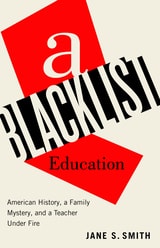
A Blacklist Education
American History, a Family Mystery, and a Teacher Under FireJane S. Smith
Rutgers University Press, 2025
Finalist for the Society of Midland Authors Richard Frisbie Award for Adult Nonfiction
In A Blacklist Education, a mysterious file of family papers triggers a journey through the dark days of political purges in the 1950s. Jane S. Smith tells the story of the anticommunist witch hunt that sent shockwaves through New York City’s public schools as more than a thousand teachers were targeted by Board of Education investigators. Her father was one of them—a fact she learned only long after his death.
Beginning in 1949, amid widespread panic about supposed communist subversion, investigators questioned teachers in their homes, accosted them in their classrooms, and ordered them to report to individual hearings. The interrogations were not published, filmed, open to the public, or reported in the news. By 1956, hundreds of New York City teachers had been fired, often because of uncorroborated reports from paid informers or anonymous accusers.
Most of the targeted teachers resigned or retired without any public process, their names recorded only in municipal files and their futures never known. Their absence became the invisible outline of an educational void, a narrowing of thought that pervaded classrooms for decades. In this highly personal story, family lore and childhood memory lead to restricted archives, forgotten inquisitions, and an eerily contemporary campaign to control who could teach and what was acceptable for students to learn.
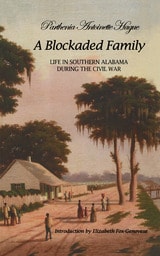
A Blockaded Family
Life in Southern Alabama During the Civil WarParthenia Hague
University of Alabama Press, 2005
Parthenia Hague experienced the Civil War while employed as a schoolteacher on a plantation near Eufaula, Alabama. This book recounts how a frightened and war-weary household dealt with privations during the blockade imposed on the South by the federal navy. The memoir of Parthenia Hague is a detailed look at the ingenious industry and self-sufficiency employed by anxious citizens as the northern army closed in.
A Body in the O
Performances and StoriesTim Miller
University of Wisconsin Press, 2019
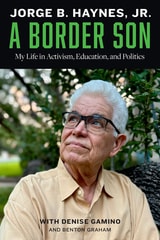
A Border Son
My Life in Activism, Education, and PoliticsJorge B. Haynes, Jr.with Denise Gamino and Benton Graham
University of Texas Press, 2026
Behind the success of every great politician, inspiring activist, or business titan, there is a staffer; Jorge B. Haynes was that staffer for some of the most influential leaders in Texas, Florida, and California.
Jorge B. Haynes had a knack for finding his way into the rooms where history was being made. From his work boycotting farmworker conditions alongside Cesar Chavez and Dolores Huerta as a young man in California to his role in President Bill Clinton’s NAFTA war room in the 1990s, he was the man advising some of the country’s most influential leaders and he left an imprint on the monumental moments that defined their time. His career spanned almost five decades, beginning with his decision to leave home in Laredo to serve in the US Air Force. But his service to the country took many different forms. Haynes worked for the Bureau of the Census the first year Latinos were allowed to declare their Hispanic heritage. He wrote speeches and orchestrated pivotal meetings for top political leadership in Texas and later Florida. In the final years of his career, he fought to make college a more accessible path for under-represented students in California.
As his paternal grandmother used to say, “Cuando vas a un lugar donde nunca has estado, finge que has estado allí,” which means, “When you go somewhere that you've never been, pretend like you've been there before.” By the end of his career, there weren’t many places that Haynes hadn’t been.
A Born Writer
Juanita Harrison and Her Beautiful WorldCathryn Halverson
University of Massachusetts Press, 2025
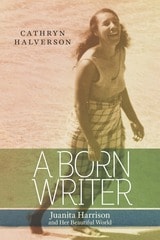
Despite the challenges she faced as an average southern Black woman of her time, Juanita Harrison transcended expectations, earning a unique place in African American and literary history. Over the course of more than four decades, she traveled constantly, first throughout the US and then throughout the world. To fund her trips, she took on short-term jobs as housekeeper, cook, and nurse, never committing to any one household. Always on the move, she made it a rule to travel alone, and she had a penchant for “passing,” not as white but as local. Her wanderlust was less aspirational and upwardly mobile than dedicated to the pursuit of leisure, freedom, and experience. “It’s my life to see and enjoy,” she declared.
In 1936, she published My Great, Wide, Beautiful World, a travelogue that charts her life between 1927 and 1935. A compilation of letters she sent to friends, employers, and patrons during her travels, the book was an immediate success, running through nine printings within ten months and becoming a bestseller for that year. The illustrious Atlantic Monthly published excerpts, the book was reviewed in newspapers and magazines nationwide, and it attracted a remarkably diverse readership, sparking the enthusiasm of Black working-class library patrons, white women’s book clubs, Japanese American journalists, Harlem Renaissance luminaries, and many others. It came back into print in 1996, ensuring her legacy would endure.
A Born Writer is the first biography of this fascinating woman who found a uniquely rewarding way to live and work that many would envy today. Combining micro histories, literary criticism, and biography—and despite limited archival records—Cathryn Halverson skillfully traces Harrison from her birth in the bitterly divided South to her death in Hawai’i, tracking her varied experiences along the way in New York, Havana, Paris, Madrid, Cairo, Mumbai, Kobe, Buenos Aires, and many other places. The resulting portrait shows a woman who transcended all kinds of borders—political, social, and cultural—to experience a freedom rarely available to women, and especially women of color, in the early-to-mid twentieth century, an achievement that continues to resonate.
A Box of Photographs
Roger Grenier
University of Chicago Press, 2013
A Brave and Lovely Woman
Mamah Borthwick and Frank Lloyd WrightMark Borthwick
University of Wisconsin Press, 2025
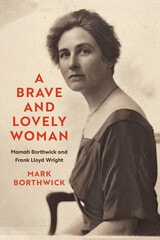
Little of Wright’s life and work has been left untouched by his many admirers, critics, and biographers. And yet the woman who stood at the center of his emotional life, Mamah Borthwick, has fallen into near obscurity. Mark Borthwick—a distant relative—recenters Mamah Borthwick in her own life, presenting a detailed portrait of a fascinating woman, a complicated figure who was at once a dedicated mother and a faithless spouse, a feminist and a member of a conservative sorority, a vivacious extrovert and a social pariah. Careful research and engaging prose at last give Borthwick, an obscure but crucial character in one of America’s most famous tragedies, center stage.
A Burning Hunger
One Family’s Struggle Against ApartheidLynda Schuster
Ohio University Press, 2006
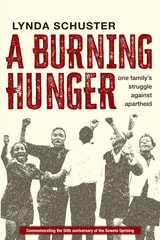
Reissued for the 50th anniversary of the Soweto Uprising, A Burning Hunger reveals how one family’s courage ignited resistance and forever changed South Africa.
If the Mandelas were the generals in the fight for black liberation, the Mashininis were the foot soldiers. Theirs is a story of exile, imprisonment, torture, and loss, but also of dignity, courage, and strength in the face of appalling adversity. Originally published in Great Britain to critical acclaim, A Burning Hunger: One Family’s Struggle Against Apartheid tells a deeply moving human story and is one of the seminal books about the struggle against apartheid.
This family, Joseph and Nomkhitha Mashinini and their thirteen children, became immersed in almost every facet of the liberation struggle—from guerrilla warfare to urban insurrection. Although Joseph and Nomkhitha were peaceful citizens who had never been involved in politics, five of their sons became leaders in the antiapartheid movement. When the students of Soweto rose up in 1976 to protest a new rule making Afrikaans the language of instruction, they were led by charismatic young Tsietsi Mashinini. Scores of students were shot down and hundreds were injured. Tsietsi’s actions on that day set in motion a chain of events that would forever change South Africa, define his family, and transform their lives.
A Burning Hunger shows the human catastrophe that plagued generations of black Africans in the powerful story of one religious and law-abiding Soweto family. Basing her narrative on extensive research and interviews, Lynda Schuster richly portrays this remarkable family and in so doing reveals black South Africa during a time of momentous change.

A Cabin Above June Lake
A MemoirMichael P. Cohen
University of Nevada Press, 2027
What does it mean to belong to a place that can never belong to you?
Set in the high country above June Lake on the eastern slope of the Sierra Nevada, this reflective narrative explores the enduring relationship between people and landscape. From their modest cabin near the headwaters of Reversed Creek, Michael and Valerie Cohen look across June Lake toward the vast expanse of the Great Basin. They are drawn to the region by its beauty and solitude, and the conviction that they are exactly where they ought to be.
Yet living in a place also means witnessing its transformation. Over nearly fifty years, the Cohens observe changes that reshape the Mono Basin and surrounding mountains: shifting economies, expanding development, record-breaking winters, wildfire threats, and the gradual erosion of community traditions.
Part memoir, part environmental reflection, part cultural history, this meditative narrative draws on writers and thinkers such as Ralph Waldo Emerson, Aldo Leopold, and Lew Welch. The Cohens’ efforts to maintain an aging cabin and a life together become a lens through which to examine stewardship, memory, resilience, and loss. This meditation on place returns to a question that has occupied generations of writers and naturalists: As the world continually reinvents itself, how must those who live within it respond?
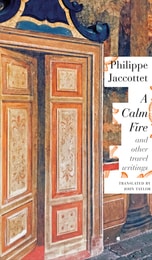
A Calm Fire
and Other Travel WritingsPhilippe Jaccottet
Seagull Books, 2018
Ultimately, whether in his native Swiss Alps or among the cedars of Lebanon, the same question pervades Philippe Jaccottet’s work: How should we live? More than a simple palliative to a depressing news cycle, Calm Fire captures a true sense of place by celebrating and pondering ways of life through the immersive experience of travel.
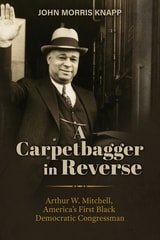
A Carpetbagger in Reverse
Arthur W. Mitchell, America's First Black Democratic CongressmanJohn Morris Knapp
University of Alabama Press, 2025
From Alabama to Congress—Arthur W. Mitchell’s fight for justice rewrote the rules of Black political power.
A Carpetbagger in Reverse offers a landmark reassessment of the life, career, and accomplishments of groundbreaking Congressman Arthur W. Mitchell, the first Black Democrat elected to Congress and the only Black member of Congress during his four terms of service from 1935 to 1943.
Born to former enslaved people in Alabama in 1883, Mitchell studied with Booker T. Washington at Tuskegee Institute and later moved to Washington DC and became a lawyer. He continued his career in Chicago, where the Great Migration had helped transform the city’s South Side into a vibrant, multiracial enclave.
As a congressman, Mitchell helped to create an enduring alliance between Black Americans and the Democratic party. Seeing his primary role as representing the South’s disempowered Black population, his belief that solutions to the region’s racial problems should arise from a new cadre of locally trained leaders brought him into frequent, vituperative conflict with the NAACP, the Republican Party, and the Black press. The first Black lawyer to argue successfully before the Supreme Court, his unanimous victory in Mitchell v. United States would have long-term consequences for the Civil Rights Movement.
A Carpetbagger in Reverse is the first publication significantly based on Mitchell’s papers, an essential and often overlooked source of insights about the development of Black political and culture life in the 1930s and 1940s.

A Castle in the Backyard
The Dream of a House in FranceBetsy Draine and Michael Hinden
University of Wisconsin Press, 2006
Like any romance, this one has had its ups and downs, and Betsy and Michael chart its course in this delightful memoir. They offer an intimate glimpse of a region little known to Americans—the Dordogne valley, its castles and prehistoric art, its walking trails and earthy cuisine—and describe the charms and mishaps of setting up housekeeping thousands of miles from home.
Along with the region’s terrain and culture, A Castle in the Backyard introduces us to the people of Périgord—the castle’s proprietor, the village children, the gossipy real-estate agent, the rascally mason, and the ninety-year-old widow with a tale of heartbreak. A celebration of a place and its people, the book also reflects on the future of historic Périgord as tourism and development pose a challenge to its graceful way of life.
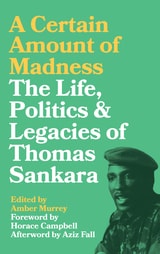
A Certain Amount of Madness
The Life Politics and Legacies of Thomas SankaraAmber Murrey
Pluto Press, 2018
This book looks at Sankara's political philosophies and legacies and their relevance today. Analyses of his synthesis of Pan-Africanism and humanist Marxist politics, as well as his approach to gender, development, ecology and decolonisation offer new insights to Sankarist political philosophies. Critical evaluations of the limitations of the revolution examine his relationship with labour unions and other aspects of his leadership style. His legacy is revealed by looking at contemporary activists, artists and politicians who draw inspiration from Sankarist thought in social movement struggles today, from South Africa to Burkina Faso.
In the 30th anniversary of his assassination, this book illustrates how Sankara's political praxis continues to provide lessons and hope for decolonisation struggles today.

A Cezanne in the Hedge and Other Memories of Charleston and Bloomsbury
Edited by Hugh Lee
University of Chicago Press, 1992
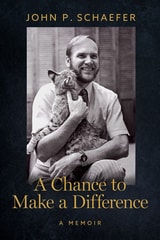
A Chance to Make a Difference
A MemoirJohn P. Schaefer
University of Arizona Press, 2025
Southwest Books of the Year Top Pick
John P. Schaefer was only thirty-six years old when he assumed the role of fifteenth president of the University of Arizona in 1971. The son of hardworking German immigrants, Schaefer grew up in Queens, New York, where childhood centered on sports, academics, and the great outdoors.
Earning a PhD in chemistry in 1958, Dr. Schaefer’s career skyrocketed through the ranks of academia, moving him from junior faculty to university president in a mere decade. As president, he led the University of Arizona through a transformational period of growth and is credited with securing the university’s status as a top-tier research institution.
A Chance to Make a Difference recounts poignant, eye-opening, and often humorous stories from childhood to presidency, revealing the characteristics of an inspiring university leader.

A Chancellor's Tale
Transforming Academic MedicineRalph Snyderman, MD
Duke University Press, 2016
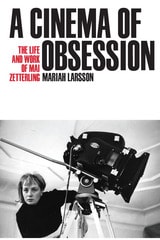
A Cinema of Obsession
The Life and Work of Mai ZetterlingMariah Larsson
University of Wisconsin Press, 2020
Critics have compared her work to that of Ingmar Bergman, Luis Buñuel, and Federico Fellini, but Zetterling had a distinct style—alternately radical and reactionary—that straddled the gendered divide between high art and mass culture. Tackling themes of sexuality, isolation, and creativity, her documentaries, short and feature films, and television works are visually striking. Her oeuvre provoked controversy and scandal through her sensational representations of reproduction and motherhood.
Mariah Larsson provides a lively and authoritative take on Zetterling's legacy and complicated position within film and women's history. A Cinema of Obsession provides necessary perspective on how the breadth of an artist's collected works keeps gatekeepers from recognizing their achievements, and questions why we still distinguish between national and global visual cultures and the big and small screens in the #MeToo era.
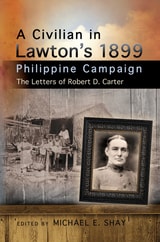
A Civilian in Lawton's 1899 Philippine Campaign
The Letters of Robert D. CarterEdited by Michael E. Shay
University of Missouri Press, 2013
In the midst of the Philippine-American War, twenty-two-year-old Robert Dexter Carter served in Manila as a civilian quartermaster clerk. Through his letters to his family, he provided a vivid picture of army life in Manila—the sights, the smells, and his responses to the native culture. In addition to his letters, his diary and several related articles present a firsthand account of the historic voyage of the United States Army Transport Grant through the Suez Canal to Manila in early 1899. Carter’s writings not only tell of his sometimes harrowing experiences, but also reveal the aspirations and fears of a young man not quite sure of his next steps on life’s journey.
Carter’s father, Robert Goldthwaite Carter, was a war hero and a longtime friend of Maj. Gen. Henry W. Lawton. Carter obtained his position through Lawton’s influence, and his respect for Lawton is clear throughout his writings. A frequent guest in the Lawton home, the young clerk was introduced to many notable figures both military and civilian. Carter’s letters, particularly to his father, are full of news and gossip related to his commander. In other letters, he reveals the kindness and generosity of Mrs. Lawton, who took time to look out for Carter while he was in the hospital and often loaned him books.
This well-researched and expertly edited work casts light on the role of support troops in war, a subject too often minimized or ignored. Shay begins each chapter with an introduction that establishes the setting, the context of events, and the disposition of Carter and his compatriots and provides notes and commentary to place the letters in context. By choosing not to edit the offensive expletives of a sometimes arrogant and racist young man, Shay presents a fully nuanced portrait of a young American exploring the larger world in a time of turmoil.
Enhanced by photographs from collections at the Library of Congress and the Military History Institute, as well as many of Carter’s own whimsical drawings, the book will appeal to armchair historians and scholars alike.
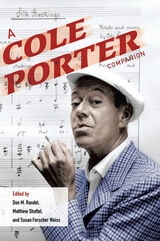
A Cole Porter Companion
Edited by Don M. Randel, Matthew Shaftel, and Susan Forscher
University of Illinois Press, 2016
In A Cole Porter Companion, a parade of performers and scholars offers essays on little-known aspects of the master tunesmith's life and art. Here are Porter's days as a Yale wunderkind and his nights as the exemplar of louche living; the triumph of Kiss Me Kate and shocking failure of You Never Know; and his spinning rhythmic genius and a turkey dinner into "You're the Top" while cultural and economic forces take "Ev'ry Time We Say Goodbye" in unforeseen directions. Other entries explore notes on ongoing Porter scholarship and delve into his formative works, performing career, and long-overlooked contributions to media as varied as film and ballet.
Prepared with the cooperation of the Porter archives, A Cole Porter Companion is an invaluable guide for the fans and scholars of this beloved American genius.
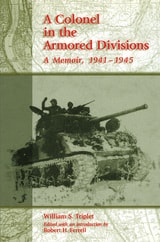
A Colonel in the Armored Divisions
A Memoir, 1941-1945William S. Triplet, Edited by Robert H. Ferrell
University of Missouri Press, 2001
In this fascinating memoir William S. Triplet continues the saga begun in his earlier book, A Youth in the Meuse-Argonne: A Memoir, 1917-1918. After serving in World War I, Triplet chose to become a career military man and entered West Point. Upon graduation in 1924, his assignments were routine—to regiments in the Southwest and in Panama or as an officer in charge of Reserve Officers' Training Corps units or of men sent to a tank school. All this changed, however, when a new war opened in Europe.
From 1940 to1942, Triplet was assigned to the Infantry Board at Fort Benning, Georgia, where he engaged in testing new weapons and machines for the expanding army. He became a full colonel in December 1942. After leaving Benning he received posts with four armored forces: the Thirteenth Armored Division forming in the United States, an amphibious tank and troop carrier group training at Fort Ord, California, and the Second and Seventh Armored Divisions in Europe. His extraordinary abilities as a tank commander became evident in the Seventh Armored, where he took over a four-thousand-man unit known as Combat Command A. He was soon moving from triumph to triumph as he led his unit into Germany. Here was much room for professional judgment and decision, and the colonel was in his element. In the war's last days Triplet and his men fought their way to the Baltic, preventing many German troops from joining in the defense of Berlin against the advancing Soviet army.
Although Triplet was recommended for brigadier general, Dwight D. Eisenhower believed the U.S. Army had enough generals to finish the war; thus, the indomitable Triplet served out the few remaining years of his career as a colonel. After retiring in 1954, Triplet moved to Leesburg, Virginia, where he soon began to mull over his military experiences. Fascinated by the history he had witnessed, engaged by the attraction of writing about it, he recorded his memories with a combination of verve, thoughtfulness, and harsh judgments concerning ranking officers he considered incompetent— generals not excluded.
Through his annotations, Robert H. Ferrell provides the historical context for Triplet's experiences. Well written and completely absorbing, A Colonel in the Armored Divisions provides readers the rare opportunity to see firsthand what a real professional in the U.S. Army thought about America's preparation for and participation in the war against Germany and Japan.
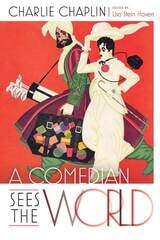
A Comedian Sees the World
Charlie Chaplin, Edited by Lisa Stein Haven
University of Missouri Press, 2014
Available only in the USA and Canada.
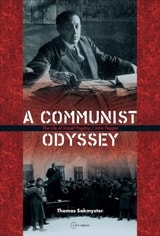
A Communist Odyssey
The life of József Pogány/John PepperThomas Sakmyster
Central European University Press, 2012
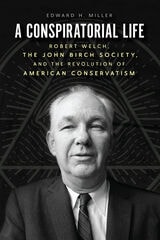
A Conspiratorial Life
Robert Welch, the John Birch Society, and the Revolution of American ConservatismEdward H. Miller
University of Chicago Press, 2021
Though you may not know his name, Robert Welch (1899-1985)—founder of the John Birch Society—is easily one of the most significant architects of our current political moment. In A Conspiratorial Life, the first full-scale biography of Welch, Edward H. Miller delves deep into the life of an overlooked figure whose ideas nevertheless reshaped the American right.
A child prodigy who entered college at age 12, Welch became an unlikely candy magnate, founding the company that created Sugar Daddies, Junior Mints, and other famed confections. In 1958, he funneled his wealth into establishing the organization that would define his legacy and change the face of American politics: the John Birch Society. Though the group’s paranoiac right-wing nativism was dismissed by conservative thinkers like William F. Buckley, its ideas gradually moved from the far-right fringe into the mainstream. By exploring the development of Welch’s political worldview, A Conspiratorial Life shows how the John Birch Society’s rabid libertarianism—and its highly effective grassroots networking—became a profound, yet often ignored or derided influence on the modern Republican Party. Miller convincingly connects the accusatory conservatism of the midcentury John Birch Society to the inflammatory rhetoric of the Tea Party, the Trump administration, Q, and more. As this book makes clear, whether or not you know his name or what he accomplished, it’s hard to deny that we’re living in Robert Welch’s America.
A Conspiratorial Life
Robert Welch, the John Birch Society, and the Revolution of American ConservatismEdward H. Miller
University of Chicago Press, 2021
This is an auto-narrated audiobook edition of this book.
The first full-scale biography of Robert Welch, who founded the John Birch Society and planted some of modern conservatism’s most insidious seeds.
Though you may not know his name, Robert Welch (1899-1985)—founder of the John Birch Society—is easily one of the most significant architects of our current political moment. In A Conspiratorial Life, the first full-scale biography of Welch, Edward H. Miller delves deep into the life of an overlooked figure whose ideas nevertheless reshaped the American right.
A child prodigy who entered college at age 12, Welch became an unlikely candy magnate, founding the company that created Sugar Daddies, Junior Mints, and other famed confections. In 1958, he funneled his wealth into establishing the organization that would define his legacy and change the face of American politics: the John Birch Society. Though the group’s paranoiac right-wing nativism was dismissed by conservative thinkers like William F. Buckley, its ideas gradually moved from the far-right fringe into the mainstream. By exploring the development of Welch’s political worldview, A Conspiratorial Life shows how the John Birch Society’s rabid libertarianism—and its highly effective grassroots networking—became a profound, yet often ignored or derided influence on the modern Republican Party. Miller convincingly connects the accusatory conservatism of the midcentury John Birch Society to the inflammatory rhetoric of the Tea Party, the Trump administration, Q, and more. As this book makes clear, whether or not you know his name or what he accomplished, it’s hard to deny that we’re living in Robert Welch’s America.
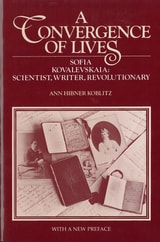
A Convergence of Lives
Sofia Kovalevskaia - Scientist, Writer, RevolutionaryKoblitz, Ann
Rutgers University Press, 1993
Sofia Kovalevskaia's interest in mathematics was roused at an early age--her attic nursery had been wallpapered with lecture notes for a course on calculus. She spent hours studying the mysterious walls, trying to figure out which page followed from the next. Kovalevskaia (1850-1891) became the only woman mathematician whose name all mathematicians recognize, thanks to her contributions to mathematical analysis. Indeed, she was the first professional woman scientist to win international eminence in any field: the first woman doctorate in mathematics, the first to hold a chair in mathematics, the first to sit on the editorial board of a major scientific journal.
She was also an accomplished writer, a proponent of women's rights and education, a wife and mother in an unconventional marriage, and a champion of radical political causes in Russia and Western Europe--a friend and correspondent of Dostoyevsky, Chekhov, George Eliot, Kropotkin, Helmholtz, and Darwin. This sympathetic portrait of a remarkable woman will appeal to any reader, non-mathematicians and mathematicians alike.
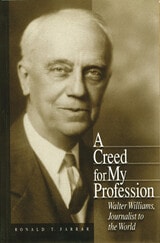
A Creed for My Profession
Walter Williams, Journalist to the WorldRonald T. Farrar
University of Missouri Press, 1998
This superb biography provides for the first time a candid look at the remarkable life of Walter Williams, the man who founded the world's first school of journalism and perhaps contributed more toward the promotion of professional journalism than any other person of his time.
Williams, the youngest of six children, was born in Boonville, Missouri, in 1864. Never an athletic child, he always had a love of books and of learning; yet, he scarcely had a high school education. He began his journalistic career as a printer's devil at seventy cents per week and eventually became editor and part- owner of a weekly in Columbia, Missouri. During his time as an editor, Williams became convinced that journalism would never reach its potential until its practitioners had the opportunity for university training in their field. After years of crusading, he established the first journalism school, on the University of Missouri campus. Later, he was chosen president of the University of Missouri, which he led with distinction during the Great Depression.
Williams was an unwavering advocate of high professional standards. His Journalist's Creed became one of the most widely circulated codes of professional ethics. Williams inspired the confidence of his fellow journalists, and he carried his message to nearly every country in which newspapers were published. Not only did he invent journalism education, he also created global organizations of journalists and spread the gospel of professionalism throughout the world. His death, in 1935, was mourned throughout the United States, and editorial tributes came from around the world. As one British editor succinctly put it, "Williams was not born to greatness. Neither was it thrust upon him. Literally, he achieved greatness."
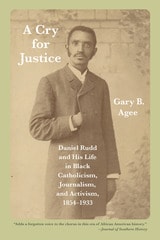
A Cry for Justice
Daniel Rudd and His Life in Black Catholicism, Journalism, and Activism, 1854-1933Gary B. Agee
University of Arkansas Press, 2017
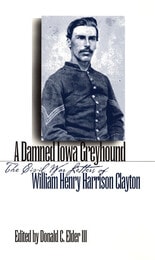
A Damned Iowa Greyhound
The Civil War Letters of William Henry Harrison ClaytonDonald C. Elder, III
University of Iowa Press, 1998
William Henry Harrison Clayton was one of nearly 75,000 soldiers from Iowa to join the Union ranks during the Civil War. Possessing a high school education and superior penmanship, Clayton served as a company clerk in the 19th Infantry, witnessing battles in the Trans-Mississippi theater. His diary and his correspondence with his family in Van Buren County form a unique narrative of the day-to-day soldier life as well as an eyewitness account of critical battles and a prisoner-of-war camp.
Clayton participated in the siege of Vicksburg and took part in operations against Mobile, but his writings are unique for the descriptions he gives of lesser-known but pivotal battles of the Civil War in the West. Fighting in the Battle of Prairie Grove, the 19th Infantry sustained the highest casualties of any federal regiment on the field. Clayton survived that battle with only minor injuries, but he was later captured at the Battle of Stirling's Plantation and served a period of ten months in captivity at Camp Ford, Texas.
Clayton's writing reveals the complicated sympathies and prejudices prevalent among Union soldiers and civilians of that period in the country's history. He observes with great sadness the brutal effects of war on the South, sympathizing with the plight of refugees and lamenting the destruction of property. He excoriates draft evaders and Copperheads back home, conveying the intra-sectional acrimony wrought by civil war. Finally, his racist views toward blacks demonstrate a common but ironic attitude among Union soldiers whose efforts helped lead to the abolition of slavery in the United States.