Results by title
2 books match the query 'Biological systems'
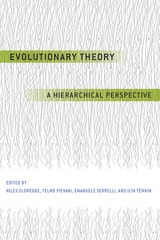
Evolutionary Theory
A Hierarchical PerspectiveEdited by Niles Eldredge, Telmo Pievani, Emanuele Serrelli, and Ilya Temkin
University of Chicago Press, 2016
The natural world is infinitely complex and hierarchically structured, with smaller units forming the components of progressively larger systems: molecules make up cells, cells comprise tissues and organs that are, in turn, parts of individual organisms, which are united into populations and integrated into yet more encompassing ecosystems. In the face of such awe-inspiring complexity, there is a need for a comprehensive, non-reductionist evolutionary theory. Having emerged at the crossroads of paleobiology, genetics, and developmental biology, the hierarchical approach to evolution provides a unifying perspective on the natural world and offers an operational framework for scientists seeking to understand the way complex biological systems work and evolve.
Coedited by one of the founders of hierarchy theory and featuring a diverse and renowned group of contributors, this volume provides an integrated, comprehensive, cutting-edge introduction to the hierarchy theory of evolution. From sweeping historical reviews to philosophical pieces, theoretical essays, and strictly empirical chapters, it reveals hierarchy theory as a vibrant field of scientific enterprise that holds promise for unification across the life sciences and offers new venues of empirical and theoretical research. Stretching from molecules to the biosphere, hierarchy theory aims to provide an all-encompassing understanding of evolution and—with this first collection devoted entirely to the concept—will help make transparent the fundamental patterns that propel living systems.
Coedited by one of the founders of hierarchy theory and featuring a diverse and renowned group of contributors, this volume provides an integrated, comprehensive, cutting-edge introduction to the hierarchy theory of evolution. From sweeping historical reviews to philosophical pieces, theoretical essays, and strictly empirical chapters, it reveals hierarchy theory as a vibrant field of scientific enterprise that holds promise for unification across the life sciences and offers new venues of empirical and theoretical research. Stretching from molecules to the biosphere, hierarchy theory aims to provide an all-encompassing understanding of evolution and—with this first collection devoted entirely to the concept—will help make transparent the fundamental patterns that propel living systems.
[more]

Into the Cool
Energy Flow, Thermodynamics, and LifeEric D. Schneider and Dorion Sagan
University of Chicago Press, 2005
Scientists, theologians, and philosophers have all sought to answer the questions of why we are here and where we are going. Finding this natural basis of life has proved elusive, but in the eloquent and creative Into the Cool, Eric D. Schneider and Dorion Sagan look for answers in a surprising place: the second law of thermodynamics. This second law refers to energy's inevitable tendency to change from being concentrated in one place to becoming spread out over time. In this scientific tour de force, Schneider and Sagan show how the second law is behind evolution, ecology,economics, and even life's origin.
Working from the precept that "nature abhors a gradient," Into the Cool details how complex systems emerge, enlarge, and reproduce in a world tending toward disorder. From hurricanes here to life on other worlds, from human evolution to the systems humans have created, this pervasive pull toward equilibrium governs life at its molecular base and at its peak in the elaborate structures of living complex systems. Schneider and Sagan organize their argument in a highly accessible manner, moving from descriptions of the basic physics behind energy flow to the organization of complex systems to the role of energy in life to the final section, which applies their concept of energy flow to politics, economics, and even human health.
A book that needs to be grappled with by all those who wonder at the organizing principles of existence, Into the Cool will appeal to both humanists and scientists. If Charles Darwin shook the world by showing the common ancestry of all life, so Into the Cool has a similar power to disturb—and delight—by showing the common roots in energy flow of all complex, organized, and naturally functioning systems.
“Whether one is considering the difference between heat and cold or between inflated prices and market values, Schneider and Sagan argue, we can apply insights from thermodynamics and entropy to understand how systems tend toward equilibrium. The result is an impressive work that ranges across disciplinary boundaries and draws from disparate literatures without blinking.”—Publishers Weekly
[more]