Results by title
82 books match the query 'Birdwatching Guides' and 7 start with a

A Birder’s West Indies
An Island-by-Island TourBy Roland H. Wauer
University of Texas Press, 1996
The West Indies offer so much more than sun, sand, and shopping. This sweeping arc of islands, which runs from Cuba to Grenada and includes the Virgin Islands, teems with a rich diversity of plant and animal life. Up to 40 percent of the plants in some forests are found nowhere else on earth, while the West Indian flyway is a critical link in the migratory routes of many birds.
In A Birder's West Indies, Roland Wauer takes you on an island-by-island journey of discovery. He describes the unique natural features of each island and recounts his often fascinating experiences in seeking out the nearly 400 species of birds known in the West Indies. His accounts give insight into the birds' habitats, status, and ecology and record some of the threats posed by human activities.
For readers planning trips to the West Indies, Wauer also includes helpful, up-to-date facts about the best times to travel, the kinds of entry and customs systems to expect, the money exchange services available, and general information about weather, food, and accommodations. Filling a unique niche among current guides, A Birder's West Indies offers both professional ornithologists and avocational bird watchers a chance to compare notes and experiences with an expert observer. And for readers who haven't yet visited the islands, Wauer's fluid prose and lovely color photographs will be the next-best thing to being there—and an irresistible invitation to go.

A Naturalist amid Tropical Splendor
Alexander F. Skutch
University of Iowa Press, 1987
In this reflective account of life in the tropics, Alexander Skutch offers readers both his observations and his interpretations of what he has experienced. In the many chapters about birds and their behavior, he describes a dove that defends its nest with rare courage, castlebuilders who create elaborate nests of interlaced twigs, oropendolas that cluster long woven pouches in high treetops, and an exceptionally graceful hummingbird who fails to pay for its nectar by pollinating the flowers that yield it. Skutch also describes curious plants and their flowers, including a birthwort that holds its pollinating flies captive and fern fronds that twine high up trunks in the rain forest.
With penetrating clarity, Skutch considers the significance of all this restless activity: he examines the origins of beauty and our ability to appreciate it, the foundations of tropical splendor, the factors that help us feel close to nature or alienated from it, and the possibility of consciousness and emotion in animals. He also addresses the quandary of the biologist contemplating painful experiments on animals rather than learning by direct observation, and he asserts that our capacity to care for the world around us is the truest criterion of our evolutionary advancement.
Skutch brings a thoughtful, unequaled voice to the description of the world he has grown to know and understand, a world considered forbidding by most northerners and still largely unexplored.

Adaptive Strategies and Population Ecology of Northern Grouse
Volume 1. Population StudiesArthur T. Bergerud and Michael W. Gratson, Editors
University of Minnesota Press, 1988
Adaptive Strategies and Population Ecology of Northern Grouse was first published in 1988. Minnesota Archive Editions uses digital technology to make long-unavailable books once again accessible, and are published unaltered from the original University of Minnesota Press editions.
This book is at once a major reference to the species of grouse that inhabit North America and the Holarctic and a synthesis of all the available data on their ecology, sociobiology, population dynamics, and management. The book undertakes to answer two long-standing questions in population ecology: what actually regulates the numbers within a population, and what are the breeding and survival strategies evolved in this northern environment? For Volume I, editors Arthur T. Bergerud and Michael W. Gratson have drawn together their own work and that of colleagues in North America, Iceland, and Norway—in all, eleven research studies, averaging six years' duration, on eight species of grouse. These studies deal with the blue and ruffed grouse of the forest habitat; the sharp-tailed grouse, prairie chicken, and sage grouse of the prairie or steppe; and the white-tailed, rick, and willow ptarmigan found in alpine and arctic tundras. The authors describe the rich repertoire of behavior patterns developed by the hen and the cock to achieve their two primary objectives—first, to stay alive, and then to breed. Volume II, primarily the work of Bergerud, synthesizes the evidence in Volume I and in the grouse research literature from a theoretical perspective. Several potentially controversial sociobiological hypotheses are advanced to account for flocking behavior, migration, dispersal, roosting and feeding behavior, mate choice and mating systems. The demographic analysis provides new insights into cycles of abundance, the limitation of numbers, and the demographic factors that determine densities. The contributors, besides Bergerud and Gratson: R.C. Davies, A. Gardarson, J.E. Hartzler, R.A. Huempfner, D.A. Jenni, D.H. Mossop, S. Myrberget, R.E. Page, R.K. Schmidt, W.D. Svedarsky, and J.R. Tester.
Adaptive Strategies and Population of Northern Grouse
Volume II. Theory and SynthesisArthur T. Bergerud and Michael W. Gratson, Editors
University of Minnesota Press, 1988
Adaptive Strategies and Population of Northern Grouse was first published in 1988. Minnesota Archive Editions uses digital technology to make long-unavailable books once again accessible, and are published unaltered from the original University of Minnesota Press editions.
The first volume contains eleven studies of eight grouse species; the second contains primarily the work of Bergerud, which utilizes the evidence in the first volume to advance theories of behavior and offer new demographic insights.
This second volume contains primarily the work of Bergerud, which utilizes the evidence in the first volume to advance theories of behavior and offer new demographic insights.
Annotated Checklist of the Birds of Arizona
Gale Monson and Allan R. Phillips
University of Arizona Press, 1981
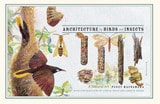
Architecture by Birds and Insects
A Natural ArtPaintings by Peggy Macnamara
University of Chicago Press, 2008
A visual celebration of these natural feats of engineering and ingenuity, Architecture by Birds and Insects allows readers a peek inside a wide range of nests, offering a rare opportunity to get a sense of the materials and methods used to build them. Here, we see the kinds of places where nests are built—for instance, the house wren has been known to occupy cow skulls, flower pots, tin cans, and the pockets of hanging laundry, while the uglynest caterpillar prefers rose bushes and cherry trees. Inspired by the vast nest collection at the Field Museum, which features specimens gathered throughout North and South America, Peggy Macnamara’s paintings are enhanced by text written by museum curators. This narrative provides a foundation in natural history for each painting, as well as fascinating anecdotes about the nests and their builders.
Like so many natural treasures, nests are easy to ignore. But Macnamara’s gorgeous paintings will undoubtedly change that. Architecture by Birds and Insects at last gives the tiniest engineers their rightful moment in the spotlight, and in so doing increases awareness and encourages the protection of birds, insects, and their habitats. Readers will never look at a Frank Gehry design, or a treetop nest, the same way again.
Atlas of Wintering North American Birds
An Analysis of Christmas Bird Count DataTerry Root
University of Chicago Press, 1989
Terry Root has used the data from the 1963-72 counts to provide the first large-scale biogeographical account of birds wintering in North America. Using sophisticated computer techniques, Root has translated the data into both traditional contour maps and innovative new maps that stimulate three dimensions. The maps show at a glance that, for example, the Baltimore Oriole winters primarily along the eastern seaboard, with the densest populations in Florida between Tallahassee and Gainesville and in North Carolina from Rocky Mount to the Croatan National Forest.