Results by title
17 books match the query 'Birmingham'

A Century of Jewish Life In Dixie
The Birmingham ExperienceMark H. Elovitz
University of Alabama Press, 2003
Exploring the resilience, identity, and contributions of Southern Jews in the heart of Alabama.
This is the first substantial history of the Jews in any inland town or city of the industrial South. A Century of Jewish Life in Dixie offers a vivid and deeply researched portrait of Birmingham, Alabama’s Jewish community. Mark H. Elovitz traces the community’s evolution from its immigrant roots in the late 19th century through its growth into a vibrant and influential part of Southern society. Drawing on archival records, oral histories, and cultural analysis, Elovitz explores how Southern Jews balanced tradition and assimilation, navigated racial and religious tensions, and contributed to civic and economic life in a region undergoing dramatic transformation. This book provides a rare and nuanced look at Jewish identity in the American South, making it an essential resource for scholars of Jewish studies, Southern history, and American cultural life.
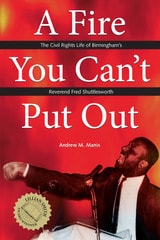
A Fire You Can't Put Out
The Civil Rights Life of Birmingham's Reverend Fred ShuttlesworthAndrew M. Manis
University of Alabama Press, 2001
WINNER, LILLIAN SMITH AWARD
WINNER, JAMES F. SULZBY, JR. AWARD
The fire of freedom that changed Birmingham—and America.
When Fred Shuttlesworth suffered only a bump on the head in the 1956 bombing of his home, members of his church called it a miracle. Shuttlesworth took it as a sign that God would protect him on the mission that had made him a target that night. Standing in front of his demolished home, Shuttlesworth vigorously renewed his commitment to integrate Birmingham's buses, lunch counters, police force, and parks. The incident transformed him, in the eyes of Birmingham's blacks, from an up-and-coming young minister to a virtual folk hero and, in the view of white Birmingham, from obscurity to rabble-rouser extraordinaire.
From his 1956 founding of the Alabama Christian Movement for Human Rights through the historic demonstrations of 1963, driven by a sense of divine mission, Shuttlesworth pressured Jim Crow restrictions in Birmingham with radically confrontational acts of courage. His intensive campaign pitted him against the staunchly segregationist police commissioner Eugene "Bull" Connor and ultimately brought him to the side of Martin Luther King Jr. and to the inner chambers of the Kennedy White House.
First published in 1999, Andrew Manis's award-winning biography of "one of the nation's most courageous freedom fighters" demonstrates compellingly that Shuttleworth's brand of fiery, outspoken confrontation derived from his prophetic understanding of the pastoral role. Civil rights activism was tantamount to salvation in his understanding of the role of Christian minister.
A Time to Speak
The Story of a Young American Lawyer's Struggle for His City—and HimselfCharles Morgan Jr., With a New Foreword by Senator Doug Jones
University of Alabama Press, 2022
Brings back into print a classic account of courage and calamity in the long march toward racial justice in the South, and the nation
On September 15, 1963, a bomb exploded at the Sixteenth Street Baptist Church in Birmingham, Alabama, killing four young Black girls. The very next day, a prominent white lawyer named Charles Morgan Jr. was scheduled to speak at a luncheon held by the Young Men’s Business Club of Birmingham. A well-regarded figure in the city’s legal and business establishment, Morgan had been mentioned frequently as a candidate for political office. To the shock of his longtime friends and associates, Morgan deviated from his planned remarks, instead using his platform to place the blame for the murder of the four young girls squarely on the shoulders of the city’s white middle-class establishment, those seated before him.
As much as his stand was admired nationally, in Birmingham the results were destructive for him personally. Threats against his life and the lives of his family poured in daily by phone and mail, his political career was finished, and he was faced with financial ruin. Within weeks, he moved his family out of the state, and thenceforward committed himself to legal action in the name of racial justice. In 1964, he established the regional office of the ACLU in Atlanta. In the 1964 Supreme Court case Reynolds v. Sims, Morgan successfully argued that districts in state legislatures needed to be of nearly equal size, establishing the principle of “one man, one vote” to effectively end the use of gerrymandering.
A Time to Speak was originally published in 1964, a mere year after Morgan and his family fled Birmingham. The memoir recounts not only his speech, but his entire upbringing and the political, cultural, and social milieus in which he was raised and which gave rise to the cowardice, institutional silence, fear, and hate that those conditions nursed. This new edition features a foreword from US Senator Doug Jones.
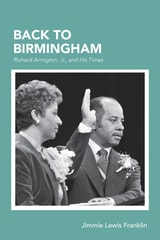
Back To Birmingham
Richard Arrington, Jr., and His TimesJimmie Lewis Franklin
University of Alabama Press, 1989
During the 1960s, Birmingham, Alabama was the central battleground in the struggle for human rights in the American South. As one of the most segregated cities in the United States, the city of Birmingham became infamous for its suppression of civil rights and for official and vigilante violence against its African American citizens, most notoriously the use of explosives in the Sixteenth Street Baptist Church bombing and the bombing of the home of Reverend Fred Shuttlesworth.
In October of 1979, Birmingham elected its first Black mayor, Richard Arrington Jr. He was born in the rural town of Livingston, Alabama. His family moved to Birmingham when he was a child. A man of quiet demeanor, he was nevertheless destined to bring to fruition many of the fundamental changes that the Civil Rights Movement had demanded. This is his story. Not a conventional political or Civil Rights history, Back to Birmingham is the story of a man who demonstrated faith in his region and people. The work illuminates Arrington's sense of place, a quality that enables a person to claim sentimentally a portion of the natural and human environment. Franklin passionately underscores the importance of the attachment of Southern Blacks to their land and place.
Back to Birmingham will appeal to both the general reader and the serious student of American society. The book endeavors to bridge the gap between popular and scholarly history. It is guided by the assumption that Americans of whatever description can find satisfaction in comprehending social change and that they are buoyed by the individual triumph of those who beat the odds.
Birmingham's Rabbi
Morris Newfield and Alabama, 1895-1940Mark Cowett
University of Alabama Press, 1986
Taking a multidimensional approach, Cowett places Newfield's early life in the context of his Hungarian childhood and also relates Newfield’s career to those of fellow Hebrew Union College graduates and to national Reform Jewish history. The reader is made aware constantly of changing conditions in Birmingham, in Alabama, and in the south and how those changes affected Newfield’s congregants. Cowett illuminates Newfield’s efforts to help Jews maintain a sense of religious identity in a predominately Southern and Christian environment.
Based upon essential sources including interviews, newspapers, and manuscript collections in Alabama and at the American Jewish Archives in Cincinnati, Cowett shows Newfield’s struggle to support social welfare efforts in Alabama during the Progressive Era. He recognized the need for Jews to develop bonds with other American ethnic groups. Cowett portrays him as a mediator between not only Jew and Christian but also black and white, labor and capital, liberal and conservative—in short, within the full spectrum of political and social exchange in an industrial city of the New South.
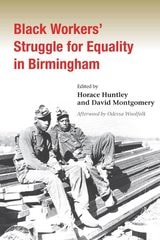
Black Workers' Struggle for Equality in Birmingham
Edited by Horace Huntley and David Montgomery
University of Illinois Press, 2004
Horace Huntley and David Montgomery curate a collection of annotated oral interviews of black workers who served on the front lines of the Civil Rights Movement in Birmingham, Alabama. As the interviewees recount their struggles against discrimination, they show how collective action--whether through unions, the Movement, or networks of workplace activists--sought to gain access to better jobs, municipal services, housing, and less restrictive voter registration.
Powerful and honest, Black Workers' Struggle for Equality in Birmingham draws on work by the Birmingham Civil Rights Institute to offer readers vivid eyewitness accounts of American history in the making.
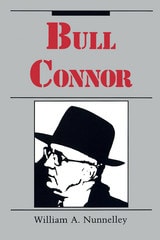
Bull Connor
William A. Nunnelley
University of Alabama Press, 1990
Nunnelley’s biography covers Connor’s early life as a sportscaster, his years as a nearly pathological police chief, and his reign as president of a corrupt public service commission.While providing the first published biographical study of Connor, Bull also traces the evolution of the civil rights movement in Birmingham. The book amplifies traditional one-dimensional accounts through the use of such primary sources a s Connor FBI files gained from a Freedom of Information request, Connor papers discovered in an old fire station about to be demolished, files from a law firm which represented Connor, interviews, and newspaper files. Connor’s racist image remains intact, but a more complete portrait of the controversial commissioner emerges.
Eugene “Bull” Connor gained infamy during the spring of 1963 as the heavy-handed Birmingham police commissioner who turned power hoses and police dogs on the black demonstrators led by Martin Luther King, Jr. Bull Connor and Birmingham symbolized hard-line Southern racism. Connor’s actions received national and international media coverage, which dramatized the plight of black people in segregated areas, giving the civil rights movement much-needed attention. After viewing television reports of the fire-hose and police-dogs episode, President John Kennedy said, “The civil rights movement should thank God for Bull Connor. He helped is as much as Abraham Lincoln.”
Bull Connor was an unlikely catalyst for the civil rights movement. Rather than forestalling integration, his response to the 1963 demonstrations hastened the demise of the dual society of which he became a symbol. Within weeks of King’s much-publicized Birmingham campaign, Congress took the first steps toward enacting the most sweeping civil rights legislation in American history. Birmingham was a turning point in the civil rights struggle, and Connor was the movement’s perfect adversary.
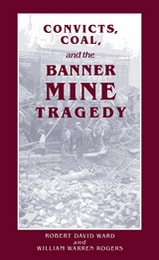
Convicts, Coal, and the Banner Mine Tragedy
Robert David Ward
University of Alabama Press, 1987
In the late 1870s, Jefferson County, Alabama, and the town of Elyton (near the future Birmingham) became the focus of a remarkable industrial and mining revolution. Together with the surrounding counties, the area was penetrated by railroads. Surprisingly large deposits of bituminous coal, limestone, and iron ore—the exact ingredients for the manufacture of iron and, later, steel—began to be exploited. Now, with transportation, modern extractive techniques, and capital, the region’s geological riches began yielding enormous profits.
This book is about the men who worked involuntarily in the Banner Coal Mine, owned by the Pratt Consolidated Coal Company. And it is about the repercussions and consequences that followed an explosion at the mine in the spring of 1911 that killed 128 convict miners.

Doc
The Story of a Birmingham Jazz ManFrank "Doc" Adams and Burgin Mathews
University of Alabama Press, 2012
Autobiography of jazz elder statesman Frank “Doc” Adams, highlighting his role in Birmingham, Alabama’s, historic jazz scene and tracing his personal adventure that parallels, in many ways, the story and spirit of jazz itself.
Doc tells the story of an accomplished jazz master, from his musical apprenticeship under John T. “Fess” Whatley and his time touring with Sun Ra and Duke Ellington to his own inspiring work as an educator and bandleader.
Central to this narrative is the often-overlooked story of Birmingham’s unique jazz tradition and community. From the very beginnings of jazz, Birmingham was home to an active network of jazz practitioners and a remarkable system of jazz apprenticeship rooted in the city’s segregated schools. Birmingham musicians spread across the country to populate the sidelines of the nation’s bestknown bands. Local musicians, like Erskine Hawkins and members of his celebrated orchestra, returned home heroes. Frank “Doc” Adams explores, through first-hand experience, the history of this community, introducing readers to a large and colorful cast of characters—including “Fess” Whatley, the legendary “maker of musicians” who trained legions of Birmingham players and made a significant mark on the larger history of jazz. Adams’s interactions with the young Sun Ra, meanwhile, reveal life-changing lessons from one of American music’s most innovative personalities.
Along the way, Adams reflects on his notable family, including his father, Oscar, editor of the Birmingham Reporter and an outspoken civic leader in the African American community, and Adams’s brother, Oscar Jr., who would become Alabama’s first black supreme court justice. Adams’s story offers a valuable window into the world of Birmingham’s black middle class in the days before the civil rights movement and integration. Throughout, Adams demonstrates the ways in which jazz professionalism became a source of pride within this community, and he offers his thoughts on the continued relevance of jazz education in the twenty-first century.
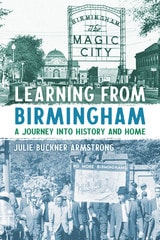
Learning from Birmingham
A Journey into History and HomeJulie Buckner Armstrong
University of Alabama Press, 2023
A steel town daughter’s search for truth and beauty in Birmingham, Alabama
“As Birmingham goes, so goes the nation,” Fred Shuttlesworth observed when he invited Martin Luther King Jr. to the city for the transformative protests of 1963. From the height of the Civil Rights Movement through its long aftermath, images of police dogs, fire hoses and four girls murdered when Ku Klux Klan members bombed the Sixteenth Street Baptist Church have served as an uncomfortable racial mirror for the nation. Like many white people who came of age in the Civil Rights Movement’s wake, Julie Buckner Armstrong knew little about this history. Only after moving away and discovering writers like Toni Morrison and Alice Walker did she realize how her hometown and family were part of a larger, ongoing story of struggle and injustice.
When Armstrong returned to Birmingham decades later to care for her aging mother, Shuttlesworth’s admonition rang in her mind. By then an accomplished scholar and civil rights educator, Armstrong found herself pondering the lessons Birmingham holds for a twenty-first century America. Those lessons extended far beyond what a 2014 Teaching Tolerance report describes as the common distillation of the Civil Rights Movement into “two names and four words: Martin Luther King Jr, Rosa Parks, and ‘I have a dream.’” Seeking to better understand a more complex local history, its connection to broader stories of oppression and resistance, and her own place in relation to it, Armstrong embarked on a journey to unravel the standard Birmingham narrative to see what she would find.
Beginning at the center, with her family’s 1947 arrival to a housing project near the color line, within earshot of what would become known as Dynamite Hill, Armstrong works her way over time and across the map. Weaving in stories of her white working-class family, classmates, and others not traditionally associated with Birmingham’s civil rights history, including members of the city’s LGBTQ community, she forges connections between the familiar and lesser-known. The result is a nuanced portrait of Birmingham--as seen in public housing, at old plantations, in segregated neighborhoods, across contested boundary lines, over mountains, along increasingly polluted waterways, beneath airport runways, on highways cutting through town, and under the gaze of the iconic statue of Vulcan.
In her search for truth and beauty in Birmingham, Armstrong draws on the powers of place and storytelling to dig into the cracks, complicating easy narratives of civil rights progress. Among the discoveries she finds in America’s racial mirror is a nation that has failed to recognize itself in the horrific images from Birmingham’s past and to acknowledge the continuing inequalities that make up the Civil Right’s Movement’s unfinished business. Learning from Birmingham reminds us that stories of civil rights, structural oppression, privilege, abuse, race and gender bias, and inequity are difficult and complicated, but their telling, especially from multiple stakeholder perspectives, is absolutely necessary.
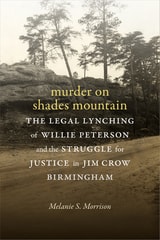
Murder on Shades Mountain
The Legal Lynching of Willie Peterson and the Struggle for Justice in Jim Crow BirminghamMelanie S. Morrison
Duke University Press, 2018
In Murder on Shades Mountain Melanie S. Morrison tells the gripping and tragic story of the attack and its aftermath—events that shook Birmingham to its core. Having first heard the story from her father—who dated Nell's youngest sister when he was a teenager—Morrison scoured the historical archives and documented the black-led campaigns that sought to overturn Peterson's unjust conviction, spearheaded by the NAACP and the Communist Party. The travesty of justice suffered by Peterson reveals how the judicial system could function as a lynch mob in the Jim Crow South. Murder on Shades Mountain also sheds new light on the struggle for justice in Depression-era Birmingham. This riveting narrative is a testament to the courageous predecessors of present-day movements that demand an end to racial profiling, police brutality, and the criminalization of black men.
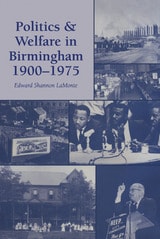
Politics and Welfare in Birmingham, 1900–1975
Edward Shannon LaMonte
University of Alabama Press, 1995
This well-written volume explores the relationships between politics and welfare programs for low-income residents in Birmingham during four periods in the twentieth century:
From the time of its founding in 1871, Birmingham has had a biracial population, so the theme of race relations runs naturally throughout the narrative. LaMonte pays particular attention to those efforts to achieve a more harmonious biracial community, including the failed effort to establish an Urban League in the 1940s, the progressive activities of the Community Chest’s Interracial Division in the 1950s, which were abruptly terminated, and the dramatic events of the Civil Rights Movement in the 1960s, when local events were elevated to international significance.

Sloss Furnaces and the Rise of the Birmingham District
An Industrial EpicW. David Lewis
University of Alabama Press, 1994
"A masterpiece that deserves to be ranked with such seminal and influential works as Cash’s Mind of the South." —Edwin T. Layton Jr., author of The Revolt of the Engineers: Social Responsibility and the American Profession
This pathbreaking book tells the dramatic story of a unique manufacturing complex and the city that it helped to create. The events recounted and interpreted by W. David Lewis are of more than local or regional significance. The rise of Sloss furnaces and Birmingham epitomized the emergence of the United States as the world's foremost economic power. Similarly, the closing of a once-profitable ironmaking installation amid social and technological changes that convulsed Birmingham nine decades after the city's founding typified challenges that were facing America at the dawn of the postindustrial age.
Above all, Sloss Furnaces resonates with the class of competition and the frenetic energy with which southerners joined other Americans in a rush to transform a continent after a fratricidal drive for independence had failed. The sweeping narrative that Lewis has produced amply justifies its subtitle, An Industrial Epic.
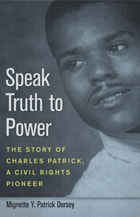
Speak Truth to Power
The Story of Charles Patrick, a Civil Rights PioneerMignette Y. Patrick Dorsey
University of Alabama Press, 2010
"Patrick did not intend to become a civil rights pioneer, but a minor dispute over a parking spot led to his arrest, beating while in custody, and eventual legal tribulations. His daughter's account of his ordeal is well researched, beautifully narrated, and extremely informative." —Journal of Southern History
On December 11, 1954, Charles Patrick drove to downtown Birmingham to buy a Boy Scout uniform for his son. Christmas traffic around the downtown department stores was heavy, and Patrick circled unsuccessfully until at last a streetside spot opened up and he began to pull in. As he did so, he was cut off by a woman who ordered him out of the way, as she was the wife of a city police officer. Patrick pulled away, remarking, "Ma’am, he doesn’t own the streets of Birmingham."
Normal low-level urban hassle? Not in 1954 Birmingham, when the woman was white and Patrick black. The woman reported to her husband that a black man had sassed her, and Patrick was summarily arrested, charged with disorderly conduct, and placed in a cell where he was beaten by the husband and another police officer.
Usually that would have been the end of it, but Patrick was not the sort of man to meekly endure an injustice. He found an attorney, went to court to fight the charges, and brought his assailants to justice--as whites, blacks, politicians and the press offered public support.
This book tells the story of Patrick’s quest for justice in segregated Alabama on the eve of the civil rights movement and represents a telling instance of the growing determination of African Americans to be treated fairly, part of the broadening and deepening stream of resolve that led to the widespread activism of the civil rights movement.
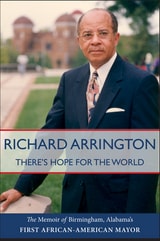
There's Hope for the World
The Memoir of Birmingham, Alabama's First African American MayorRichard Arrington
University of Alabama Press, 2008
On a sultry September morning in 1955, a young African American man, the son of share croppers, boarded a Greyhound bus in Birmingham, Alabama, to leave his home state for the first time in his life. He was headed for the University of Detroit on a teaching scholarship from MilesCollege. Richard Arrington could not have guessed then that his future as a teacher would be postponed for decades by big-city politics--and that he would serve a record-setting five terms as chief executive of Alabama’s largest city.
Under Arrington’s leadership, Birmingham rebuilt itself from a foundering, steel-driven industrial center to one of the most diversified metropolitan areas in the Southeast, with an economy fueled by health care, biomedical research, engineering, telecommunications, and banking. As mayor, Arrington’s economic legacy is impressive. When he left office, Birmingham boasted a record number of jobs and the lowest unemployment rate in its history. Additionally, Birmingham had built the strongest tax base in Alabama, expanded its city limits by 60 square miles, reduced crime to its lowest level in 25 years, and funded a $260 million school construction program. Today Birmingham is financially sound and is the only city in the Southeast with a $100 million endowment fund.

Unloose My Heart
A Personal Reckoning with the Twisted Roots of My Southern Family TreeMarcia Edwina Herman-Giddens
University of Alabama Press, 2023
A deeply personal memoir that unearths a family history of racism, slaveholding, and trauma as well as love and sparks of delight.
Marcia Herman’s family moved to Birmingham in 1946, when she was five years old, and settled in the steel-making city dense with smog and a rigid apartheid system. Marcia, a shy only child, struggled to fit in and understand this world, shadowed as it was by her mother’s proud antebellum heritage. In 1966, weary of Alabama’s toxic culture, Marcia and her young family left Birmingham and built a life in North Carolina.
Later in life, Herman-Giddens resumed a search to find out what she did not know about her family history. Unloose My Heart interweaves the story of her youth and coming of age in Birmingham during the Civil Rights Movement together with this quest to understand exactly who and what her maternal ancestors were and her obligations as a white woman within a broader sense of American family.
More than a memoir set against the backdrop of Jim Crow and the civil rights struggle, this is the work of a woman of conscience writing in the twenty-first century. Haunted by the past, Unloose My Heart is a journey of exploration and discovery, full of angst, sorrow, and yearning. Unearthing her forebears’ centuries-long embrace of plantation slavery, Herman-Giddens dug deeply to parse the arrogance and cruelty necessary to be a slaveholder and the trauma and fear that ripple out in its wake. All this forced her to scrutinize the impact of this legacy in her life, as well as her debt to the enslaved people who suffered and were exploited at her ancestors’ hands. But she also discovers lost connections, new cousins and friends, unexpected joys, and, eventually, a measure of peace in the process. With heartbreak, moments of grace, and an enduring sense of love, Unloose My Heart shines a light in the darkness and provides a model for a heartfelt reckoning with American history.
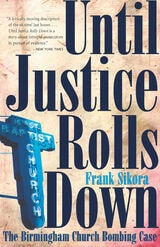
Until Justice Rolls Down
The Birmingham Church Bombing CaseFrank Sikora
University of Alabama Press, 2005
This book tells the story of one grim Sunday in September 1963 when an intentionally planted cache of dynamite ripped through the walls of the Sixteenth Street Baptist Church and ended the dreams and the lives of four young black girls. Their deaths spurred the Kennedy administration to send an army of FBI agents to Alabama and led directly to the passage of the Civil Rights Act. When the Justice Department was unable to bring anyone to trial for this heinous crime, a young Alabama attorney general named Bill Baxley began his own investigation to find the perpetrators. In 1977, 14 years after the bombing, Baxley brought one Klansman to trial and, in a courtroom only blocks from the bombed church (now a memorial to the victims), persuaded a jury to return a guilty verdict. More than 20 years later two other perpetrators were tried for the bombing, found guilty, and remanded to prison.
Frank Sikora has used the court records, FBI reports, oral interviews, and newspaper accounts to weave a story of spellbinding proportions. A reporter by profession, Sikora tells this story compellingly, explaining why the civil rights movement had to be successful and how Birmingham had to change.