Results by title
2 books match the query 'Biro, Matthew'
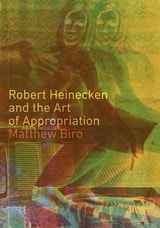
Robert Heinecken and the Art of Appropriation
Matthew Biro
University of Minnesota Press, 2022
The first comprehensive study of the artist Robert Heinecken and his critical views on the culture of mass media
This is the first book-length study dedicated to the artist Robert Heinecken, whose innovative photographic practices sought to interrogate how mass media imagery facilitated the construction of individual and collective identities. Appropriating, rephotographing, and layering pictures culled from newspapers, advertisements, pornography, and television, Heinecken recombined and transformed the ubiquitous images of mass culture to encourage viewers to critically reflect on their sense of self.
From the 1960s through the late 1990s, Heinecken’s controversial art continually challenged inherited ideas around consumerism, the facticity of reportage, and visual culture’s relationship to gender and identity politics. Embodying the evolution of contemporary art toward increasingly hybrid and conceptual approaches, his oeuvre includes examples of painting, sculpture, photomontage, performance, installation, time-based media, and artist’s books, all of which collectively exploit photography’s reproducibility to subvert society’s dominant ideologies and stereotypical modes of representation.
Author Matthew Biro presents an exhaustive look at Heinecken’s life and art, locating him within a lineage that encompasses the activities of the early twentieth-century avant-gardes and the postmodern strategies of the Pictures Generation artists. Assessing his career within the specific political and historical contexts from which he gleaned his material, and illustrated throughout with vibrant full-color reproductions of his art, this in-depth examination demonstrates Robert Heinecken’s significance as a key figure of twentieth-century art and an incisive commentator on modern life in America.

The Dada Cyborg
Visions of the New Human in Weimar BerlinMatthew Biro
University of Minnesota Press, 2009
Finding the cyborg in early twentieth-century German art
In an era when technology, biology, and culture are becoming ever more closely connected, The Dada Cyborg explains how the cyborg as we know it today actually developed between 1918 and 1933 when German artists gave visual form to their utopian hopes and fantasies in a fearful response to World War I.
In what could be termed a prehistory of the posthuman, Matthew Biro shows the ways in which new forms of human existence were imagined in Germany between the two world wars through depictions of cyborgs. Examining the work of Hannah Höch, Raoul Hausmann, George Grosz, John Heartfield, Otto Dix, and Rudolf Schlichter, he reveals an innovative interpretation of the cyborg as a representative of hybrid identity, as well as a locus of new modes of awareness created by the impact of technology on human perception. Tracing the prevalence of cyborgs in German avant-garde art, Biro demonstrates how vision, hearing, touch, and embodiment were beginning to be reconceived during the Weimar Republic. Biro’s unique and interdisciplinary analysis offers a substantially new account of the Berlin Dada movement, one that integrates the group’s poetic, theoretical, and performative practices with its famous visual strategies of photomontage, assemblage, and mixed-media painting to reveal radical images of a “new human.”