Results by title
4 books match the query 'Birth control clinics'
ANY FRIEND OF THE MOVEMENT
NETWORKING FOR BIRTH CONTROL 1920-1940JIMMY ELAINE WILKINS MEYER
The Ohio State University Press, 2004
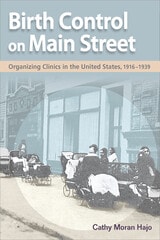
Birth Control on Main Street
Organizing Clinics in the United States, 1916-1939Cathy Moran Hajo
University of Illinois Press, 2010
Unearthing individual stories and statistical records from previously overlooked birth control clinics, Cathy Moran Hajo looks past the rhetoric of the birth control movement to show the relationships, politics, and issues that defined the movement in neighborhoods and cities across the United States. Whereas previous histories have emphasized national trends and glossed over the majority of clinics, Birth Control on Main Street contextualizes individual case studies to add powerful new layers to the existing narratives on abortion, racism, eugenics, and sterilization.
Hajo draws on an original database of more than 600 clinics run by birth control leagues, hospitals, settlement houses, and public health groups to isolate the birth control clinic from the larger narrative of the moment. By revealing how clinics tested, treated, and educated women regarding contraceptives, she shows how clinic operation differed according to the needs and concerns of the districts it served.
Moving thematically through the politicized issues of the birth control movement, Hajo infuses her analysis of the practical and medical issues of the clinics with unique stories of activists who negotiated with community groups to obey local laws and navigated the swirling debates about how birth control centers should be controlled, who should receive care, and how patients should be treated.
The Human Drama of Abortion
A Global Search for ConsensusAnibal Faundes
Vanderbilt University Press, 2006
Deeply touched by the tragedies of botched abortions that they witnessed as medical students and young physicians in Chile in the 1940s and later around the world, the authors have attempted in their professional lives and now in this book to establish a framework for dialogue to replace the polarization that exists today.
Doctors Faundes and Barzelatto use their decades of international work to document the personal experiences of different classes of women in different countries and those countries' policies and practices. No other book provides such a comprehensive and reasoned examination of the entire topic of abortion, from the medical to the religious and ethical and from the psychological to the legal, in plain language understandable by non-specialists.
The central thesis is that there are too many induced abortions in the world today, that most are preventable and should be prevented--a middle ground that both pro-life and pro-choice advocates can accept. The first part of the book reviews why women have abortions, as well as the magnitude and consequences. The second part examines values. The third part discusses effective interventions. The final part states conclusions about what can be done to reach a necessary social consensus.
The Portuguese edition of this book was issued at the very end of 2004. The Spanish edition, launched in mid-2005, is already in a second printing. The authors are making presentations at special events sponsored by universities, professional associations, and feminist networks in Argentina, Chile, Mexico, Peru, Uruguay, Colombia, the Dominican Republic, and the United States.
The Regulation of Sexuality
Experiences of Family Planning WorkersCarole Joffe
Temple University Press, 1987