Results by title
2 books match the query 'Black Feminist Theory'

Distinctly Different
On Autism and Gender, a Black Feminist TheoryDanielle Procope Bell
University of Illinois Press, 2027
Named for Toni Morrison’s description of Sula, Distinctly Different brings Black feminist theory and neurodiversity studies together to challenge conventional ideas about autism and gender. Danielle Procope Bell examines neuronormativity—the cultural system enforcing “correct” ways to think, feel, and move through the world—with particular attention to its pernicious consequences for Black women.
Procope Bell draws on literature, memoirs, media, and lived experience to consider gender when untethered from social performance. She reframes autism as a distinct and meaningful way of being, centering internal felt life over external directives. Thinking alongside figures from Sojourner Truth and Anna Julia Cooper to Megan Thee Stallion and Caster Semenya, Procope Bell establishes autigendering as a methodology for defining gender from within.
Distinctly Different maps what becomes possible when interiority and attunement, rather than conformity, guide understanding of the self. Procope Bell develops a Black feminist reading of autism that refuses to equate well-being with normativity, offering new directions for gender, care, and disability.
[more]
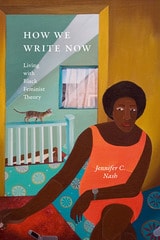
How We Write Now
Living with Black Feminist TheoryJennifer C. Nash
Duke University Press, 2024
In How We Write Now Jennifer C. Nash examines how Black feminists use beautiful writing to allow writers and readers to stay close to the field’s central object and preoccupation: loss. She demonstrates how contemporary Black feminist writers and theorists such as Jesmyn Ward, Elizabeth Alexander, Christina Sharpe, and Natasha Trethewey mobilize their prose to ask readers to feel, undo, and reassemble themselves. These intimate invitations are more than a set of tools for decoding the social world; Black feminist prose becomes a mode of living and feeling, dreaming and being, and a distinctly affective project that treats loss as not only paradigmatic of Black life but also an aesthetic question. Through her own beautiful writing, Nash shows how Black feminism offers itself as a companion to readers to chart their own lives with and in loss, from devastating personal losses to organizing around the movement for Black lives. Charting her own losses, Nash reminds us that even as Black feminist writers get as close to loss as possible, it remains a slippery object that troubles memory and eludes capture.
[more]