Results by title

4 books match the query 'Black interpretations'
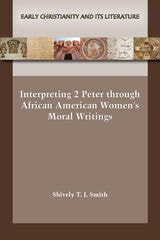
cover of Interpreting 2 Peter through African American Women’s Moral Writings

Interpreting 2 Peter through African American Women’s Moral Writings

Shively T. J. Smith

SBL Press, 2023
Shively T. J. Smith reconsiders what is most distinct, troubling, and potentially thrilling about the often overlooked and dismissed book of 2 Peter. Using the rhetorical strategies of nineteenth-century African American women, including Ida B. Wells, Jarena Lee, Anna Julia Cooper, and others, Smith redefines the use of biblical citations, the language of justice and righteousness, and even the matter of pseudonymity in 2 Peter. She approaches 2 Peter as an instance of Christian cultural rhetoric that forges a particular kind of community identity and behavior. This pioneering study considers how 2 Peter cultivates the kind of human relations and attitudes that speak to the values of moral people seeking justice in the past as well as today.
[more]
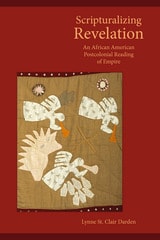
cover of Scripturalizing Revelation: An African American Postcolonial Reading of Empire

Scripturalizing Revelation

An African American Postcolonial Reading of Empire

Lynne St. Clair Darden

SBL Press, 2015

A fresh contribution to the growing body of New Testament scholarship on empire, both ancient and modern

Darden’s reading of Revelation examines John the Seer’s rhetorical strategy, in general, and imperial cult imagery in chapters 4 and 5, in particular, through the lens of an African American scripturalization supplemented by postcolonial theory. The scripturalization proposes that John the Seer’s signifyin(g) on empire demonstrated that he was well aware of the oppressive nature of Roman imperialism on the lives of provincial Asian Christians. Yet, ironically, John reinscribed imperial processes and practices. Darden argues that African American biblical scholarship must now attend adequately to these complex cultural negotiations lest it find itself inadvertently feeding the imperial beast.

Features:

  • Relates the potential for African American cooption by the U.S. Empire to the cooption by the Roman Empire both thematized and performed in Revelation
  • Book-length study on postcolonial African American biblical hermeneutics
  • A reading supplemented by postcolonial theory that better addresses the hybridity of African American identity
[more]
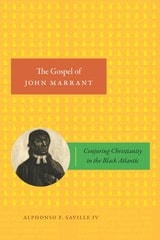
cover of The Gospel of John Marrant: Conjuring Christianity in the Black Atlantic

The Gospel of John Marrant

Conjuring Christianity in the Black Atlantic

Alphonso F. Saville IV

Duke University Press, 2024
The Reverend John Marrant (1755–91) was North America’s first Black ordained minister and one of America’s earliest Black authors and preachers. In The Gospel of John Marrant, Alphonso F. Saville IV examines how Protestantism and West African indigenous religious practices deeply informed his life and ministry. Saville follows Marrant from his time evangelizing the Cherokee in Georgia to meeting with Black Freemasons in Boston to engaging with diasporic communities along the Eastern Seaboard and in England. Using the Black folk magic tradition of conjure as a lens for understanding Marrant’s religious imagination, Saville outlines the importance of Africana religious and cultural themes, symbols, and cosmologies in the biblical interpretation and ritual culture of early Black North American Christian communities. Marrant’s life and work, Saville contends, reveal the diverse religious cultures that contributed to the formation of African American Christianity and its evolution into a prominent institution during the colonial and early history of the United States. In so doing, he demonstrates the need to recenter both religion and Africa in the study of African American cultural and intellectual history.
[more]
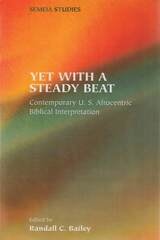
cover of “Yet with a Steady Beat”: U. S. Afrocentric Biblical  Interpretation

“Yet with a Steady Beat”

U. S. Afrocentric Biblical Interpretation

Randall C. Bailey

SBL Press, 2003

This collection of essays exemplifies new directions being taken by biblical scholars using new literary, historical, and sociological critical tools to explore issues of concern to their communities and thus poses a challenge to others in the discipline to broaden the canons of interpretation and sources. The essays, from the generation of scholars following the writers of the historic Stony the Road We Trod: African American Biblical Interpretation (Fortress, 1991), address issues of cultural criticism, utilization of Black religious sources such as the Negro spirituals and sermons, histories of struggles of Afro-diasporan peoples, and ideological criticism in interpreting the biblical text. This collection of essays exemplifies new directions being taken by biblical scholars using new literary, historical, and sociological critical tools to explore issues of concern to their communities and thus poses a challenge to others in the discipline to broaden the canons of interpretation and sources. The essays, from the generation of scholars following the writers of the historic Stony the Road We Trod: African American Biblical Interpretation (Fortress, 1991), address issues of cultural criticism, utilization of Black religious sources such as the Negro spirituals and sermons, histories of struggles of Afro-diasporan peoples, and ideological criticism in interpreting the biblical text.
[more]