Results by title
239 books match the query 'Black people' and 25 start with a

A Different Hunger
Writings on Black ResistanceA. Sivanandan
Pluto Press, 1991
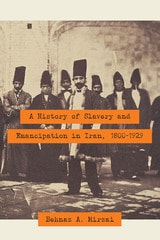
A History of Slavery and Emancipation in Iran, 1800-1929
By Behnaz A. Mirzai
University of Texas Press, 2017
Shortlisted for the 2018 Wallace K. Ferguson Prize, Canadian Historical Association
The leading authority on slavery and the African diaspora in modern Iran presents the first history of slavery in this key Middle Eastern country and shows how slavery helped to shape the nation’s unique character.
Slavery in the Middle East is a growing field of study, but the history of slavery in a key country, Iran, has never before been written. This history extends to Africa in the west and India in the east, to Russia and Turkmenistan in the north, and to the Arab states in the south. As the slave trade between Iran and these regions shifted over time, it transformed the nation and helped forge its unique culture and identity. Thus, a history of Iranian slavery is crucial to understanding the character of the modern nation.
Drawing on extensive archival research in Iran, Tanzania, England, and France, as well as fieldwork and interviews in Iran, Behnaz A. Mirzai offers the first history of slavery in modern Iran from the early nineteenth century to emancipation in the mid-twentieth century. She investigates how foreign military incursion, frontier insecurity, political instability, and economic crisis altered the patterns of enslavement, as well as the ethnicity of the slaves themselves. Mirzai’s interdisciplinary analysis illuminates the complex issues surrounding the history of the slave trade and the process of emancipation in Iran, while also giving voice to social groups that have never been studied—enslaved Africans and Iranians. Her research builds a clear case that the trade in slaves was inexorably linked to the authority of the state. During periods of greater decentralization, slave trading increased, while periods of greater governmental autonomy saw more freedom and peace.
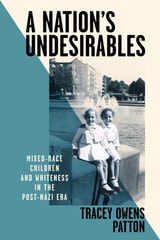
A Nation’s Undesirables
Mixed-Race Children and Whiteness in the Post-Nazi EraTracey Owens Patton
The Ohio State University Press, 2024
An innovative investigation of the entangled histories of race, transnational adoption, and post-Nazi Germany.
In a moving blend of family history and cutting-edge scholarship, Tracey Owens Patton’s A Nation’s Undesirables synthesizes work in rhetorical postmemory studies, critical adoption studies, Afrofuturism, and more to tell the story of her mother and aunt, Lore and Lilli. Two of thousands of children born to white German women and Black American men after World War II, the twins moved to the United States at age seven, where their mother renounced her parental rights and put them into the adoption system. They did not see her again for fifty-two years.Patton takes up the twins’ story and their reckoning with their mixed-race, Black German identity to disrupt standard narratives around World War II, Black experiences in Germany, and race and adoption. Combining family interviews, historical artifacts, and autoethnographic reflection, Patton composes a new narrative of women and Black German children in the postwar era. In examining the systemic racism of Germany’s efforts to move children like Lore and Lilli out of the country—and the suppression of German women’s bodily autonomy—Patton amplifies the once unacknowledged identities of these Black German children to broaden our understanding of citizenship, racism, and sexism after World War II.
A Sense of Arrival
Kevin Adonis Browne
Duke University Press, 2024
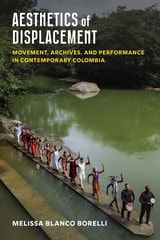
Aesthetics of Displacement
Movement, Archives, and Performance in Contemporary ColombiaMelissa Blanco Borelli
University of Michigan Press, 2026
Aesthetics of Displacement centers the embodied aesthetic practices of Afro-Colombian people and their experiences, asking readers to reassess Colombian national history, legacies of colonialism and racism, politics of memory, and the inheritances of violence related to the Colombian armed conflict. Through a theoretical frame of destierro or “displacement” and an examination of the Afro-Colombian philosophy vivir sabroso or “to live harmoniously,” Aesthetics of Displacement focuses on how theatre-makers, choreographers, filmmakers, activist groups, and photojournalists create an embodied Colombian perspective informed by decolonial practices and thinking that rely on movement as a strategy for existence and that counter European hegemonic aesthetics as the major foundations of taste and value. This approach not only enhances our understanding of contemporary Colombian culture, but also highlights the importance of performance as a means of resistance and identity formation.
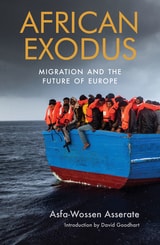
African Exodus
Migration and the Future of EuropeAsfa-Wossen Asserate
Haus Publishing, 2018
Asfa-Wossen Asserate argues here that building higher fences or finding more effective methods of integration will only, in the long term, perpetuate rather than solve the problems associated with these large numbers of displaced refugees. We need to realize that we are only treating the symptoms of an oncoming catastrophe and that, if we are to respond to mass migration, we will ultimately have to understand its causes. African Exodus places its emphasis firmly on the causes of the refugee crisis, which are to be found not least in Europe itself, and charts ways in which we might deal with it effectively in the long term.
In the course of this analysis, Asserate asks why our view of Africa—a troubled continent, but rich in so many ways—is so distorted. How can we combat the corrupt, authoritarian regimes that stymie progress and development? Why are millions fleeing to Europe? How is the EU complicit in the migration crisis? And finally, in practical terms: what can be done, and what prospects does the future hold?

African Stars
Studies in Black South African PerformanceVeit Erlmann
University of Chicago Press, 1991
become ever more popular in the West, where they are now
widely celebrated as expressions of opposition to
discrimination and repression. Less well known is the
rich history of these arts, which were shaped by several
generations of black artists and performers whose
struggles, visions, and aspirations did not differ fundamentally
from those of their present-day counterparts.
In five detailed case studies Veit Erlmann digs deep to expose the roots of the most important of these performance traditions. He relates the early history of isicathamiya, the a cappella vocal style made famous by Ladysmith Black Mambazo.
In two chapters on Durban between the World Wars he charts the evolution of Zulu music and dance, studying in depth the transformation of ingoma, a dance form popular among migrant workers since the 1930s. He goes on to
record the colorful life and influential work of Reuben T. Caluza,
South Africa's first black ragtime composer. And Erlmann's reconstruction of the 1890s concert tours of an Afro-American vocal group, Orpheus M. McAdoo and the Virginia Jubilee Singers, documents the earliest link between the African and American performance traditions.
Numerous eyewitness reports, musicians' personal testimonies, and song texts enrich Erlmann's narratives and demonstrate that black performance evolved in response to the growing economic and racial segmentation of South African
society. Early ragtime, ingoma, and isicathamiya enabled the black urban population to comment on their precarious social position and to symbolically construct a secure space within a rapidly changing political world.
Today, South African workers, artists, and youth continue to build upon this performance tradition in their struggle for freedom and democracy. The early performers portrayed by Erlmann were guiding lights—African stars—by which the present and future course of South Africa is being determined.

African Students in East Germany, 1949-1975
Sara Pugach
University of Michigan Press, 2022
This book explores the largely unexamined history of Africans who lived, studied, and worked in the German Democratic Republic. African students started coming to the East in 1951 as invited guests who were offered scholarships by the East German government to prepare them for primarily technical and scientific careers once they returned home to their own countries. Drawn from previously unexplored archives in Germany, Ghana, Kenya, Zambia, and the United Kingdom, African Students in East Germany, 1949–1975 uncovers individual stories and reconstructs the pathways that African students took in their journeys to the GDR and what happened once they got there. The book places these experiences within the larger context of German history, questioning how ideas of African racial difference that developed from the eighteenth through the early twentieth centuries impacted East German attitudes toward the students.
The book additionally situates African experiences in the overlapping contexts of the Cold War and decolonization. During this time, nations across the Western and Soviet blocs were inviting Africans to attend universities and vocational schools as part of a drive to offer development aid to newly independent countries and encourage them to side with either the United States or Soviet Union in the Cold War. African leaders recognized their significance to both Soviet and American blocs, and played on the desire of each to bring newly independent nations into their folds. Students also recognized their importance to Cold War competition, and used it to make demands of the East German state. The book is thus located at the juncture of many different histories, including those of modern Germany, modern Africa, the Global Cold War, and decolonization.

African-American Reflections on Brazil's Racial Paradise
David Hellwig
Temple University Press, 1992
Africana Studies
Theoretical FuturesEdited by Grant Farred
Temple University Press, 2022
As Africana Studies celebrates its fiftieth anniversary throughout the United States, this invigor ating collection presents possibilities for the future of the discipline’s theoretical paths. The essays in Africana Studies focus on philosophy, science, and technology; poetry, literature, and music; the crisis of the state; issues of colonialism, globalization, and neoliberalism; and the ever-expanding diaspora. The editor and contributors to this volume open exciting avenues for new narratives, philosophies, vision, and scale in this critical field of study—formed during the 1960s around issues of racial injustice in America—to show what Africana Studies is already in the process of becoming.
Africana Studies recognizes how the discipline has been shaped, changing over the decades as scholars have opened new modes of theoretical engagement such as addressing issues of gender and sexuality, politics, and cultural studies. The essays debate and (re)consider black and diasporic life to sustain, provoke, and cultivate Africana Studies as a singular yet polyvalent mode of thinking.
Contributors: Akin Adeṣọkan, John E. Drabinski, Zeyad El Nabolsy, Pierre-Philippe Fraiture, Kasareka Kavwahirehi, Gregory Pardlo, Radwa Saad, Sarah Then Bergh, and the editor
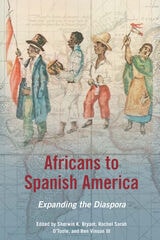
Africans to Spanish America
Expanding the DiasporaEdited by Sherwin K. Bryant, Rachel Sarah O’Toole, & Ben Vinson III
University of Illinois Press, 2014
Contributors are Joan C. Bristol, Nancy E. van Deusen, Leo J. Garofalo, Herbert S. Klein, Charles Beatty-Medina, Karen Y. Morrison, Rachel Sarah O'Toole, Frank "Trey" Proctor III, and Michele Reid-Vazquez.
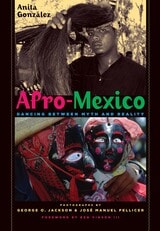
Afro-Mexico
Dancing between Myth and RealityBy Anita González
University of Texas Press, 2010
While Africans and their descendants have lived in Mexico for centuries, many Afro-Mexicans do not consider themselves to be either black or African. For almost a century, Mexico has promoted an ideal of its citizens as having a combination of indigenous and European ancestry. This obscures the presence of African, Asian, and other populations that have contributed to the growth of the nation. However, performance studies—of dance, music, and theatrical events—reveal the influence of African people and their cultural productions on Mexican society.
In this work, Anita González articulates African ethnicity and artistry within the broader panorama of Mexican culture by featuring dance events that are performed either by Afro-Mexicans or by other ethnic Mexican groups about Afro-Mexicans. She illustrates how dance reflects upon social histories and relationships and documents how residents of some sectors of Mexico construct their histories through performance. Festival dances and, sometimes, professional staged dances point to a continuing negotiation among Native American, Spanish, African, and other ethnic identities within the evolving nation of Mexico. These performances embody the mobile histories of ethnic encounters because each dance includes a spectrum of characters based upon local situations and historical memories.
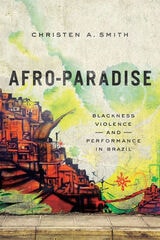
Afro-Paradise
Blackness, Violence, and Performance in BrazilChristen A. Smith
University of Illinois Press, 2016
Christen A. Smith argues that the dialectic of glorified representations of black bodies and subsequent state repression reinforces Brazil's racially hierarchal society. Interpreting the violence as both institutional and performative, Smith follows a grassroots movement and social protest theater troupe in their campaigns against racial violence. As Smith reveals, economies of black pain and suffering form the backdrop for the staged, scripted, and choreographed afro-paradise that dazzles visitors. The work of grassroots organizers exposes this relationship, exploding illusions and asking unwelcome questions about the impact of state violence performed against the still-marginalized mass of Afro-Brazilians.
Based on years of field work, Afro-Paradise is a passionate account of a long-overlooked struggle for life and dignity in contemporary Brazil.
Afro-Sweden
Becoming Black in a Color-Blind CountryRyan Thomas Skinner
University of Minnesota Press, 2022
A compelling examination of Sweden’s African and Black diaspora
Contemporary Sweden is a country with a worldwide progressive reputation, despite an undeniable tradition of racism within its borders. In the face of this contradiction of culture and history, Afro-Swedes have emerged as a vibrant demographic presence, from generations of diasporic movement, migration, and homemaking. In Afro-Sweden, Ryan Thomas Skinner uses oral histories, archival research, ethnography, and textual analysis to explore the history and culture of this diverse and growing Afro-European community.
Skinner employs the conceptual themes of “remembering” and “renaissance” to illuminate the history and culture of the Afro-Swedish community, drawing on the rich theoretical traditions of the African and Black diaspora. Remembering fosters a sustained meditation on Afro-Swedish social history, while Renaissance indexes a thriving Afro-Swedish public culture. Together, these concepts illuminate significant existential modes of Afro-Swedish being and becoming, invested in and contributing to the work of global Black studies.
The first scholarly monograph in English to focus specifically on the African and Black diaspora in Sweden, Afro-Sweden emphasizes the voices, experiences, practices, knowledge, and ideas of these communities. Its rigorously interdisciplinary approach to understanding diasporic communities is essential to contemporary conversations around such issues as the status and identity of racialized populations in Europe and the international impact of Black Lives Matter.

AfroSwedish Places of Belonging
Nana Osei-Kofi
Northwestern University Press, 2024
Afrocentric Idea Revised
Molefi Asante
Temple University Press, 1998
Afrodescendants, Identity, and the Struggle for Development in the Americas
Bernd Reiter
Michigan State University Press, 2012
Indigenous people and African descendants in Latin America and the Caribbean have long been affected by a social hierarchy established by elites, through which some groups were racialized and others were normalized. Far from being “racial paradises” populated by an amalgamated “cosmic race” of mulattos and mestizos, Latin America and the Caribbean have long been sites of shifting exploitative strategies and ideologies, ranging from scientific racism and eugenics to the more sophisticated official denial of racism and ethnic difference. This book, among the first to focus on African descendants in the region, brings together diverse reflections from scholars, activists, and funding agency representatives working to end racism and promote human rights in the Americas. By focusing on the ways racism inhibits agency among African descendants and the ways African-descendant groups position themselves in order to overcome obstacles, this interdisciplinary book provides a multi-faceted analysis of one of the gravest contemporary problems in the Americas.

Afrofuturism and World Order
Reynaldo Anderson
The Ohio State University Press, 2025
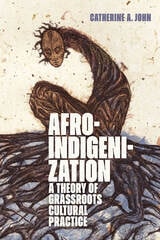
Afroindigenization
A Theory of Grassroots Cultural PracticeCatherine A. John
Duke University Press, 2026

Alive in the Sound
Black Music as CounterhistoryRonald Radano
Duke University Press, 2025

American Allegory
Lindy Hop and the Racial ImaginationBlack Hawk Hancock
University of Chicago Press, 2013
In American Allegory, Black Hawk Hancock offers an embedded and embodied ethnography that situates dance within a larger Chicago landscape of segregated social practices. Delving into two Chicago dance worlds, the Lindy and Steppin’, Hancock uses a combination of participant-observation and interviews to bring to the surface the racial tension that surrounds white use of black cultural forms. Focusing on new forms of appropriation in an era of multiculturalism, Hancock underscores the institutionalization of racial disparities and offers wonderful insights into the intersection of race and culture in America.

Améfrica in Letters
Literary Interventions from Mexico to the Southern ConeJennifer Carolina Gómez Menjívar
Vanderbilt University Press, 2022

Archival Irruptions
Constructing Religion and Criminalizing Obeah in Eighteenth-Century JamaicaKatharine Gerbner
Duke University Press, 2025
At Home in Diaspora
Black International WritingWendy Walters
University of Minnesota Press, 2005
In At Home in Diaspora, Wendy Walters investigates the work of Himes, Cliff, and three other twentieth-century black international writers—Caryl Phillips, Simon Njami, and Richard Wright—who have lived in and written from countries they do not call home. Unlike other authors in exile, those of the African diaspora are doubly displaced, first by the discrimination they faced at home and again by their life abroad. Throughout, Walters suggests that in the absence of a recoverable land of origin, the idea of diaspora comes to represent a home that is not singular or exclusionary. In this way, writing in exile is much more than a literary performance; it is a profound political act.
Wendy W. Walters is assistant professor of literature at Emerson College.
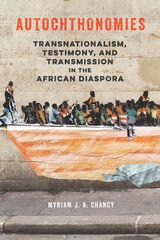
Autochthonomies
Transnationalism, Testimony, and Transmission in the African DiasporaMyriam J. A. Chancy
University of Illinois Press, 2020
A bold challenge to established scholarship, Autochthonomies ranges from Africa to Europe and the Americas to provide powerful new tools for charting the transnational interactions between African cultural producers and sites.