Results by title
3 books match the query 'Black people in popular culture'
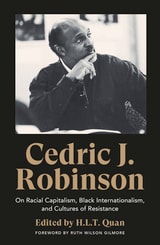
Cedric J. Robinson
On Racial Capitalism, Black Internationalism, and Cultures of ResistanceCedric J. Robinson
Pluto Press, 2019
"Before the movement for black lives made black radicalism cool for millennials, Cedric Robinson did the work of excavating an intellectual history we rely upon today."—The Root
"Like W. E. B. Du Bois, Michel Foucault, Sylvia Wynter, and Edward Said, Robinson was that rare polymath capable of seeing the whole....He left behind a body of work to which we must return constantly and urgently"—Robin D. G. Kelley, author of Freedom Dreams
Cedric J. Robinson is one of the doyens of Black Studies and a pioneer in study of the Black Radical Tradition. His works have been essential texts, deconstructing racial capitalism and inspiring insurgent movements from Ferguson, Missouri to the West Bank. For the first time, Robinson's essays come together, spanning over four decades and reflective of his diverse interests in the interconnections between culture and politics, radical social theory, and classic and modern political philosophy.
Themes explored include Africa and Black internationalism, World politics, race and US Foreign Policy, representations of blackness in popular culture, and reflections on popular resistance to racial capitalism, white supremacy and more. Essays here include:
*The Black Detective and American Memory
*Slavery and the Platonic Origins of Anti-Democracy
*Africa: In Hock to History and the Banks
*Blaxploitation and the Misrepresentation of Liberalism
*The Mulatta on Film
*Race, Capitalism, and Anti-democracy
*The Killing in Ferguson
*And much more!
Accompanied by an introduction by H. L. T. Quan and a foreword by Ruth Wilson Gilmore, this collection, which includes previously unpublished materials, extends the many contributions by a giant in Black radical thought.
[more]
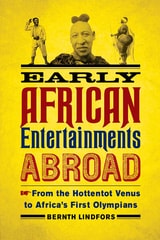
Early African Entertainments Abroad
From the Hottentot Venus to Africa's First OlympiansBernth Lindfors
University of Wisconsin Press, 2014
In the nineteenth and early twentieth centuries African and pseudo-African performers were displayed as curiosities throughout Europe and America. Appearing in circuses, ethnographic exhibitions, and traveling shows, these individuals and troupes drew large crowds. As Bernth Lindfors shows, the showmen, impresarios, and even scientists who brought supposedly representative inhabitants of the "Dark Continent" to a gaping public often selected the performers for their sensational impact. Spotlighting and exaggerating physical, mental, or cultural differences, the resulting displays reinforced pernicious racial stereotypes and left a disturbing legacy.
Using period illustrations and texts, Early African Entertainments Abroad illuminates the mindset of the era's largely white audiences as they viewed wax models of Africans with tails and watched athletic competitions showcasing hungry cannibals. White spectators were thus assured of their racial superiority. And blacks were made to appear less than fully human precisely at the time when abolitionists were fighting to end slavery and establish equality.
Using period illustrations and texts, Early African Entertainments Abroad illuminates the mindset of the era's largely white audiences as they viewed wax models of Africans with tails and watched athletic competitions showcasing hungry cannibals. White spectators were thus assured of their racial superiority. And blacks were made to appear less than fully human precisely at the time when abolitionists were fighting to end slavery and establish equality.
[more]
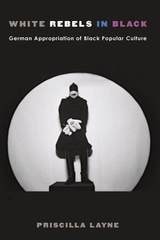
White Rebels in Black
German Appropriation of Black Popular CulturePriscilla Layne
University of Michigan Press, 2018
Analyzing literary texts and films, White Rebels in Black shows how German authors have since the 1950s appropriated black popular culture, particularly music, to distance themselves from the legacy of Nazi Germany, authoritarianism, and racism, and how such appropriation changes over time. Priscilla Layne offers a critique of how blackness came to symbolize a positive escape from the hegemonic masculinity of postwar Germany, and how black identities have been represented as separate from, and in opposition to, German identity, foreclosing the possibility of being both black and German. Citing four autobiographies published by black German authors Hans Jürgen Massaquo, Theodor Michael, Günter Kaufmann, and Charly Graf, Layne considers how black German men have related to hegemonic masculinity since Nazi Germany, and concludes with a discussion on the work of black German poet, Philipp Khabo Köpsell.
[more]