Results by title
10 books match the query 'Black race'
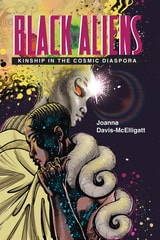
Black Aliens
Kinship in the Cosmic DiasporaJoanna Davis-McElligatt
The Ohio State University Press, 2026
Analyzing prose, poetry, film, record albums, comic books, illustrations, art installations, and exhibition catalogues, Davis-McElligatt traces how Octavia E. Butler, Maisy Card, Sun Ra, and Dwayne McDuffie and M. D. Bright visualize aliens whose bodies and beings are subject to interpellation as Black on Earth. She argues that these creators intentionally locate the Black alien as a subject whose galactic bonds are constructed in and as narrative form itself, made manifest in plot, characterization, and narrativization. In recasting narrative spacetime, they reimagine Black entanglements, kinship systems, and histories as a cosmic diaspora.

Geologic Life
Inhuman Intimacies and the Geophysics of RaceKathryn Yusoff
Duke University Press, 2024

Globalization and Race
Transformations in the Cultural Production of BlacknessKamari Maxine Clarke and Deborah A. Thomas, eds.
Duke University Press, 2006
A number of the essays bring to light the formative but not unproblematic influence of African American identity on other populations within the black diaspora. Among these are an examination of the impact of “black America” on racial identity and politics in mid-twentieth-century Liverpool and an inquiry into the distinctive experiences of blacks in Canada. Contributors investigate concepts of race and space in early-twenty-first century Harlem, the experiences of trafficked Nigerian sex workers in Italy, and the persistence of race in the purportedly non-racial language of the “New South Africa.” They highlight how blackness is consumed and expressed in Cuban timba music, in West Indian adolescent girls’ fascination with Buffy the Vampire Slayer, and in the incorporation of American rap music into black London culture. Connecting race to ethnicity, gender, sexuality, nationality, and religion, these essays reveal how new class economies, ideologies of belonging, and constructions of social difference are emerging from ongoing global transformations.
Contributors. Robert L. Adams, Lee D. Baker, Jacqueline Nassy Brown, Tina M. Campt, Kamari Maxine Clarke, Raymond Codrington, Grant Farred, Kesha Fikes, Isar Godreau, Ariana Hernandez-Reguant, Jayne O. Ifekwunigwe, John L. Jackson Jr., Oneka LaBennett, Naomi Pabst, Lena Sawyer, Deborah A. Thomas

Haunted Life
Visual Culture and Black ModernityMarriott, David
Rutgers University Press, 2007
Drawing on a range of comparative readings by writers, theorists, and filmmakers, including John Edgar Wideman, Frantz Fanon, Richard Wright, Issac Julien, Alain Locke, and Sidney Poitier, Haunted Life is a bold and original exploration of the legacies of black visual culture and the political, deeply sexualized violence that lies buried beneath it.

Impossible Purities
Blackness, Femininity, and Victorian CultureJennifer DeVere Brody
Duke University Press, 1998
Opening with a reading of Daniel Defoe’s “A True-Born Englishman,” which posits the mixed origins of English identity, Brody goes on to analyze mulattas typified by Rhoda Swartz in William Thackeray’s Vanity Fair, whose mixed-race status reveals the “unseemly origins of English imperial power.” Examining Victorian stage productions from blackface minstrel shows to performances of The Octoroon and Uncle Tom’s Cabin, she explains how such productions depended upon feminized, “black” figures in order to reproduce Englishmen as masculine white subjects. She also discusses H.G. Wells’s The Island of Dr. Moreau in the context of debates about the “new woman,” slavery, and fears of the monstrous degeneration of English gentleman. Impossible Purities concludes with a discussion of Bram Stoker’s novella, “The Lair of the White Worm,” which brings together the book’s concerns with changing racial representations on both sides of the Atlantic.
This book will be of interest to scholars in Victorian studies, literary theory, African American studies, and cultural criticism.

Negritude Women
T. Denean Sharpley-Whiting
University of Minnesota Press, 2002
Rediscovers the crucial role that women played in the influential Negritude movement.
The Negritude movement, which signaled the awakening of a pan-African consciousness among black French intellectuals, has been understood almost exclusively in terms of the contributions of its male founders: Aimé Césaire, Léopold Sédar Senghor, and Léon G. Damas. This masculine genealogy has completely overshadowed the central role played by French-speaking black women in its creation and evolution. In Negritude Women, T. Denean Sharpley-Whiting offers a long-overdue corrective, revealing the contributions made by the women who were not merely integral to the success of the movement, but often in its vanguard.
Through such disparate tactics as Lacascade’s use of Creole expressions in her French prose writings, the literary salon and journal founded by the Martinique-born Nardal sisters, and Roussy-Césaire’s revolutionary blend of surrealism and Negritude in the pages of Tropiques, the journal she founded with her husband, these four remarkable women made vital contributions. In exploring their influence on the development of themes central to Negritude-black humanism, the affirmation of black peoples and their cultures, and the rehabilitation of Africa-Sharpley-Whiting provides the movement’s first genuinely inclusive history.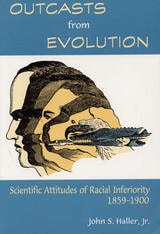
Outcasts from Evolution
Scientific Attitudes of Racial Inferiority, 1859 - 1900John S. Haller, Jr.
Southern Illinois University Press, 1996
In the only book to date to explore the period between the 1859 publication of Darwin’s Origin of Species and the discovery in 1900 of Gregor Mendel’s experiments in genetics, John S. Haller, Jr., shows the relationship between scientific "conviction" and public policy. He focuses on the numerous liberally educated American scientists who were caught up in the triumph of evolutionary ideas and who sought to apply those ideas to comparative morality, health, and the physiognomy of nonwhite races.
During this period, the natural and social scientists of the day not only accepted without question the genetic and cultural superiority of the Caucasian; they also asserted that the Caucasian race held a monopoly on evolutionary progress, arguing that "inferior races" were no more than evolutionary survivors doomed by their genetic legacy to remain outcasts from evolution.
Hereditarians and evolutionists believed that "less fit" human races were perishing from the rigors of civilization’s struggle and competition. Indeed, racial inferiority lay at the very foundation of the evolutionary framework and, remaining there, rose to the pinnacle of "truth" with the myth of scientific certainty.

Stolen Life
Fred Moten
Duke University Press, 2018
In Stolen Life—the second volume in his landmark trilogy consent not to be a single being—Fred Moten undertakes an expansive exploration of blackness as it relates to black life and the collective refusal of social death. The essays resist categorization, moving from Moten's opening meditation on Kant, Olaudah Equiano, and the conditions of black thought through discussions of academic freedom, writing and pedagogy, non-neurotypicality, and uncritical notions of freedom. Moten also models black study as a form of social life through an engagement with Fanon, Hartman, and Spillers and plumbs the distinction between blackness and black people in readings of Du Bois and Nahum Chandler. The force and creativity of Moten's criticism resonate throughout, reminding us not only of his importance as a thinker, but of the continued necessity of interrogating blackness as a form of sociality.
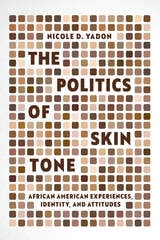
The Politics of Skin Tone
African American Experiences, Identity, and AttitudesNicole D. Yadon
University of Chicago Press, 2025
A nuanced examination of the salience of skin tone within African American politics.
Research shows that skin tone is associated with significant differences in life experiences. On average, African Americans with darker skin earn lower wages, suffer worse health outcomes, and endure more negative criminal justice experiences than lighter-skinned African Americans. Nicole D. Yadon conceptualizes skin tone as one facet of the multidimensional construct of race that powerfully influences racialized experiences which, in turn, can influence political identities and attitudes.
Drawing on evidence from one hundred in-depth interviews, multiple surveys, and a survey experiment, The Politics of Skin Tone investigates the political associations of skin tone. Yadon finds that skin tone correlates with political attitudes, particularly on issues where color-based disparities are especially pronounced such as criminal justice. Moreover, a sizable number of African Americans adopt a skin tone-based identity. In an era of shifting racial boundaries and growing color-based discrimination, The Politics of Skin Tone examines the implications for both scholars and policymakers.

The Universal Machine
Fred Moten
Duke University Press, 2018
In The Universal Machine—the concluding volume to his landmark trilogy consent not to be a single being—Fred Moten presents a suite of three essays on Emmanuel Levinas, Hannah Arendt, and Frantz Fanon, in which he explores questions of freedom, capture, and selfhood. In trademark style, Moten considers these thinkers alongside artists and musicians such as William Kentridge and Curtis Mayfield while interrogating the relation between blackness and phenomenology. Whether using Levinas's idea of escape in unintended ways, examining Arendt's antiblackness through Mayfield's virtuosic falsetto and Anthony Braxton's musical language, or showing how Fanon's form of phenomenology enables black social life, Moten formulates blackness as a way of being in the world that evades regulation. Throughout The Universal Machine—and the trilogy as a whole—Moten's theorizations of blackness will have a lasting and profound impact.