Results by title

10 books match the query 'Blackface entertainers'
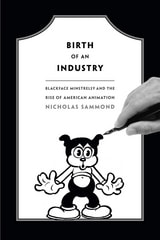
cover of Birth of an Industry: Blackface Minstrelsy and the Rise of American Animation

Birth of an Industry

Blackface Minstrelsy and the Rise of American Animation

Nicholas Sammond

Duke University Press, 2015
In Birth of an Industry, Nicholas Sammond describes how popular early American cartoon characters were derived from blackface minstrelsy. He charts the industrialization of animation in the early twentieth century, its representation in the cartoons themselves, and how important blackface minstrels were to that performance, standing in for the frustrations of animation workers. Cherished cartoon characters, such as Mickey Mouse and Felix the Cat, were conceived and developed using blackface minstrelsy's visual and performative conventions: these characters are not like minstrels; they are minstrels. They play out the social, cultural, political, and racial anxieties and desires that link race to the laboring body, just as live minstrel show performers did. Carefully examining how early animation helped to naturalize virulent racial formations, Sammond explores how cartoons used laughter and sentimentality to make those stereotypes seem not only less cruel, but actually pleasurable. Although the visible links between cartoon characters and the minstrel stage faded long ago, Sammond shows how important those links are to thinking about animation then and now, and about how cartoons continue to help to illuminate the central place of race in American cultural and social life.
[more]
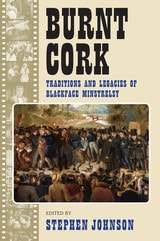
cover of Burnt Cork: Traditions and Legacies of Blackface Minstrelsy

Burnt Cork

Traditions and Legacies of Blackface Minstrelsy

Stephen Johnson

University of Massachusetts Press, 2012

Beginning in the 1830s and continuing for more than a century, blackface minstrelsy—stage performances that claimed to represent the culture of black Americans—remained arguably the most popular entertainment in North America. A renewed scholarly interest in this contentious form of entertainment has produced studies treating a range of issues: its contradictory depictions of class, race, and gender; its role in the development of racial stereotyping; and its legacy in humor, dance, and music, and in live performance, film, and television. The style and substance of minstrelsy persist in popular music, tap and hip-hop dance, the language of the standup comic, and everyday rituals of contemporary culture. The blackface makeup all but disappeared for a time, though its influence never diminished—and recently, even the makeup has been making a comeback. 

This collection of original essays brings together a group of prominent scholars of blackface performance to reflect on this complex and troublesome tradition. Essays consider the early relationship of the blackface performer with American politics and the antislavery movement; the relationship of minstrels to the commonplace compromises of the touring “show” business and to the mechanization of the industrial revolution; the exploration and exploitation of blackface in the mass media, by D. W. Griffith and Spike Lee, in early sound animation, and in reality television; and the recent reappropriation of the form at home and abroad.

In addition to the editor, contributors include Dale Cockrell, Catherine Cole, Louis Chude-Sokei, W. T. Lhamon, Alice Maurice, Nicholas Sammond, and Linda Williams.
[more]
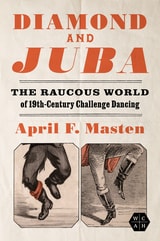
cover of Diamond and Juba: The Raucous World of 19th-Century Challenge Dancing

Diamond and Juba

The Raucous World of 19th-Century Challenge Dancing

April F. Masten

University of Illinois Press, 2025
During the tumultuous years before the Civil War, Irish American John Diamond and African American William Henry Lane, known as Juba, became internationally famous as competitors in the art and sport of challenge dancing. April F. Masten’s dual biography reconstructs the lives and work of these extraordinary dancers, casting fresh light on their contributions to the history of American popular culture. Challenge dancing was born from Black-Irish social interaction in the dockside markets, taverns, and theaters of antebellum New York. Promoted as a masculine art with close ties to boxing, it featured prolific gambling, hefty purses, and championship belts, yet also included women competitors, cross-dressing, and blackface. The astonishing jigs of its foremost practitioners attracted huge audiences across northeastern port cities, along Mississippi Valley circus routes, and into England’s provincial music halls. Diamond and Juba’s rivalry and parallel careers provide a rare glimpse into Black and immigrant strivings in an expanding nation keen for talent yet divided by prejudice. A vivid portrait of a forgotten world, Diamond and Juba tells the intertwined stories of two legendary performers.
[more]
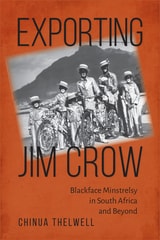
cover of Exporting Jim Crow: Blackface Minstrelsy in South Africa and Beyond

Exporting Jim Crow

Blackface Minstrelsy in South Africa and Beyond

Chinua Thelwell

University of Massachusetts Press, 2020

Following the pathways of imperial commerce, blackface minstrel troupes began to cross the globe in the mid-nineteenth century, popularizing American racial ideologies as they traveled from Britain to its colonies in the Pacific, Asia, and Oceania, finally landing in South Africa during the 1860s and 1870s. The first popular culture export of the United States, minstrel shows frequently portrayed black characters as noncitizens who were unfit for democratic participation and contributed to the construction of a global color line.

Chinua Thelwell brings blackface minstrelsy and performance culture into the discussion of apartheid's nineteenth-century origins and afterlife, employing a broad archive of South African newspapers and magazines, memoirs, minstrel songs and sketches, diaries, and interview transcripts. Exporting Jim Crow highlights blackface minstrelsy's cultural and social impact as it became a dominant form of entertainment, moving from its initial appearances on music hall stages to its troubling twentieth-century resurgence on movie screens and at public events. This carefully researched and highly original study demonstrates that the performance of race in South Africa was inherently political, contributing to racism and shoring up white racial identity.
[more]
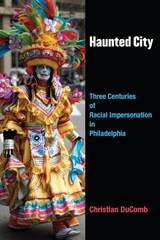
cover of Haunted City: Three Centuries of Racial Impersonation in Philadelphia

Haunted City

Three Centuries of Racial Impersonation in Philadelphia

Christian DuComb

University of Michigan Press, 2017

Haunted City explores the history of racial impersonation in Philadelphia from the late eighteenth century through the present day. The book focuses on select historical moments, such as the advent of the minstrel show and the ban on blackface makeup in the Philadelphia Mummers Parade, when local performances of racial impersonation inflected regional, national, transnational, and global formations of race.

Mummers have long worn blackface makeup during winter holiday celebrations in Europe and North America; in Philadelphia, mummers’ blackface persisted from the colonial period well into the twentieth century. The first annual Mummers Parade, a publicly sanctioned procession from the working-class neighborhoods of South Philadelphia to the city center, occurred in 1901. Despite a ban on blackface in the Mummers Parade after civil rights protests in 1963–64, other forms of racial and ethnic impersonation in the parade have continued to flourish unchecked. Haunted City combines detailed historical research with the author’s own experiences performing in the Mummers Parade to create a lively and richly illustrated narrative. Through its interdisciplinary approach, Haunted City addresses not only theater history and performance studies but also folklore, American studies, critical race theory, and art history.  It also offers a fresh take on the historiography of the antebellum minstrel show.
 
[more]
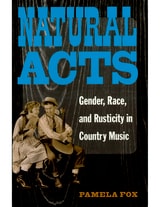
cover of Natural Acts: Gender, Race, and Rusticity in Country Music

Natural Acts

Gender, Race, and Rusticity in Country Music

Pamela Fox

University of Michigan Press, 2009
Whether found in country barn dances, the plaintive twang of Hank Williams, the glitzy glamour of Dolly Parton, or the country-pop sound of Faith Hill, country music has always maintained an allegiance to its own authenticity. Its specific sounds and images have changed over the past century, but country music has consistently been associated with rusticity, a notion connected to the working class and rooted in ideals like unspoiled rural life and values and humble origins. The music suggests not only uncomplicated musical arrangements and old-time instruments such as the banjo and fiddle, but performers who identify with their everyday fans. Natural Acts explores the ways that country musicians -- particularly women artists -- have established a "natural" country identity. Pamela Fox focuses on five revealing moments in country performance: blackface comedy during country music's "Golden Age" of pre-1945 radio and stage programming; the minstrel's "rube" or hillbilly equivalent in the same period; postwar honky-tonk music and culture; the country star memoir or autobiography of the '80s and '90s; and the recent roots phenomenon known as alt.country. "'All I gotta do is act naturally,' Buck Owens sang, and Pamela Fox knows where the acting comes in. From early hillbilly acts to alt.country, Natural Acts lays bare, with wide-ranging scholarship and incisive analysis, the ideologies of authenticity on which country music rests. As engrossing and useful as any book I know on country music." ---Eric Lott, author of Love and Theft: Blackface Minstrelsy and the American Working Class "The first completely mature book of country music historical criticism. It is a deep investigation of country music's power to articulate the displaced pleasures and anxieties of a society wracked by structural change. Historically rigorous, Fox uncovers documents that demonstrate the ongoing power of minstrelsy in barn dance programs across the country past World War II; musically and lyrically astute, she shows how the best honky-tonk music simultaneously critiques the dangers of that setting while seductively luring listeners to those sawdust and alcohol drenched environments; with her ear attuned to the formal complexities of autobiography, Fox directs our attention to the contradictory performance of identity that characterizes the life stories of Reba McEntire, Naomi Judd, Dolly Parton, and others. Natural Acts is provocative, stunning, and engagingly written. Country music studies has come of age." ---Barry Shank, The Ohio State University
[more]
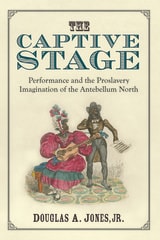
cover of The Captive Stage: Performance and the Proslavery Imagination of the Antebellum North

The Captive Stage

Performance and the Proslavery Imagination of the Antebellum North

Douglas A. Jones, Jr.

University of Michigan Press, 2014
In The Captive Stage, Douglas A. Jones, Jr. argues that proslavery ideology remained the dominant mode of racial thought in the antebellum north, even though chattel slavery had virtually disappeared from the region by the turn of the nineteenth century—and that northerners cultivated their proslavery imagination most forcefully in their performance practices. Jones explores how multiple constituencies, ranging from early national artisans and Jacksonian wage laborers to patrician elites and bourgeois social reformers, used the stage to appropriate and refashion defenses of black bondage as means to affirm their varying and often conflicting economic, political, and social objectives. Joining performance studies with literary criticism and cultural theory, he uncovers the proslavery conceptions animating a wide array of performance texts and practices, such as the “Bobalition” series of broadsides, blackface minstrelsy, stagings of the American Revolution, reform melodrama, and abolitionist discourse. Taken together, he suggests, these works did not amount to a call for the re-enslavement of African Americans but, rather, justifications for everyday and state-sanctioned racial inequities in their post-slavery society. Throughout, The Captive Stage elucidates how the proslavery imagination of the free north emerged in direct opposition to the inclusionary claims black publics enacted in their own performance cultures. In doing so, the book offers fresh contexts and readings of several forms of black cultural production, including early black nationalist parades, slave dance, the historiography of the revolutionary era, the oratory of radical abolitionists and the black convention movement, and the autobiographical and dramatic work of ex-slave William Wells Brown.
[more]
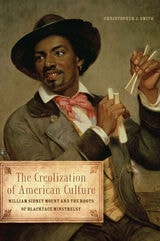
cover of The Creolization of American Culture: William Sidney Mount and the Roots of Blackface Minstrelsy

The Creolization of American Culture

William Sidney Mount and the Roots of Blackface Minstrelsy

Christopher J. Smith

University of Illinois Press, 2014
The Creolization of American Culture examines the artworks, letters, sketchbooks, music collection, and biography of the painter William Sidney Mount (1807–1868) as a lens through which to see the multiethnic antebellum world that gave birth to blackface minstrelsy. As a young man living in the multiethnic working-class community of New York's Lower East Side, Mount took part in the black-white musical interchange his paintings depict. An avid musician and tune collector as well as an artist, he was the among the first to depict vernacular fiddlers, banjo players, and dancers precisely and sympathetically. His close observations and meticulous renderings provide rich evidence of performance techniques and class-inflected paths of musical apprenticeship that connected white and black practitioners.
 
Looking closely at the bodies and instruments Mount depicts in his paintings as well as other ephemera, Christopher J. Smith traces the performance practices of African American and Anglo-European music-and-dance traditions while recovering the sounds of that world. Further, Smith uses Mount's depictions of black and white music-making to open up fresh perspectives on cross-ethnic cultural transference in Northern and urban contexts, showing how rivers, waterfronts, and other sites of interracial interaction shaped musical practices by transporting musical culture from the South to the North and back. The "Africanization" of Anglo-Celtic tunes created minstrelsy's musical "creole synthesis," a body of melodic and rhythmic vocabularies, repertoires, tunes, and musical techniques that became the foundation of American popular music.
 
Reading Mount's renderings of black and white musicians against a background of historical sites and practices of cross-racial interaction, Smith offers a sophisticated interrogation and reinterpretation of minstrelsy, significantly broadening historical views of black-white musical exchange.
[more]
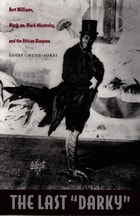
cover of The Last "Darky": Bert Williams, Black-on-Black Minstrelsy, and the African Diaspora

The Last "Darky"

Bert Williams, Black-on-Black Minstrelsy, and the African Diaspora

Louis Chude-Sokei

Duke University Press, 2006

The Last “Darky” establishes Bert Williams, the comedian of the late nineteenth century and early twentieth, as central to the development of a global black modernism centered in Harlem’s Renaissance. Before integrating Broadway in 1910 via a controversial stint with the Ziegfeld Follies, Williams was already an international icon. Yet his name has faded into near obscurity, his extraordinary accomplishments forgotten largely because he performed in blackface. Louis Chude-Sokei contends that Williams’s blackface was not a display of internalized racism nor a submission to the expectations of the moment. It was an appropriation and exploration of the contradictory and potentially liberating power of racial stereotypes.

Chude-Sokei makes the crucial argument that Williams’s minstrelsy negotiated the place of black immigrants in the cultural hotbed of New York City and was replicated throughout the African diaspora, from the Caribbean to Africa itself. Williams was born in the Bahamas. When performing the “darky,” he was actually masquerading as an African American. This black-on-black minstrelsy thus challenged emergent racial constructions equating “black” with African American and marginalizing the many diasporic blacks in New York. It also dramatized the practice of passing for African American common among non-American blacks in an African American–dominated Harlem. Exploring the thought of figures such as Booker T. Washington, W. E. B. Du Bois, Marcus Garvey, and Claude McKay, Chude-Sokei situates black-on-black minstrelsy at the center of burgeoning modernist discourses of assimilation, separatism, race militancy, carnival, and internationalism. While these discourses were engaged with the question of representing the “Negro” in the context of white racism, through black-on-black minstrelsy they were also deployed against the growing international influence of African American culture and politics in the twentieth century.

[more]
cover of Transoceanic Blackface: Empire, Race, Performance

Transoceanic Blackface

Empire, Race, Performance

Kellen Hoxworth

Northwestern University Press, 2024

A sweeping history of racialized performance across the Anglophone imperial world from the eighteenth to the early twentieth century

A material history of racialized performance throughout the Anglophone imperial world, Transoceanic Blackface: Empire, Race, Performance revises prevailing understandings of blackface and minstrelsy as distinctively US American cultural practices. Tracing intertwined histories of racialized performance from the mid-eighteenth through the early twentieth century across the United States and the British Empire, this study maps the circulations of blackface repertoires in theatrical spectacles, popular songs, visual materials, comic operas, closet dramas, dance forms, and Shakespearean burlesques.

Kellen Hoxworth focuses on overlooked performance histories, such as the early blackface minstrelsy of T. D. Rice’s “Jump Jim Crow” and the widely staged blackface burlesque versions of Othello, as traces of the racial and sexual anxieties of empire. From the nascent theatrical cultures of Australia, Britain, Canada, India, Jamaica, South Africa, and the United States, Transoceanic Blackface offers critical insight into the ways racialized performance animated the imperial “common sense” of white supremacy on a global scale. 
 
[more]