Results by title
3 books match the query 'Blair, Emily Newell'
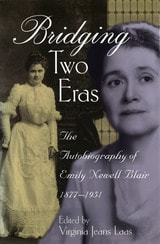
Bridging Two Eras
The Autobiography of Emily Newell Blair, 1877-1951Emily Newell Blair, Edited & Intro by Virginia Jeans Laas
University of Missouri Press, 1999
First written in 1937 and never before published, Bridging Two Eras is the fascinating autobiography of Emily Newell Blair, a remarkable woman who successfully reconciled a productive public life with the traditional values of a housewife and mother.
Because Blair's life essentially spanned two eras, from the end of the nineteenth century through the middle of the twentieth, she thought of herself as a bridge builder. A dedicated feminist, she wanted her autobiography to help women understand what life was like during that transition time. She had moved from being a conventional, middle-class, midwestern wife and mother to becoming an acclaimed author, a nationally known feminist, and vice chairman of the Democratic National Committee only two years after women gained the right to vote. She felt that her story could encourage women to take their rightful places in public life.
Bridging Two Eras is divided into two parts. Book I is a charming evocation of life in southwest Missouri in the closing decades of the nineteenth century. It offers great insight into family relationships, class structure, and social attitudes typical of much of small-town America. Book II addresses Blair's public career and follows her progress as professional writer, suffrage activist, and partisan politician. Included are acute judgments of leading political figures, fascinating vignettes of the suffrage movement, an insider's view of the workings of the national Democratic Party in the 1920s and 1930s, and a valuable outlook on Missouri politics during the first third of the twentieth century.
Perceptive and introspective, Blair captivates her readers as she traces her own evolution. With candor, she explains her conflicts between family and career, acknowledging the difficulties and tensions she faced in pursuing a public life. Delightfully written, Bridging Two Eras provides valuable insight into all the possibilities, as well as the limitations, life then held for an American woman.
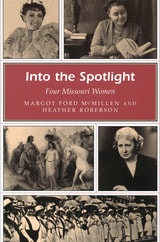
Into the Spotlight
Four Missouri WomenMargot Ford McMillen & Heather Roberson
University of Missouri Press, 2004
Sacred Sun, also called Mohongo, was a Native American of the Osage tribe in Missouri. In 1827, her people lost their land, their sacred places, and many of their traditions. Seeking answers to the dilemma faced by her people, and possibly aid from the French, she journeyed to Europe with a group of prominent Osage and a French entrepreneur. The harrowing events she experienced there would shape the woman she became when she returned to the Osage tribe, which had been forced to move to Oklahoma and was still struggling to survive.
Emily Newell Blair was born into a successful southwest Missouri family. Although she was born at a time when the contributions of women in the workforce were quite limited, she was encouraged by her family to get an education and expand her skills in writing and speaking. When women did begin to pursue education and careers, Blair was at the forefront, working tirelessly to secure voting rights for women. Eventually, she was elected to the Democratic National Committee and later poured her energy into organizing Democratic women’s clubs.
Josephine Baker grew up in segregated turn-of-the-century St. Louis society, which determined human worth by the color of one’s skin. Her mixed ethnic background left Baker feeling isolated both from her own black family and from white society. Driven to develop her own unique style, she became a star of song and stage, toured Europe, served as a spy, and was a fervent civil rights and antiracism activist.
Elizabeth Virginia Wallace, known to her family as “Bess,” grew up in one of Missouri’s most prominent families. She married a neighborhood boy—considered unacceptable by her mother—who would go on to become President Harry Truman. Bess Truman, called “the boss” by her husband, worked side by side with him, editing his speeches and providing advice and guidance through innumerable crises during and after World War II.
Into the Spotlight provides valuable new insights into Missouri and American history, as well as women’s history, and will be a welcome addition to the Missouri Heritage Readers Series.
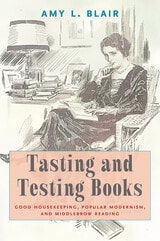
Tasting and Testing Books
Good Housekeeping, Popular Modernism, and Middlebrow ReadingAmy L. Blair
University of Massachusetts Press, 2024
A CHOICE 2025 Outstanding Academic Title
Honorable Mention, 2023-2024 Research Society of American Periodicals Book Prize
In its February 1926 issue, Good Housekeeping magazine introduced a column for its approximately one million subscribers called “Tasting and Testing Books.” The column’s author, Emily Newell Blair, would go on to produce ninety-one reading advice columns for the magazine between 1926 and 1934. During this period, Good Housekeeping became the most widely circulated periodical in the United States, doubling its circulation to over two million copies. Much of its popularity stemmed from its intensive promotion of its Seal of Approval for a variety of products, which brought consumers to it for utilitarian purposes. With her focus on regular books, Blair distinguished herself from highbrow literary critics, many of whom have been objects of study as High Modernists. She offered advice to help middle-class women readers make their own choices about the best books in which to invest time and money, rather than dictating what they should or should not read. She aligns herself with the average subscriber, outside the book publishing and reviewer industries, focusing on books that would now be termed middlebrow reading.
Blair’s time at Good Housekeeping covers the era from the heights of the “Roaring Twenties” to the depths of the Great Depression, and her recommendations offer a window into the uses of middlebrow reading during this period of dramatic economic and social shifts. Tasting and Testing Books argues that the consumer-first message of Good Housekeeping infused Blair’s advice column and validated a new attitude of proudly middlebrow pleasure reading in the mid-twentieth century. These columns shed new light on the reading lives of too-often overlooked women, often living outside of urban centers and away from elite literary circles, and present Emily Newell Blair, who strongly identified with her readers as a truly democratic tastemaker.