Results by title
12 books match the query 'Blake, William'
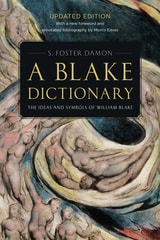
A Blake Dictionary
The Ideas and Symbols of William BlakeS. Foster Damon
Dartmouth College Press, 2013
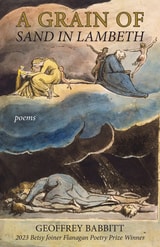
A Grain of Sand in Lambeth
PoemsGeoffrey Babbitt
University of Nevada Press, 2025
Each poem in this collection inhabits a moment of Blake’s life, offering a vivid glimpse into his unique perspective—a perspective that rejected the normative for the transformative power of imagination. From his visionary watercolors to his provocative views on oil painting, these poems draw readers into Blake’s world, where reality and the unseen converge in prismatic intensity.
A Grain of Sand in Lambeth is an invitation to experience the world through Blake’s eyes—a world where imagination reigns supreme and art is a living force.
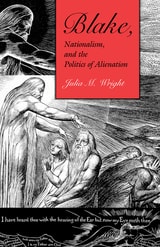
Blake, Nationalism, and the Politics of Alienation
Julia M. Wright
Ohio University Press, 2027
William Blake’s reputation as a staunch individualist is based in large measure on his repeated attacks on institutions and belief systems that constrain the individual’s imagination. Blake, however, rarely represents isolation positively, suggesting that the individual’s absolute freedom from communal pressures is not the ideal. Instead, as Julia Wright argues in her award-winning study Blake, Nationalism, and the Politics of Alienation, Blake’s concern lies with the kind of community that is being established. Moreover, writing at the moment of the emergence of modern nationalism, Blake reveals a concern with the national community in particular.
Beginning with a discussion of the priority of national narrative in late-eighteenth-century art theory and antiquarianism, Blake, Nationalism, and the Politics of Alienation traces its relevance in Blake’s printed works, from The Poetical Sketches and the Lambeth Prophecies to The Laocoön. Professor Wright then turns to Europe, America, and Visions of the Daughters of Albion, focusing on Blake’s portrayals of particular characters’ alienation from the groups and ideologies represented in the texts. The book closes by arguing that Blake’s major printed works, Milton and Jerusalem, are explicit and extensive engagements with the question of nation—and empire.
Although nationalism existed in various forms during the Romantic period, Blake’s contemporaries generally assumed that nations should progress continuously, producing a clear narrative line from an auspicious origin to the perfect fulfillment of that promise. Wright argues that these mutually determining constructs of national character and national narrative inform Blake’s handling of the problem of the individual-within-a-community.

Critical Paths
Blake and the Argument of MethodDan Miller, Mark Bracher and Donald Ault, eds.
Duke University Press, 1987
The contributors assembled here, leading exponents of contemporary critical methods as well as close students of Blake, argue the grounds, purposes, and validity of each approach and then apply its method in detailed readings of Blake's works. We see deconstruction, psychoanalytic interpretation, feminist critique, semiotic analysis, Marxist criticism, revisionism, and other methods brought to bear on Blake's texts and into confrontation with one another by those best able to do so.
Through the essays themselves and in the reaction they will certainly provoke, Critical Paths will bring increased theoretical awareness to the study of Blake and will further the ongoing redefinition of Blake's art. At the same time, the collection investigates the general problem of methodology in literary studies by means of a casebook examination of modern critical approaches. Blake criticism and current literary theory here come together; the encounter illuminates and enriches both.
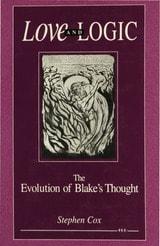
Love and Logic
The Evolution of Blake's ThoughtStephen Cox
University of Michigan Press, 1992
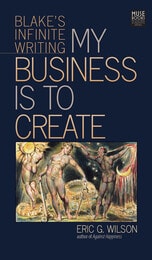
My Business Is to Create
Blake's Infinite WritingEric G. Wilson
University of Iowa Press, 2011
p.MsoNormal, li.MsoNormal, div.MsoNormal { margin: 0in 0in 0.0001pt; font-size: 12pt; font-family: "Times New Roman"; }div.Section1 { page: Section1; }
For William Blake, living is creating, conforming is death, and “the imagination . . . is the Human Existence itself.” But why are imagination and creation—so vital for Blake—essential for becoming human? And what is imagination? What is creation? How do we create? Blake had answers for these questions, both in word and in deed, answers that serve as potent teachings for aspiring writers and accomplished ones alike. Eric G. Wilson’s My Business Is to Create emulates Blake, presenting the great figure’s theory of creativity as well as the practices it implies.
In both his life and his art, Blake provided a powerful example of creativity at any cost—in the face of misunderstanding, neglect, loneliness, poverty, even accusations of insanity. Just as Los cries out in Jerusalem: The Emanation of the Giant Albion, “I must Create a System, or be enslav'd by another Man's; / I will not Reason and Compare: my business is to Create,” generations of writers and artists as diverse as John Ruskin, William Butler Yeats, Allen Ginsberg, Philip K. Dick, songwriter Patti Smith, the avant-garde filmmaker Jim Jarmusch, and the underground comic-book artist R. Crumb have taken Blake’s creed as inspiration.
Unwilling to cede his vision, Blake did more than simply produce iconoclastic poems and paintings; he also cleared a path toward spiritual and ethical enlightenment. To fashion powerful art is to realize the God within and thus to feel connected with enduring vitality and abundant generosity. This is Blake’s everlasting gospel, distilled here in an artist’s handbook of interest to scholars, writing teachers, and those who have made writing their way of life. My Business Is to Create is indispensable for all serious artists who want to transform their lives into art and make their art more alive.
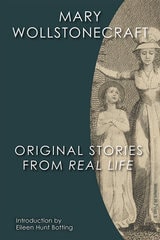
Original Stories from Real Life
With Conversations Calculated to Regulate the Affections, and Form the Mind to Truth and GoodnessMary Wollstonecraft. Edited by Valerie Hotchkiss. Illustrated by William Blake. Introduction by Eileen Hunt Botting.
University of Illinois Press, 2016
This beautiful facsimile of the 1791 edition includes the original illustrations by William Blake. A commentary by Eileen Hunt Botting puts the text in context and hints at influences on Wollstonecraft's daughter Mary Shelley and the pedagogical philosophy behind Shelley's novel Frankenstein.
Like all volumes in the Women in Print series, Original Stories from Real Life is provided as an open access book and downloads to a wide variety of platforms and online e-readers.
Sweet Science
Romantic Materialism and the New Logics of LifeAmanda Jo Goldstein
University of Chicago Press, 2017
Goldstein puts apparently literary projects, such as William Blake’s poetry of embryogenesis, Goethe’s journals On Morphology, and Percy Shelley’s “poetry of life,” back into conversation with the openly poetic life sciences of Erasmus Darwin, J. G. Herder, Jean-Baptiste Lamarck, and Étienne Geoffroy Saint-Hilaire. Such poetic sciences, Goldstein argues, share in reviving Lucretius’s De rerum natura to advance a view of biological life as neither self-organized nor autonomous, but rather dependent on the collaborative and symbolic processes that give it viable and recognizable form. They summon De rerum natura for a logic of life resistant to the vitalist stress on self-authorizing power and to make a monumental case for poetry’s role in the perception and communication of empirical realities. The first dedicated study of this mortal and materialist dimension of Romantic biopoetics, Sweet Science opens a through-line between Enlightenment materialisms of nature and Marx’s coming historical materialism.
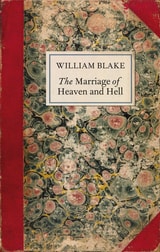
The Marriage of Heaven and Hell
William Blake
Bodleian Library Publishing, 2011
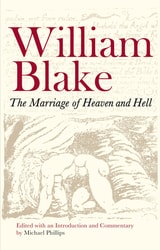
This new facsimile edition of The Marriage of Heaven and Hell includes a plate-by-plate guide to the texts, interlinear figures, and larger designs in a commentary accompanying the transcript of each reproduced plate. Drawings from Blake’s manuscript notebook, which were used as a basis for the designs, as well as working proof impressions, are also included, demonstrating the evolution of the work. This edition also reproduces a single plate from each of the other eight surviving copies, revealing how over a period of more than thirty years Blake altered the way he finished each copy. An introduction explores the book's literary and historical background, Blake’s printing process, and the book's anonymous initial publication.
This expertly edited work is available for students and scholars in paperback and for collectors in a special hardcover edition. Both versions allow Blake’s vision to reassert its breathtaking power.
The Marriage of Heaven and Hell
William Blake
Bodleian Library Publishing, 2011
This new facsimile edition of The Marriage of Heaven and Hell includes a plate-by-plate guide to the texts, interlinear figures, and larger designs in a commentary accompanying the transcript of each reproduced plate. Drawings from Blake’s manuscript notebook, which were used as a basis for the designs, as well as working proof impressions, are also included, demonstrating the evolution of the work. This edition also reproduces a single plate from each of the other eight surviving copies, revealing how over a period of more than thirty years Blake altered the way he finished each copy. An introduction explores the book's literary and historical background, Blake’s printing process, and the book's anonymous initial publication.
This expertly edited work is available for students and scholars in paperback and for collectors in a special hardcover edition. Both versions allow Blake’s vision to reassert its breathtaking power.
The Religion of Empire
Political Theology in Blake's Prophetic SymbolismG. A. Rosso
The Ohio State University Press, 2016
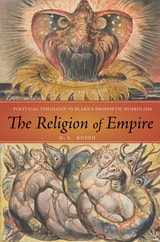
The Religion of Empire also reevaluates Blake’s relationship with Milton, whose influence Blake both affirms and contests in a unique appropriation of Milton’s prophetic legacy. In this context, Rosso challenges recent views of Blake as complicit with the nationalism and sexism of his time, expanding the religion-empire nexus to include Blake’s esoteric understanding of gender. Foregrounding the role of female characters in the longer prophecies, Rosso discloses the variegated and progressive nature of Blake’s apocalyptic humanism.
William Blake and the Impossible History of the 1790s
Saree Makdisi
University of Chicago Press, 2003