Results by title
4 books match the query 'Bloor, David'

Knowledge and Social Imagery
David Bloor
University of Chicago Press, 1991
The first edition of this book profoundly challenged and divided students of philosophy, sociology, and the history of science when it was published in 1976. In this second edition, Bloor responds in a substantial new Afterword to the heated debates engendered by his book.
[more]

Scientific Knowledge
A Sociological AnalysisBarry Barnes, David Bloor, and John Henry
University of Chicago Press, 1996
Although science was once seen as the product of individual great men working in isolation, we now realize that, like any other creative activity, science is a highly social enterprise, influenced in subtle as well as obvious ways by the wider culture and values of its time. Scientific Knowledge is the first introduction to social studies of scientific knowledge.
The authors, all noted for their contributions to science studies, have organized this book so that each chapter examines a key step in the process of doing science. Using case studies from cognitive science, physics, and biology to illustrate their descriptions and applications of the social study of science, they show how this approach provides a crucial perspective on how science is actually done.
Scientific Knowledge will be of interest not only to those engaged in science studies, but also to anyone interested in the practice of science.
[more]
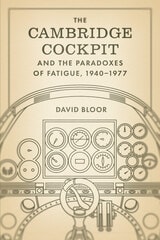
The Cambridge Cockpit and the Paradoxes of Fatigue, 1940–1977
David Bloor
University of Chicago Press, 2025
The story of a unique and controversial wartime study of pilot fatigue.
During World War II, members of the Cambridge Psychology Laboratory were commissioned to study pilot fatigue. They set up a Spitfire cockpit in the laboratory, turned it into a piece of laboratory apparatus, and carried out a series of important experiments that appeared to dramatically confirm the dangers of fatigue. Historians of psychology are aware of this episode, but the experiments, the events surrounding them, and the scientific reasoning involved have never been studied in detail. By going into the episode in depth, and by looking behind the scenes at archival material, David Bloor offers an analysis that is both original and more penetrating than anything that has been said before on the topic.
Bloor describes the Cockpit experiments themselves before turning to the theoretical interpretation of the results and the intellectual resources that informed how they were viewed. Bloor then explains a major empirical and theoretical challenge to the Cambridge Cockpit work drawn from a field study of landing accidents apparently showing that fatigue-effects were operationally negligible. Bloor delves into the consequences of this challenge, and the Cambridge reaction to it, in the post-war years. The analysis is deepened by comparison with the corresponding wartime work on fatigue carried out both in Germany and the United States. As the author demonstrates, even today the Cambridge Cockpit experiments pose a challenge to the current understanding of pilot fatigue.
[more]

The Enigma of the Aerofoil
Rival Theories in Aerodynamics, 1909-1930David Bloor
University of Chicago Press, 2011
Why do aircraft fly? How do their wings support them? In the early years of aviation, there was an intense dispute between British and German experts over the question of why and how an aircraft wing provides lift. The British, under the leadership of the great Cambridge mathematical physicist Lord Rayleigh, produced highly elaborate investigations of the nature of discontinuous flow, while the Germans, following Ludwig Prandtl in Göttingen, relied on the tradition called “technical mechanics” to explain the flow of air around a wing. Much of the basis of modern aerodynamics emerged from this remarkable episode, yet it has never been subject to a detailed historical and sociological analysis.
In The Enigma of the Aerofoil, David Bloor probes a neglected aspect of this important period in the history of aviation. Bloor draws upon papers by the participants—their restricted technical reports, meeting minutes, and personal correspondence, much of which has never before been published—and reveals the impact that the divergent mathematical traditions of Cambridge and Göttingen had on this great debate. Bloor also addresses why the British, even after discovering the failings of their own theory, remained resistant to the German circulation theory for more than a decade. The result is essential reading for anyone studying the history, philosophy, or sociology of science or technology—and for all those intrigued by flight.
[more]