Results by title

2 books match the query 'Blues Culture'
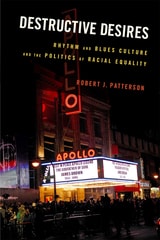
cover of Destructive Desires: Rhythm and Blues Culture and the Politics of Racial Equality

Destructive Desires

Rhythm and Blues Culture and the Politics of Racial Equality

Robert J. Patterson

Rutgers University Press, 2019
Despite rhythm and blues culture’s undeniable role in molding, reflecting, and reshaping black cultural production, consciousness, and politics, it has yet to receive the serious scholarly examination it deserves. Destructive Desires corrects this omission by analyzing how post-Civil Rights era rhythm and blues culture articulates competing and conflicting political, social, familial, and economic desires within and for African American communities. As an important form of black cultural production, rhythm and blues music helps us to understand black political and cultural desires and longings in light of neo-liberalism’s increased codification in America’s racial politics and policies since the 1970s. Robert J. Patterson provides a thorough analysis of four artists—Kenneth “Babyface” Edmonds, Adina Howard, Whitney Houston, and Toni Braxton—to examine black cultural longings by demonstrating how our reading of specific moments in their lives, careers, and performances serve as metacommentaries for broader issues in black culture and politics.
[more]
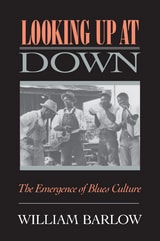
cover of Looking Up at Down: The Emergence of Blues Culture

Looking Up at Down

The Emergence of Blues Culture

William Barlow

Temple University Press, 1990

More than just a history of a musical genre, Looking Up at Down traces the evolution of the various strands of blues music within the broader context of the culture on which it commented, and discusses its importance as a form of cultural resistance and identity for Afro-Americans. William Barlow explores the lyrics, describes the musical styles, and portrays the musicians and performers who created this uniquely American music. He describes how the blues sound—with its recognizable dissonance and African musical standards—and the blues text, which provided a bottom up view of American society, became bulwarks of cultural resistance.

Using rare recordings, oral histories, and interviews, Barlow analyzes how the blues was sustained as a form of Afro-American cultural resistance despite attempts by the dominant culture to assimilate and commercialize the music and exploit its artists.

[more]