Results by title
7 books match the query 'Board of Governors of the Federal Reserve System (U.S.)'
A History of the Federal Reserve, Volume 1
1913-1951Allan H. Meltzer
University of Chicago Press, 2002
To understand why the Federal Reserve acted as it did at key points in its history, Meltzer draws on meeting minutes, correspondence, and other internal documents (many made public only during the 1970s) to trace the reasoning behind its policy decisions. He explains, for instance, why the Federal Reserve remained passive throughout most of the economic decline that led to the Great Depression, and how the Board's actions helped to produce the deep recession of 1937 and 1938. He also highlights the impact on the institution of individuals such as Benjamin Strong, governor of the Federal Reserve Bank of New York in the 1920s, who played a key role in the adoption of a more active monetary policy by the Federal Reserve. Meltzer also examines the influence the Federal Reserve has had on international affairs, from attempts to build a new international financial system in the 1920s to the Bretton Woods Agreement of 1944 that established the International Monetary Fund and the World Bank, and the failure of the London Economic Conference of 1933.
Written by one of the world's leading economists, this magisterial biography of the Federal Reserve and the people who helped shape it will interest economists, central bankers, historians, political scientists, policymakers, and anyone seeking a deep understanding of the institution that controls America's purse strings.
"It was 'an unprecedented orgy of extravagance, a mania for speculation, overextended business in nearly all lines and in every section of the country.' An Alan Greenspan rumination about the irrational exuberance of the late 1990s? Try the 1920 annual report of the board of governors of the Federal Reserve. . . . To understand why the Fed acted as it did—at these critical moments and many others—would require years of study, poring over letters, the minutes of meetings and internal Fed documents. Such a task would naturally deter most scholars of economic history but not, thank goodness, Allan Meltzer."—Wall Street Journal
"A seminal work that anyone interested in the inner workings of the U. S. central bank should read. A work that scholars will mine for years to come."—John M. Berry, Washington Post
"An exceptionally clear story about why, as the ideas that actually informed policy evolved, things sometimes went well and sometimes went badly. . . . One can only hope that we do not have to wait too long for the second installment."—David Laidler, Journal of Economic Literature
"A thorough narrative history of a high order. Meltzer's analysis is persuasive and acute. His work will stand for a generation as the benchmark history of the world's most powerful economic institution. It is an impressive, even awe-inspiring achievement."—Sir Howard Davies, Times Higher Education Supplement
A History of the Federal Reserve, Volume 2, Book 1, 1951-1969
Allan H. Meltzer
University of Chicago Press, 2009
Allan H. Meltzer’s critically acclaimed history of the Federal Reserve is the most ambitious, most intensive, and most revealing investigation of the subject ever conducted. Its first volume, published to widespread critical acclaim in 2003, spanned the period from the institution’s founding in 1913 to the restoration of its independence in 1951. This two-part second volume of the history chronicles the evolution and development of this institution from the Treasury–Federal Reserve accord in 1951 to the mid-1980s, when the great inflation ended. It reveals the inner workings of the Fed during a period of rapid and extensive change. An epilogue discusses the role of the Fed in resolving our current economic crisis and the needed reforms of the financial system.
In rich detail, drawing on the Federal Reserve’s own documents, Meltzer traces the relation between its decisions and economic and monetary theory, its experience as an institution independent of politics, and its role in tempering inflation. He explains, for example, how the Federal Reserve’s independence was often compromised by the active policy-making roles of Congress, the Treasury Department, different presidents, and even White House staff, who often pressured the bank to take a short-term view of its responsibilities. With an eye on the present, Meltzer also offers solutions for improving the Federal Reserve, arguing that as a regulator of financial firms and lender of last resort, it should focus more attention on incentives for reform, medium-term consequences, and rule-like behavior for mitigating financial crises. Less attention should be paid, he contends, to command and control of the markets and the noise of quarterly data.
At a time when the United States finds itself in an unprecedented financial crisis, Meltzer’s fascinating history will be the source of record for scholars and policy makers navigating an uncertain economic future.
A History of the Federal Reserve, Volume 2, Book 2, 1970-1986
Allan H. Meltzer
University of Chicago Press, 2009
Allan H. Meltzer’s critically acclaimed history of the Federal Reserve is the most ambitious, most intensive, and most revealing investigation of the subject ever conducted. Its first volume, published to widespread critical acclaim in 2003, spanned the period from the institution’s founding in 1913 to the restoration of its independence in 1951. This two-part second volume of the history chronicles the evolution and development of this institution from the Treasury–Federal Reserve accord in 1951 to the mid-1980s, when the great inflation ended. It reveals the inner workings of the Fed during a period of rapid and extensive change. An epilogue discusses the role of the Fed in resolving our current economic crisis and the needed reforms of the financial system.
In rich detail, drawing on the Federal Reserve’s own documents, Meltzer traces the relation between its decisions and economic and monetary theory, its experience as an institution independent of politics, and its role in tempering inflation. He explains, for example, how the Federal Reserve’s independence was often compromised by the active policy-making roles of Congress, the Treasury Department, different presidents, and even White House staff, who often pressured the bank to take a short-term view of its responsibilities. With an eye on the present, Meltzer also offers solutions for improving the Federal Reserve, arguing that as a regulator of financial firms and lender of last resort, it should focus more attention on incentives for reform, medium-term consequences, and rule-like behavior for mitigating financial crises. Less attention should be paid, he contends, to command and control of the markets and the noise of quarterly data.
At a time when the United States finds itself in an unprecedented financial crisis, Meltzer’s fascinating history will be the source of record for scholars and policy makers navigating an uncertain economic future.
Congress, the President, and the Federal Reserve
The Politics of American Monetary Policy-MakingIrwin L. Morris
University of Michigan Press, 2002
Current formal theories of the general policy-making process are utilized to construct an explanatory framework that identifies the mechanisms through which congressional and executive influence is exercised. The theoretical framework presented in the text also helps to explain the political dynamics of several of the most significant policy decisions of the Federal Reserve during the last half-century. In addition, this book provides a unique perspective on the manner in which Fed policymakers attempt to shield themselves from unwelcome political influence.
While the main focus of Congress, the President, and the Federal Reserve is monetary policy-making, it also speaks to the political nature of policy-making in a more general sense and provides a guide for the future study of the political dynamics in a wide variety of substantive policy areas. Thus it will interest not only political scientists and economists interested in monetary policy-making specifically but also those interested in the nature of public policy-making more generally.
Irwin L. Morris is Assistant Professor of Political Science, University of Maryland.
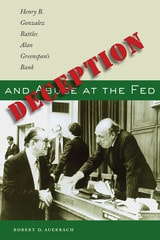
Deception and Abuse at the Fed
Henry B. Gonzalez Battles Alan Greenspan's BankBy Robert D. Auerbach
University of Texas Press, 2008
The Federal Reserve—the central bank of the United States—is the most powerful peacetime bureaucracy in the federal government. Under the chairmanship of Alan Greenspan (1987-2006), the Fed achieved near mythical status for its part in managing the economy, and Greenspan was lauded as a genius. Few seemed to notice or care that Fed officials operated secretly with almost no public accountability. There was a courageous exception to this lack of oversight, however: Henry B. Gonzalez (D-TX)—chairman of the U.S. House of Representatives Financial Services (banking) Committee.
In Deception and Abuse at the Fed, Robert Auerbach, a former banking committee investigator, recounts major instances of Fed mismanagement and abuse of power that were exposed by Rep. Gonzalez, including:
- Blocking Congress and the public from holding powerful Fed officials accountable by falsely declaring—for 17 years—it had no transcripts of its meetings;
- Manipulating the stock and bond markets in 1994 under cover of a preemptive strike against inflation;
- Allowing $5.5 billion to be sent to Saddam Hussein from a small Atlanta branch of a foreign bank—the result of faulty bank examination practices by the Fed;
- Stonewalling Congressional investigations and misleading the Washington Post about the $6,300 found on the Watergate burglars.
Auerbach provides documentation of these and other abuses at the Fed, which confirms Rep. Gonzalez's belief that no government agency should be allowed to operate with the secrecy and independence in which the Federal Reserve has shrouded itself. Auerbach concludes with recommendations for specific, broad-ranging reforms that will make the Fed accountable to the government and the people of the United States.
The Federal Reserve
A New HistoryRobert L. Hetzel
University of Chicago Press, 2022
In The Federal Reserve: A New History, Robert L. Hetzel draws on more than forty years of experience as an economist in the central bank to trace the influences of the Fed on the American economy. Comparing periods in which the Fed stabilized the economy to those when it did the opposite, Hetzel tells the story of a century-long pursuit of monetary rules capable of providing for economic stability.
Recast through this lens and enriched with archival materials, Hetzel’s sweeping history offers a new understanding of the bank’s watershed moments since 1913. This includes critical accounts of the Great Depression, the Great Inflation, and the Great Recession—including how these disastrous events could have been avoided.
A critical volume for a critical moment in financial history, The Federal Reserve is an expert, sweeping account that promises to recast our understanding of the central bank in its second century.
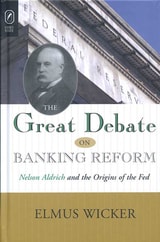
The GREAT DEBATE ON BANKING REFORM
Nelson Aldrich and the Origins of the FedElmus Wicker
The Ohio State University Press, 2005