Results by title
3 books match the query 'Boat'

Boat of Letters
Eve Grubin
Four Way Books, 2025
In her much anticipated second full-length collection of poems, Eve Grubin conjures an "inky swamp, wild and warm, / where leaves hang down like muted lamps." Grubin navigates wild waters in a "boat of letters" she constructs, with poems narrating a daughter in mourning for her mother in adulthood's half-light; a wife in the middle of life's existential marathon; a mother raising two children in the terrifying present; an American living in London; a Jewish woman following religious tradition in what can feel like a faithless world. Grubin shapes language and silences into a bridge that holds us between longing and understanding, between effort and the holy ground of that unattainable destination. "The Poetics of Reticence" describes hovering above the waters where "there is no vessel; there are no oars," just the "sounds of a boat creaking," a material contradiction in the hushed void. "Silence is praise: words cannot touch glory," Grubin writes, but she also demonstrates what wonders our speech makes possible. In one poem, the narrator looks back at her wedding and considers how little she knew about marriage, and thinking in the context of her husband's area of expertise, palaeography, she reflects, "I didn't know that when two graphemes join / in a single glyph there is potential for stylistic re-imaginings, / for inventive, elegant variations." All is preordained, she seems to say, while paradoxically, we re-imagine and invent. And even as we create our future, we embrace the beauty of all that we cannot know: "Yesterday, we talked about the shade / of a certain blue mentioned in the Torah. / Was it the blue of our son's lips after a bath? // Or the blue of redemption? // Or the dark blue of the sky / the night we walked across the sands, the seas all around us."

Boat
PoemsChristopher Merrill
Tupelo Press, 2013
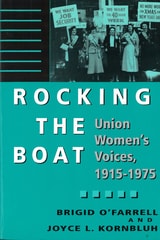
Rocking the Boat
Union Women's Voices, 1915-1975O'Farrell, Brigid
Rutgers University Press, 1996
Rocking the Boat is a celebration of strong, committed women who helped to build the American labor movement. Through the stories of eleven women from a wide range of backgrounds, we experience the turmoil, hardships, and accomplishments of thousands of other union women activists through the period spanning the Great Depression, the New Deal, World War II, the McCarthy era, the civil rights movement, and the women's movement. These women tell powerful stories that highlight and detail women's many roles as workers, trade unionists, and family members. They all faced difficulties in their personal lives, overcame challenges in their unions, and individually and collectively helped improve women's everyday working lives.
Maida Springer-Kemp came from New York City's Harlem, Local 22 of the International Ladies' Garment Workers' Union, to represent the AFL-CIO in Africa. In Chicago, Alice Peurala fought for her job in the steel mill and her place in the steel workers' union. Jessie De La Cruz organized farm workers in California. Esther Peterson, organizer, educator, and lobbyist, became an advisor to four U.S. presidents. In chapters based on oral history interviews, these women and others provide new perspectives and practical advice for today's working women. They share an idealistic and practical commitment to the labor movement. As Dorothy Haener of the United Auto Workers and a founding member of the National Organization of Women said, "You have to take a look at how to rock the boat. You don't want to spill yourself out if you can avoid it, but sometimes you have to rock the boat." From these women we, too, learn how to rock the boat.