Results by title
7 books match the query 'Body art'
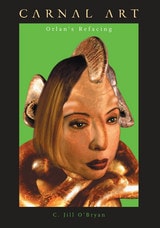
Carnal Art
Orlan’s RefacingC. Jill O'Bryan
University of Minnesota Press, 2005
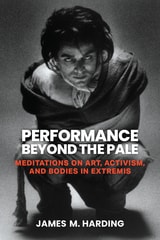
Performance Beyond the Pale
Meditations on Art, Activism, and Bodies in ExtremisJames M. Harding
University of Michigan Press, 2026
The metaphor “beyond the pale” refers to something that’s unacceptable and, as James M. Harding argues in this book, “almost always refers to something—an activity, an action, or an act—that is performed.” In this book, Harding recalls that historically the pale marked contested political boundaries and that what lay beyond the pale was considered to be a dangerous frontier. Siding with seemingly excessive and unreasonable acts and with the artists and activists who produce them, Harding brings together a series of ideas and performances that operate beyond the pale and asks readers to examine them on their own terms.
Drawing on political science, critical theory, and philosophy, Harding investigates instances of self-immolation, life-threatening journeys across deserts and seas, radical political hoaxes, extreme speech acts, and anti-police activism. The book’s five chapters consist of a series of meditations, each with an easily identifiable scholarly logic and clear argument, though the connections between the meditations are left up to the reader. Together these meditations urge readers to understand that “beyond the pale” acts are frequently the product of a sense of urgency that preempts the dictates of accepted reason, conventional logic, and safety.
Performances of Spiral Time
Leda Maria Martins. Translated by Bruna Barros and Jess Oliveira
Duke University Press, 2025
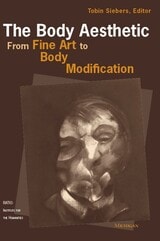
The Body Aesthetic
From Fine Art to Body ModificationTobin Siebers, Editor
University of Michigan Press, 2000
Generously and variously illustrated, this volume gathers together the work of literary critics and artists, classicists, art historians, and specialists on the history of the body, who survey the strangeness and variety with which the body has given human beings form. Richard Leppert traces how the representation of little girls responds directly to the cultural anxieties of modernity. René Girard plots how starvation becomes an art form, while Eric Gans surveys the contemporary phenomenon of body modification. Sander Gilman explores aesthetic surgery as a response to human unhappiness. Simon Goldhill discovers in the Roman empire the initial stirrings of institutions that focus on the spectacle of the body, and Cynthia S. Greig provides a glimpse of what the history of photography would look like if male nudes replaced female ones. Marion Jackson details how the different physical existence of the Inuit guides the way they make art. Joseph Grigely transforms aesthetics as usual by focusing on the disabled body, while Tobin Siebers describes the traumatic appeal in both fine art and the media of wounded flesh, whether human or animal.
The Body Aesthetic is a broad exercise in cultural studies and will address a variety of readers, from those interested in detailed, theoretical accounts of the body, to those interested in belles lettres, to those interested in fine art.
Tobin Siebers is Professor of English, University of Michigan.
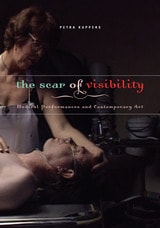
The Scar of Visibility
Medical Performances and Contemporary ArtPetra Kuppers
University of Minnesota Press, 2007
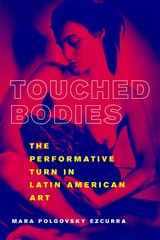
Touched Bodies
The Performative Turn in Latin American ArtMara Polgovsky Ezcurra
Rutgers University Press, 2019
Winner of the 2019 Art Journal Prize from the College Art Association
What is the role of pleasure and pain in the politics of art? In Touched Bodies, Mara Polgovsky Ezcurra approaches this question as she examines the flourishing of live and intermedial performance in Latin America during times of authoritarianism and its significance during transitions to democracy. Based on original documents and innovative readings, her book brings politics and ethics to the discussion of artistic developments during the “long 1980s”. She describes the rise of performance art in the context of feminism, HIV-activism, and human right movements, taking a close look at the work of Diamela Eltit and Raúl Zurita from Chile, León Ferrari and Liliana Maresca from Argentina, and Marcos Kurtycz, the No Grupo art collective, and Proceso Pentágono from Mexico. The comparative study of the work of these artists attests to a performative turn in Latin American art during the 1980s that, like photography and film before, recast the artistic field as a whole, changing the ways in which we perceive art and understand its role in society.
What The Body Cost
Desire, History, And PerformanceJane Blocker
University of Minnesota Press, 2004
Reexamines rebelliousness and desire in the history of performance art
Because performance is by its very nature ephemeral, it elicits a desire for what is lost more than any other form of art making. But what is the nature of that desire, and on what models has it been structured? How has it affected the ways in which the history of performance art gets told?
In What the Body Cost, Jane Blocker revisits key works in performance art by Carolee Schneemann, Vito Acconci, Hannah Wilke, Yves Klein, Ana Mendieta, and others to challenge earlier critiques that characterize performance, or body art, as a purely revolutionary art form and fail to recognize its reactionary—and sometimes damaging—effects. The scholarship to date on performance art has not, she finds, gone far enough in locating the body at the center of the performance, nor has it acknowledged the psychic, emotional, or social costs exacted on that body. Drawing on the work of critical theorists such as Roland Barthes and Catherine Belsey, as well as queer theory and feminism, What the Body Cost reads against patriarchal and heteronormative tendencies in art history while providing a corrective to the established view that performance art is necessarily transgressive. Instead, Blocker suggests that the historiography of performance art is a postmodern lovers’s discourse in which practitioners, historians, and critics alike fervently seek the body while doubting it can ever be found.